
By
Gigabit Systems
August 18, 2026
•
20 min read
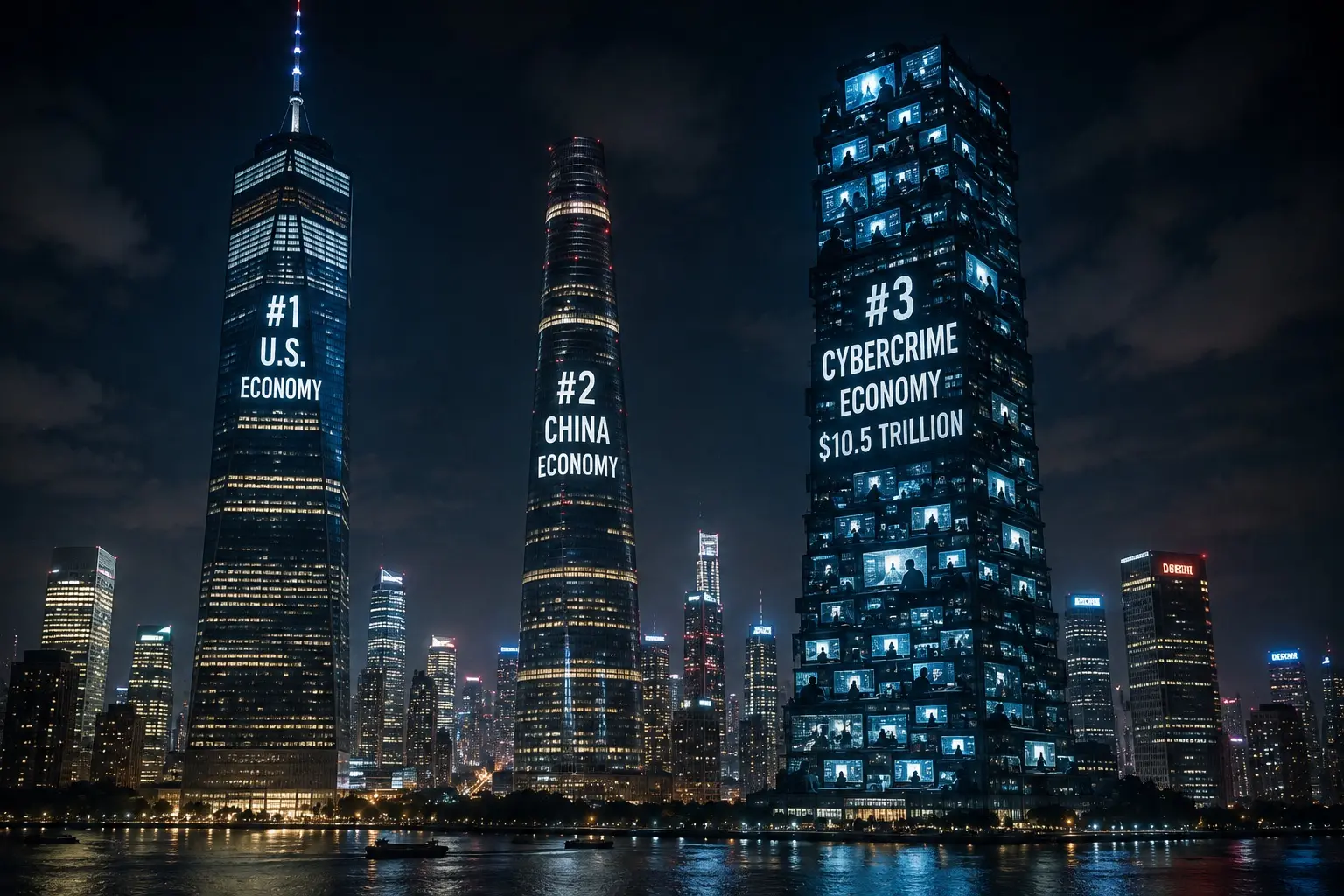
If Cybercrime Were a Country, It Would Be the World’s Third-Largest Economy
The criminals attacking you are part of a $10.5 trillion problem.
Let that number sink in.
$10.5 trillion.
That’s the widely cited estimate for the annual global cost of cybercrime.
If cybercrime were measured like a national economy, that figure would put it behind only the United States and China.
Larger than Germany.
Larger than Japan.
In fact, larger than the economies of Germany and Japan combined.
Obviously, cybercrime isn’t actually a country.
It doesn’t have borders.
It doesn’t have a president.
It doesn’t have a central bank.
And $10.5 trillion isn’t simply money deposited into criminals’ bank accounts—it represents estimated global economic damage caused by cybercrime.
But that’s almost what makes the comparison more frightening.
Because this enormous criminal economy has no borders either.
And somewhere inside it, someone is looking for you.
Cybercrime Became an Industry
We need to stop imagining scammers as lone criminals sitting in basements sending badly written emails.
Cybercrime has professionalized.
There are organizations specializing in:
Credential theft.
Phishing.
Ransomware.
Business email compromise.
Identity theft.
Cryptocurrency fraud.
Malware.
Account takeover.
Social engineering.
Some criminals steal passwords.
Others sell them.
Others obtain access to corporate networks.
Others monetize that access.
Others launder the money.
It increasingly resembles an ecosystem.
And the economics are incredibly attractive.
A criminal doesn’t need to successfully scam everyone.
They only need one person to make one mistake at the right moment.
Americans Reported Nearly $21 Billion Lost in One Year
The FBI’s 2025 Internet Crime Report received more than one million complaints.
Reported losses approached $21 billion.
Cyber-enabled fraud alone accounted for more than $17.7 billion in reported losses.
And those are reported losses.
Think about how many victims never report what happened.
How many businesses quietly absorb the loss.
How many people are embarrassed.
How many incidents aren’t discovered.
How many attempted attacks never become FBI statistics.
This isn’t some distant cybersecurity problem.
Nearly 3,000 complaints reach the FBI’s Internet Crime Complaint Center every day.
Then AI Arrived
Scammers always had one major weakness.
They sounded like scammers.
Bad grammar.
Strange wording.
Awkward emails.
Robotic conversations.
Obvious fake photographs.
Poorly written messages.
Those clues are disappearing.
The FBI says artificial intelligence is allowing criminals to create convincing synthetic profiles and personalized conversations at scale, while high-quality fake content is becoming increasingly difficult to distinguish from reality.
AI can help create:
Perfectly written emails.
Convincing text messages.
Fake identification.
Realistic photographs.
Cloned voices.
Synthetic video.
Personalized phishing messages.
Fake executives.
Fake relatives.
Fake customer-support agents.
Fake vendors.
The FBI received more than 22,000 complaints involving AI in 2025, representing nearly $893 million in reported losses.
The old advice was:
“Look for spelling mistakes.”
That advice is becoming dangerously obsolete.
Even Cybersecurity Professionals Can Be Fooled
This is the mindset everyone needs to adopt.
You are not too smart to get scammed.
Your accountant isn’t too experienced.
Your CFO isn’t too careful.
Your IT administrator isn’t too technical.
Your attorney isn’t too educated.
Your parents aren’t necessarily too skeptical.
Neither am I.
Modern scams aren’t always designed to fool stupid people.
They’re designed to create situations where smart people make decisions before they have enough time to think.
That distinction matters.
Now Combine AI With a Real Stolen Email Account
This is where things become brutal.
Imagine receiving an email from your vendor.
Not an address that looks similar.
Their actual email account.
The attacker compromised it.
They can potentially read previous conversations.
They know how the vendor writes.
They know what you’re purchasing.
They know who handles payments.
They may know an invoice is coming.
Then you receive:
We’re updating our banking information. Please use the attached wire instructions for today’s payment.
The signature is correct.
The previous email chain is underneath it.
The sender address is correct.
The invoice looks right.
The writing style sounds normal.
There may be nothing obvious to hover over and discover.
That’s Business Email Compromise, and the FBI describes BEC as one of the most financially damaging online crimes.
At that point, your defense can’t simply be:
“I’ll recognize the fake email.”
You need a process capable of surviving an email that looks completely real.
Your Best Cybersecurity Tool May Be a Ten-Second Pause
Scammers hate one thing:
Time.
They want urgency.
Pay this immediately.
Your account will be suspended.
The CEO needs this now.
Your child is in trouble.
The police are coming.
Your computer has been compromised.
Don’t tell anyone.
Transfer the money.
Give me the verification code.
Click this link.
Now.
Pressure isn’t incidental to the scam.
It’s part of the technology.
The FBI is now explicitly telling Americans to “Take a Beat” when confronted with suspicious pressure and assess what’s happening before providing money or information.
So when something creates unusual urgency:
Stop.
Ten seconds can destroy an attack that took a criminal weeks to prepare.
The Rules I Want Everyone to Follow
1. Turn On MFA Everywhere
Email.
Banking.
Microsoft 365.
Google.
Social media.
Financial applications.
Anything important.
Multi-factor authentication creates another barrier after a password is stolen.
Where available, stronger phishing-resistant authentication such as passkeys or security keys can provide even better protection.
And remember:
Never give somebody your MFA code.
A scammer asking for your verification code may already have your password and be attempting to complete the login.
The FBI specifically warns that criminals impersonating banks are tricking victims into surrendering passwords and MFA codes.
2. Never Reuse Important Passwords
Every important account should have a unique password.
If you use the same password for:
Netflix.
Your email.
Your bank.
Your business.
One compromised website can potentially give an attacker the keys to everything else.
Use a password manager.
Long, random and unique beats clever.
3. Verify Money Requests Outside the Message
This may be the single most important rule for businesses.
If someone emails:
“Our bank account changed.”
Do not verify the change by replying to that email.
Call the vendor using a previously known phone number.
Not the number conveniently supplied in the suspicious message.
If your CEO unexpectedly requests a $75,000 wire, call them.
If your attorney changes wire instructions, call.
If your title company changes banking details before closing, call.
The FBI specifically recommends independently verifying changes in payment instructions and using secondary verification for transfers.
One phone call can save hundreds of thousands of dollars.
4. Don’t Trust the Display Name
An email saying:
John Smith – CEO
doesn’t mean John Smith sent it.
Look at the actual sender address.
Attackers register domains differing by a single character.
can become something visually similar.
But remember: checking the address isn’t enough when the legitimate account itself has been compromised.
That’s why verification procedures matter.
5. Treat Urgency as a Warning Sign
The more somebody pressures you, the slower you should move.
Urgency.
Secrecy.
Fear.
Authority.
Emotion.
Those are tools.
Scammers want to move your brain from:
“Is this legitimate?”
to:
“How quickly can I solve this emergency?”
Don’t let them.
6. Never Trust a Voice Just Because You Recognize It
AI voice cloning has changed this rule forever.
If your boss calls requesting an unusual transfer, verify it.
If your child calls asking for emergency money, verify it.
If your bank calls requesting credentials, hang up and call the bank yourself.
The FBI specifically warns that criminals can use AI-generated audio and video to impersonate executives and loved ones.
Recognizing the voice is no longer authentication.
7. Keep Your Devices Updated
Attackers don’t always need to trick you.
Sometimes they exploit software.
Update:
Phones.
Computers.
Browsers.
Routers.
Firewalls.
Applications.
Security software.
Businesses should have managed patching rather than depending on employees to eventually click “Update.”
8. Protect Your Email Like Your Bank Account
Your email may be the most important digital account you own.
Think about what’s connected to it.
Password resets.
Invoices.
Bank alerts.
Customer communications.
Cloud storage.
Travel.
Medical information.
Business conversations.
Compromise someone’s email and you can potentially impersonate them from inside their real account.
Use MFA.
Review forwarding rules.
Review logged-in devices.
Watch for unusual sign-ins.
And don’t ignore strange password-reset notifications.
9. Don’t Click Just Because the Message Looks Professional
AI can write better phishing emails than many legitimate companies write themselves.
Don’t judge authenticity by grammar anymore.
Ask:
Was I expecting this?
Does the request make sense?
Is the destination legitimate?
Why am I being rushed?
Why do they need this information?
Can I verify it another way?
10. Businesses Need Layers
An SMB shouldn’t depend on employees being perfect.
Humans will eventually make mistakes.
Build layers around them.
MFA.
Endpoint detection and response.
Email security.
DNS filtering.
Managed patching.
Immutable backups.
Least-privilege access.
Security-awareness training.
Monitoring.
Incident response.
Financial verification procedures.
Your cybersecurity strategy should assume someone eventually clicks.
Then make sure one click doesn’t destroy the company.
Create a Family Safe Word
Here’s one simple trick AI has made surprisingly valuable.
Pick a family code word.
Something criminals couldn’t easily discover from social media.
If someone calls claiming:
I’ve been arrested.
I was kidnapped.
I had an accident.
I need money immediately.
Ask for the word.
And independently call the person back.
AI can clone someone’s voice.
It doesn’t automatically know your family’s secret.
Businesses Need a Financial Safe Word Too
Companies can apply the same concept procedurally.
Establish rules such as:
Banking changes require voice verification.
Large wires require two people.
New payment destinations require independent confirmation.
Executives cannot override the procedure by email.
Emergency requests receive more verification, not less.
That last rule is critical.
A scammer’s greatest weapon is convincing you that the emergency is too important to follow normal procedures.
Your policy should say exactly the opposite:
The more unusual the request, the stronger the verification.
Stop Trying to Be Faster Than the Scammer
We have trained ourselves to move too quickly online.
Notification.
Click.
Reply.
Approve.
Authenticate.
Pay.
Next.
Cybercriminals exploit that behavior.
Sometimes good cybersecurity means being deliberately inconvenient.
Read the address.
Look at the URL.
Call the person.
Question the request.
Check the account.
Ask somebody else.
Wait five minutes.
Slow down.
The scammer wants you emotional.
The scammer wants you distracted.
The scammer wants you rushed.
The scammer wants you to act before your skepticism catches up.
Don’t give them that advantage.
$10.5 Trillion Buys a Lot of Motivation
That’s the part I want people to understand.
Cybercrime isn’t disappearing because criminals suddenly develop morals.
The economics are too good.
The potential victims are everywhere.
AI is making deception cheaper, faster and more convincing.
And every smartphone, inbox, bank account and business network creates another opportunity.
You cannot guarantee that nobody will try to scam you.
You cannot guarantee that every fraudulent email will look fraudulent.
And increasingly, you can’t guarantee that the voice on the phone or face on the screen is really who you think it is.
What you can control is your process.
MFA.
Unique passwords.
Verification.
Good cyber hygiene.
Layers of security.
And perhaps most importantly:
Slow down when someone desperately wants you to hurry up.
Because in today’s cybercrime economy, paranoia isn’t the answer.
Verification is.
70% of all cyber attacks target small businesses, I can help protect yours.
#Cybersecurity #Cybercrime #DataProtection #ManagedIT #SMBSecurity