
By
Gigabit Systems
October 20, 2026
•
20 min read
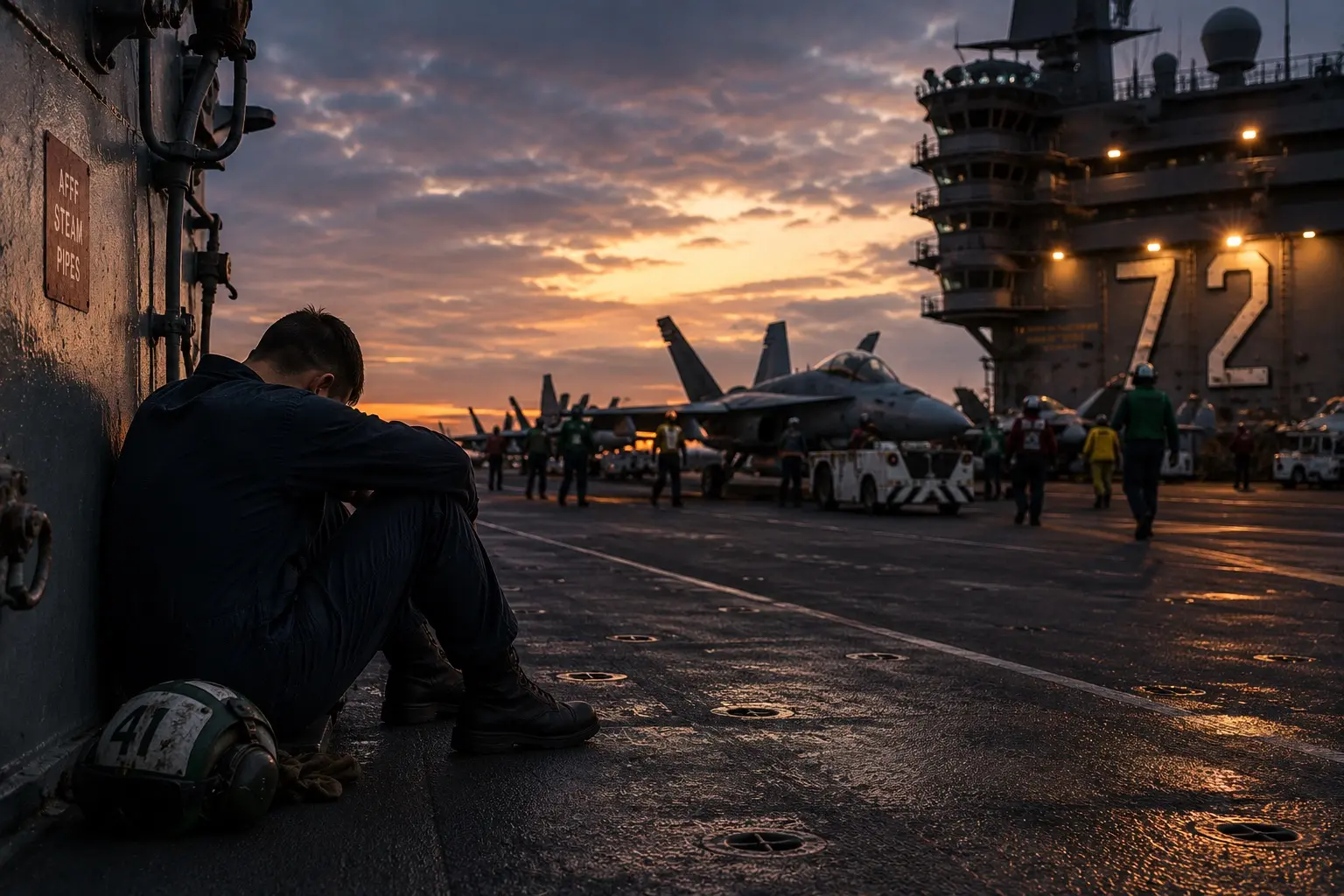
America Built a Carrier That Can Keep Going. Its Sailors Can’t.
The reactor doesn’t get tired. The crew does.
The USS Abraham Lincoln is one of the most powerful machines ever built.
Nearly 1,100 feet long.
Nuclear powered.
A floating airbase capable of launching combat aircraft thousands of miles from the United States.
It carries thousands of people, dozens of aircraft and an enormous collection of weapons, sensors, communications systems and technology.
And after an extraordinarily long deployment, approximately 5,000 American sailors and Marines arrived in Thailand for something considerably less sophisticated:
A break.
The Lincoln Carrier Strike Group arrived in Thailand after an extended deployment that included months supporting U.S. combat operations in the Middle East. The carrier’s deployment had reached roughly 286 days by its arrival, with an extraordinary stretch spent continuously at sea.
Its Thailand stop lasted five days.
That sounds like a travel story.
It isn’t.
It’s a story about the weakest component in every powerful system.
The human being operating it.
A Nuclear Carrier Has Incredible Endurance
The engineering behind a nuclear aircraft carrier is almost difficult to comprehend.
The propulsion system doesn’t depend on constantly refueling the ship with conventional fuel.
The carrier can produce enormous amounts of power.
It can desalinate seawater.
It can operate aircraft.
Maintain sophisticated radar and communications systems.
Provide medical care.
Prepare thousands of meals.
Repair equipment.
Support an entire miniature city.
In theory, a nuclear-powered carrier possesses extraordinary endurance.
But nuclear propulsion solves one particular problem:
Fueling the ship.
It doesn’t eliminate the need to sustain the people inside it.
People need food.
Sleep.
Mail.
Medical care.
Clean clothing.
Maintenance supplies.
Time away from work.
Communication with their families.
And eventually:
They need to get off the ship.
The Lincoln Has Been Pushed Extremely Hard
The carrier left San Diego in November 2025 and was eventually redirected into Middle East operations.
Its deployment stretched far beyond what many sailors and families originally anticipated.
Regular port visits became rare.
Stars and Stripes reported sailors and family members describing long workdays, disrupted mail, shortages involving food and water, and deteriorating morale. Carrier crews normally receive periodic port calls that provide opportunities for replenishment, maintenance and rest; the Lincoln went much of this deployment without them.
There have also been serious concerns about mental health.
Family members raised those concerns directly with senior Navy leadership in August, including concerns about self-harm among the approximately 5,000 personnel aboard.
That’s the part of military readiness that doesn’t fit neatly into photographs of fighter jets launching from a flight deck.
We Measure Military Power in Machines
How many aircraft carriers does America have?
How many fighters?
How many destroyers?
How many missiles?
What’s the range?
What’s the radar capability?
How many sorties can the carrier generate?
How quickly can it reach the Middle East?
Those are important questions.
But there’s another metric that matters:
How long can the people operating those systems continue performing effectively?
Because military hardware doesn’t operate itself.
Behind every aircraft launch is an enormous human machine.
Pilots.
Aircraft maintainers.
Flight-deck crews.
Weapons specialists.
Engineers.
Reactor personnel.
Radar operators.
Intelligence analysts.
Medical personnel.
Cooks.
Logistics crews.
Communications specialists.
Thousands of people performing highly specialized jobs.
Some of those jobs are dangerous even when nobody is shooting at them.
An Aircraft Carrier Never Really Sleeps
Look at photographs of an aircraft carrier flight deck during operations.
It appears almost choreographed.
Aircraft taxi.
Catapults launch.
Jets land.
Fuel moves.
Weapons move.
People move constantly.
But underneath the flight deck is an enormous industrial environment.
Machinery.
Electrical systems.
Reactors.
Workshops.
Hangars.
Fuel systems.
Weapons.
Kitchens.
Medical facilities.
Sleeping compartments.
Servers.
Networks.
Communications.
Thousands of people keeping the entire system functioning around the clock.
And fatigue matters.
A tired person isn’t merely uncomfortable.
Fatigue becomes operational risk.
That’s True in Cybersecurity Too
This is where the Lincoln becomes a lesson for businesses.
Cybersecurity professionals love technology.
EDR.
XDR.
SIEM.
Firewalls.
Zero Trust.
MFA.
AI.
Automated detection.
24/7 monitoring.
Immutable backups.
Fantastic.
But when something actually happens at 2:00 in the morning, somebody eventually receives an alert.
Then another.
Then another.
Then another.
During a major cyberattack, an incident-response team can operate for:
12 hours.
24 hours.
36 hours.
Sometimes longer.
Eventually the same limitation appears.
The software can keep going. The humans can’t.
Cybersecurity Has Its Own Version of Deployment Fatigue
I’ve seen what happens when IT teams are stretched too thin.
At first, everyone responds.
Every alert gets investigated.
Every warning matters.
Every ticket gets attention.
Then there are too many.
People become tired.
Alerts start looking familiar.
Warnings get dismissed.
Updates get postponed.
Tickets accumulate.
Someone thinks:
I’ll look at that tomorrow.
That’s how alert fatigue becomes security risk.
Not because the cybersecurity software failed.
Because the human operating the cybersecurity software reached capacity.
This Is Why “24/7 Security” Requires More Than Software
A company buys a security platform advertising:
24/7 protection.
Great.
Who’s responding at 3:17 a.m.?
If ransomware begins encrypting your network Saturday night, who has authority to isolate the environment?
If your Microsoft 365 administrator’s account gets compromised on Christmas morning, who investigates?
If your firewall detects suspicious outbound traffic at midnight, does somebody actually see it?
Technology can operate continuously.
People require rotations.
That’s why mature security operations involve staffing, escalation procedures, automation, documentation and handoffs.
The objective isn’t to create superheroes capable of working indefinitely.
It’s to build a system that doesn’t require superheroes.
The Navy Has Exactly the Same Problem—At Enormous Scale
The United States can send a carrier across the planet.
But every additional deployment creates pressure somewhere else.
Ships need maintenance.
Aircraft need maintenance.
Parts need replacement.
Supplies need replenishment.
Sailors need training.
Families need stability.
Crews need recovery.
And another carrier may need to replace the one coming home.
The Lincoln has now been relieved in the Middle East by the USS George Washington.
That’s how sustainable military presence works.
Not:
Keep one ship there forever.
But:
Build enough capacity that one force can relieve another.
Redundancy Isn’t Waste
Businesses frequently make the opposite mistake.
They look at two people capable of performing the same critical function and think:
Why are we paying both?
One person could do this.
Until that person:
Gets sick.
Goes on vacation.
Quits.
Gets overwhelmed.
Makes a mistake.
Or simply needs to sleep.
Redundancy can look inefficient on a spreadsheet.
Until something fails.
Then redundancy becomes resilience.
The Navy doesn’t need another carrier because the first carrier suddenly stops floating.
It needs another carrier because:
Sustained capability requires rotation.
Businesses need to understand the same principle.
The Port Call Is Part of the Weapons System
This sounds strange, but think about it.
Rest isn’t separate from readiness.
Recovery isn’t a luxury provided after the mission.
Recovery helps make the next mission possible.
The Navy described the Thailand visit as a chance for sailors and Marines to “rest and recharge.”
That’s operational maintenance.
We readily understand that an F/A-18 needs maintenance.
Nobody says:
The aircraft looks fine. Why are we taking it offline?
We understand preventative maintenance.
Engines need inspection.
Parts wear out.
Systems need servicing.
But human beings frequently receive a different standard:
Keep going until something breaks.
That’s terrible engineering.
Pattaya Is Preparing for 5,000 Visitors
The scale of the port call is remarkable on its own.
The carrier is docking at Laem Chabang, roughly 19 miles from Pattaya, with thousands expected to head into the city during the five-day visit.
Local businesses have been preparing for the influx.
Restaurants.
Transportation.
Tourism.
Entertainment.
Retail.
Local estimates before the arrival suggested the visit could inject millions of baht into the local economy.
But for the sailors, the value isn’t economic.
It’s normalcy.
Walking somewhere that isn’t a steel corridor.
Eating something that wasn’t transported to a carrier at sea.
Seeing something other than ocean.
Sleeping without another operational day immediately waiting.
Calling home.
Having several hours in which the person is simply:
A person.
There’s a Bigger Strategic Question Here
America’s global military power depends heavily on presence.
The United States wants forces capable of operating in:
The Middle East.
The Indo-Pacific.
Europe.
And elsewhere.
Sometimes simultaneously.
But every commitment consumes capacity.
If geopolitical demands increase faster than the force available to meet them, something eventually has to give.
Deployment lengths increase.
Maintenance gets compressed.
Training schedules change.
Ships stay forward longer.
People stay away from home longer.
And resilience begins declining.
That’s why military strength cannot simply be measured by:
How many ships do we have?
The more important question is:
How much sustainable presence can those ships actually generate?
There Is a Difference Between Capacity and Sustainable Capacity
Suppose your company has one brilliant IT engineer.
He can manage:
Servers.
Microsoft 365.
Firewalls.
Backups.
Cybersecurity.
Networking.
Phones.
Cloud systems.
Everything.
You might say:
We have the capacity.
No.
You have capability concentrated in one human being.
That’s completely different.
If he’s working 70 hours every week, your infrastructure may appear healthy.
But you’ve created operational debt.
Eventually something changes.
He leaves.
Burns out.
Gets sick.
Misses something.
And suddenly the company’s enormous technical capability disappears.
The Lincoln illustrates the same principle at national scale:
A system’s theoretical endurance and its sustainable endurance are not the same thing.
Technology Keeps Making This Mistake
We design systems around what machines can do.
Servers run 24/7.
Networks run 24/7.
Cloud services run 24/7.
Cyberattacks happen 24/7.
Markets run around the world.
Military operations continue around the clock.
Then we quietly expect humans to match the machines.
They can’t.
And they shouldn’t.
The solution isn’t finding people capable of operating indefinitely.
It’s designing organizations around human limitations.
Rotation.
Redundancy.
Automation.
Recovery.
Handoffs.
Staffing.
Maintenance.
Resupply.
Those aren’t signs of weakness.
They’re how powerful systems remain powerful.
The Lincoln Is Still an Extraordinary Demonstration of American Power
There’s another side worth acknowledging.
The fact that a U.S. carrier strike group could remain forward deployed for this long while supporting sustained combat operations thousands of miles from home is itself an extraordinary demonstration of logistics and naval capability.
Few countries can do anything remotely comparable.
The ship continued operating.
Aircraft continued flying.
Thousands of sailors continued performing.
Supplies continued reaching it.
Maintenance continued.
Operations continued.
That is remarkable.
But perhaps the biggest lesson from this deployment isn’t simply:
Look how long America can keep an aircraft carrier at sea.
It’s:
Look at what it takes from the people aboard to do it.
Machines Have Specifications. Humans Have Limits.
The USS Abraham Lincoln is nuclear powered.
Its sailors aren’t.
The carrier can be refueled.
Replenished.
Repaired.
Parts replaced.
Systems upgraded.
Human beings require something more complicated.
Sleep.
Recovery.
Family.
Morale.
Purpose.
Time.
And eventually:
Home.
A military that ignores those things may still be able to deploy tremendous power.
For a while.
The same is true of a business.
You can run understaffed.
You can keep calling the same IT person at midnight.
You can stretch your employees.
You can postpone maintenance.
You can eliminate redundancy.
You can operate everything at maximum utilization.
And you’ll look incredibly efficient.
Right until the moment something breaks.
Real resilience isn’t the ability to operate at 100% forever.
It’s having enough capacity that you don’t have to.
70% of all cyber attacks target small businesses, I can help protect yours.
#Cybersecurity #BusinessContinuity #OperationalResilience #ManagedIT #Technology
The USS Abraham Lincoln is nuclear powered. Its 5,000 sailors aren’t. After an extraordinary deployment, that difference is becoming impossible to ignore.