
By
Gigabit Systems
October 13, 2026
•
20 min read
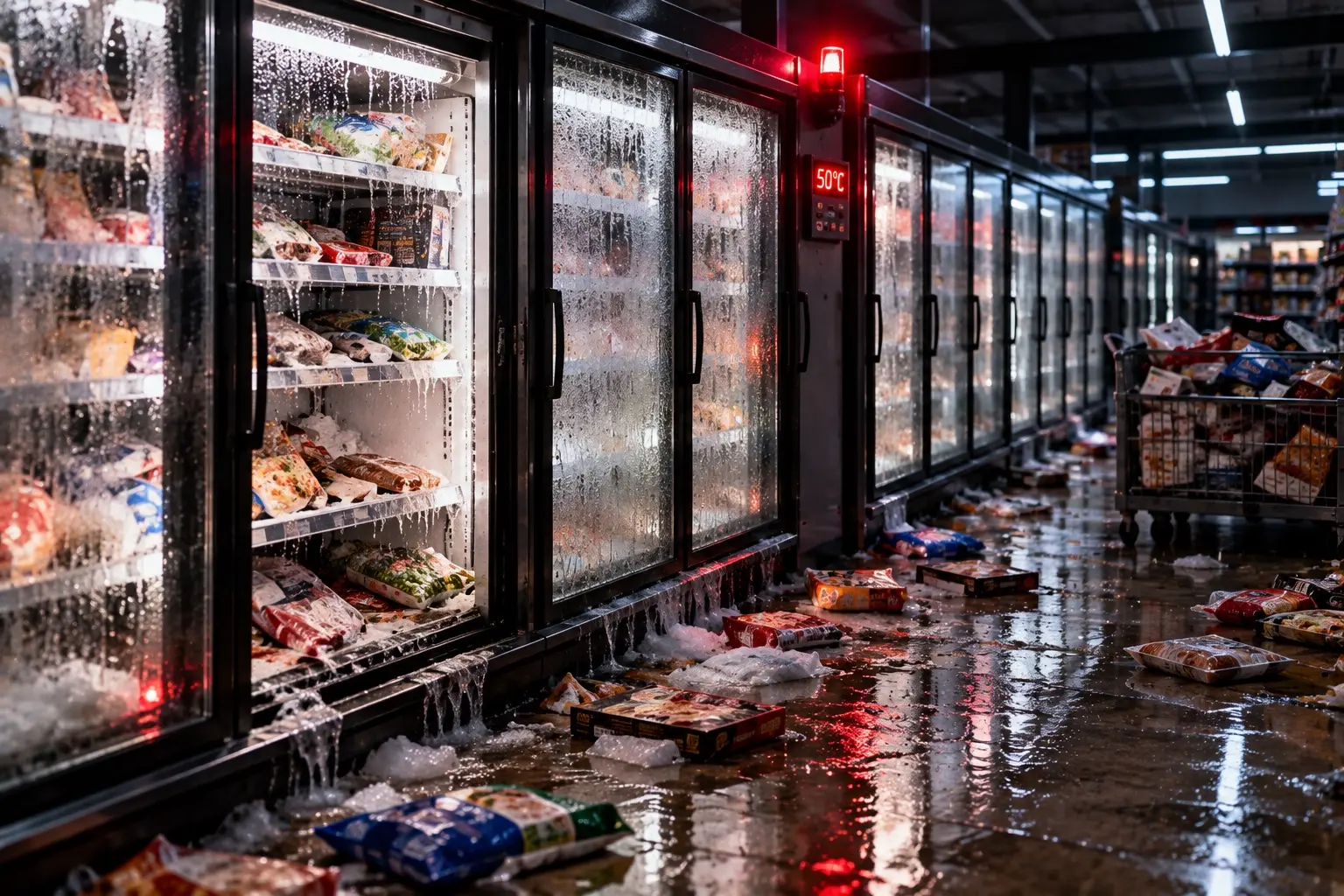
Hackers Target Supermarket Refrigerators in France. The Food Supply Is Now a Cybersecurity Target.
Hackers don’t need to steal data to cause real damage.
Imagine arriving at your supermarket in the morning and discovering that an entire refrigerated section has stopped working overnight.
Milk.
Meat.
Frozen foods.
Fresh produce.
Thousands of dollars’ worth of inventory potentially spoiled.
Now imagine the same thing happening at hundreds of supermarkets across a country.
That’s the alarming scenario described in reports circulating about a cyberattack targeting supermarket refrigeration systems in France.
According to the initial claims, attackers disrupted systems responsible for keeping food at safe temperatures, potentially forcing affected stores to discard perishable inventory.
The reported incident highlights an increasingly important cybersecurity threat: attacks against the technology that controls physical equipment.
Unlike traditional data breaches, these incidents can cause damage without stealing a single password, customer record or credit card number.
Sometimes the most damaging cyberattack is simply turning something off.
The reported scale, exact number of affected stores, and extent of food losses still require independent confirmation. Those details should not be treated as established until supported by reliable reporting.
Confirmed: Hundreds of Stores Were Hit Overnight
Reporting from Reuters, AFP, Euronews and French national media confirms that the attack took place overnight from October 11 to October 12, 2026.
Major supermarket operators acknowledged that their refrigeration systems had been compromised.
50°C
122°F — reported refrigeration temperature setting
Hundreds
Supermarkets affected across France
Among the affected operators were Intermarché, Coopérative U, Carrefour and other major supermarket chains.
Initial reports from Intermarché identified approximately 150–200 affected stores, with nearly 100 Coopérative U locations also impacted. Later French reporting described a wider total involving additional retailers.
And this wasn’t simply a matter of refrigerators losing power.
According to investigators and reporting, attackers remotely manipulated refrigeration controls, activating or extending defrost functions and raising temperatures to approximately 50°C (122°F).
Some stores reported equipment damage, spoiled inventory and even fires.
France’s national cybersecurity agency, ANSSI, and the Paris prosecutor’s office became involved in the investigation.
How Hackers Turned Freezers Into Heaters
Modern commercial refrigeration systems are much more sophisticated than the refrigerator in your kitchen.
They use electronic controllers to regulate temperatures, monitor equipment and perform maintenance functions.
One of those functions is defrosting.
Freezers accumulate ice on their evaporator coils, so commercial systems periodically activate defrost cycles to remove that ice and maintain efficiency.
Under normal conditions, the process is carefully controlled.
But if an attacker gains sufficient control of the refrigeration management system, that function can be abused.
Instead of running a normal defrost cycle, the attacker can potentially force prolonged heating or otherwise prevent the equipment from maintaining safe storage temperatures.
That’s reportedly what happened in France.
French newspaper Le Monde reported that attackers changed defrost settings and extended the duration of the process, delaying alarms and increasing the damage.
The result was devastatingly simple.
Food that was supposed to remain frozen began thawing.
Fresh products warmed beyond safe storage conditions.
Some equipment reportedly overheated.
And supermarket employees arrived to discover that entire refrigerated inventories could no longer be sold.
The attackers didn’t need to steal payment information.
They didn’t need to encrypt the store’s accounting database.
They simply interfered with the equipment responsible for keeping food safe.
A Vulnerability in a Shared Technology Supplier
Investigations have pointed toward refrigeration control technology supplied by Danish manufacturer Danfoss.
Reports indicate that older or outdated control software may have been involved, although the complete technical attack chain has not yet been publicly established.
This is one of the most important aspects of the incident.
The attackers didn’t necessarily need to compromise each supermarket’s corporate network independently.
If multiple retailers depend on similar connected equipment, software or remote management services, a weakness affecting that shared technology can create a much larger attack surface.
It’s the same underlying risk that exists when hundreds of businesses depend on one cloud provider, one remote monitoring platform or one software vendor.
A weakness in a common component can affect organizations that otherwise have very different IT environments.
That is why third-party technology security matters as much as internal cybersecurity.
The Financial Damage Goes Far Beyond Broken Equipment
A cyberattack against refrigeration creates several simultaneous problems.
First, there is the inventory loss.
Once perishable food exceeds safe temperature limits, stores may be required to discard it rather than risk selling unsafe products.
Second, there is operational disruption.
Employees must inspect refrigeration units, document damage, remove compromised products, sanitize affected areas and wait for systems to be repaired or verified.
Third, there is lost revenue.
Customers arriving at affected stores may find empty refrigerated shelves or temporarily closed departments.
Fourth, there is equipment damage.
Prolonged overheating can potentially damage components, adding repair costs to the spoiled inventory.
And finally, there is the larger supply-chain impact.
A supermarket cannot necessarily replace thousands of perishable products immediately.
Distributors, delivery schedules and storage capacity all become part of the recovery process.
Le Monde reported that one store owner documented approximately €21,000 in lost inventory at purchase cost alone. National losses were expected to reach millions of euros, although the final total remained uncertain.
This Is Operational Technology Cybersecurity
The attack highlights a distinction that many businesses overlook.
Traditional information technology, or IT, primarily handles data and business applications.
Operational technology, or OT, monitors or controls physical processes.
Examples include refrigeration controllers, industrial machinery, HVAC systems, water pumps, building automation systems and electrical equipment.
When an IT system is compromised, attackers may steal data, disrupt applications or deploy ransomware.
When an OT system is compromised, attackers may interfere with equipment that performs a physical function.
The consequences can extend beyond the digital environment.
How a connected refrigeration attack can create physical damage
Remote access to a vulnerable controller
Potentially through exposed management software or a compromised service
Unauthorized temperature or defrost changes
Cooling operations are disrupted
Physical and financial consequences
Food spoilage, equipment damage and operational downtime
The diagram illustrates the reported type of attack, not a confirmed complete forensic reconstruction of the intrusion.
Why Small Businesses Should Pay Attention
This isn’t exclusively a supermarket problem.
Many smaller organizations operate connected equipment without treating it as part of their cybersecurity environment.
Restaurants use remotely monitored walk-in freezers.
Medical practices store temperature-sensitive medications and vaccines.
Schools operate connected HVAC systems and refrigeration equipment.
Manufacturers use network-connected controllers to manage production.
Commercial buildings rely on automation platforms to control heating, ventilation and access systems.
And many of these devices are installed and maintained by specialized contractors rather than the organization’s primary IT provider.
That can create a dangerous visibility gap.
The IT department may not know the controller exists.
The equipment vendor may assume the customer’s network is secure.
And nobody may be responsible for monitoring the device’s cybersecurity posture.
An unmanaged device controlling physical equipment can be just as consequential as an unpatched server.
Six Security Measures That Could Reduce This Risk
1. Inventory connected operational equipment. Identify refrigeration controllers, HVAC systems, building automation devices and other equipment connected to your network or accessible remotely.
2. Separate operational systems from office networks. Use appropriate network segmentation and firewall policies to limit unnecessary communication between business computers and equipment controllers.
3. Restrict remote access. Avoid exposing controller management interfaces directly to the internet. Use secure, authenticated remote-access solutions with MFA where supported.
4. Keep firmware and management software updated. Establish a maintenance process with equipment vendors and identify devices that no longer receive security updates.
5. Monitor physical conditions independently. Temperature alarms and environmental monitoring should ideally provide an independent warning if the primary control system is compromised or fails.
6. Test manual recovery procedures. Know how to isolate a compromised controller, restore safe operation and preserve temperature-sensitive inventory without relying entirely on the affected remote management system.
For organizations using an MSP, operational equipment should be included in cybersecurity risk assessments even when the equipment is maintained by a separate contractor.
The MSP, equipment vendor and business owner need clearly defined responsibilities.
The Most Dangerous Cyberattack Might Not Target Your Computers
The French supermarket incident illustrates how cybersecurity failures can cross into the physical world.
A vulnerable controller.
An abused defrost function.
Hours of uncontrolled heating.
And potentially millions of euros in spoiled food.
The attack didn’t require an elaborate Hollywood-style breach of a national supermarket network.
It exploited the reality that modern businesses increasingly rely on connected technology to operate ordinary physical equipment.
As that connectivity expands, so does the potential impact of a cybersecurity failure.
Your Refrigerator Has Become an Endpoint
Businesses routinely secure laptops, desktops and servers.
They install endpoint protection.
They monitor suspicious logins.
They patch operating systems.
But what about the refrigerator holding thousands of dollars in inventory?
The HVAC controller managing an entire building?
The network-connected system protecting temperature-sensitive medications?
These devices may not look like computers.
But if they contain software, connect to networks and accept remote commands, they can introduce cybersecurity risks.
And when they fail, the damage can be immediate and physical.
The attack in France is a powerful reminder that cybersecurity is no longer only about protecting information.
It’s about protecting the technology that keeps businesses operating.
Hackers didn’t steal the groceries. They made them worthless.
70% of all cyber attacks target small businesses, I can help protect yours.
#Cybersecurity #OperationalTechnology #CyberAttack #DataProtection #ManagedIT
HACKERS TURNED SUPERMARKET FREEZERS INTO HEATERS.
Hundreds of supermarkets across France were hit overnight after attackers reportedly manipulated connected refrigeration systems, raising temperatures to 122°F.
Stores were forced to throw away food, some equipment was damaged, and millions in losses are feared.
No stolen passwords. No encrypted files. Just hacked refrigerators destroying physical inventory.
Your business probably has more connected equipment than you realize.