
By
Gigabit Systems
September 16, 2026
•
20 min read
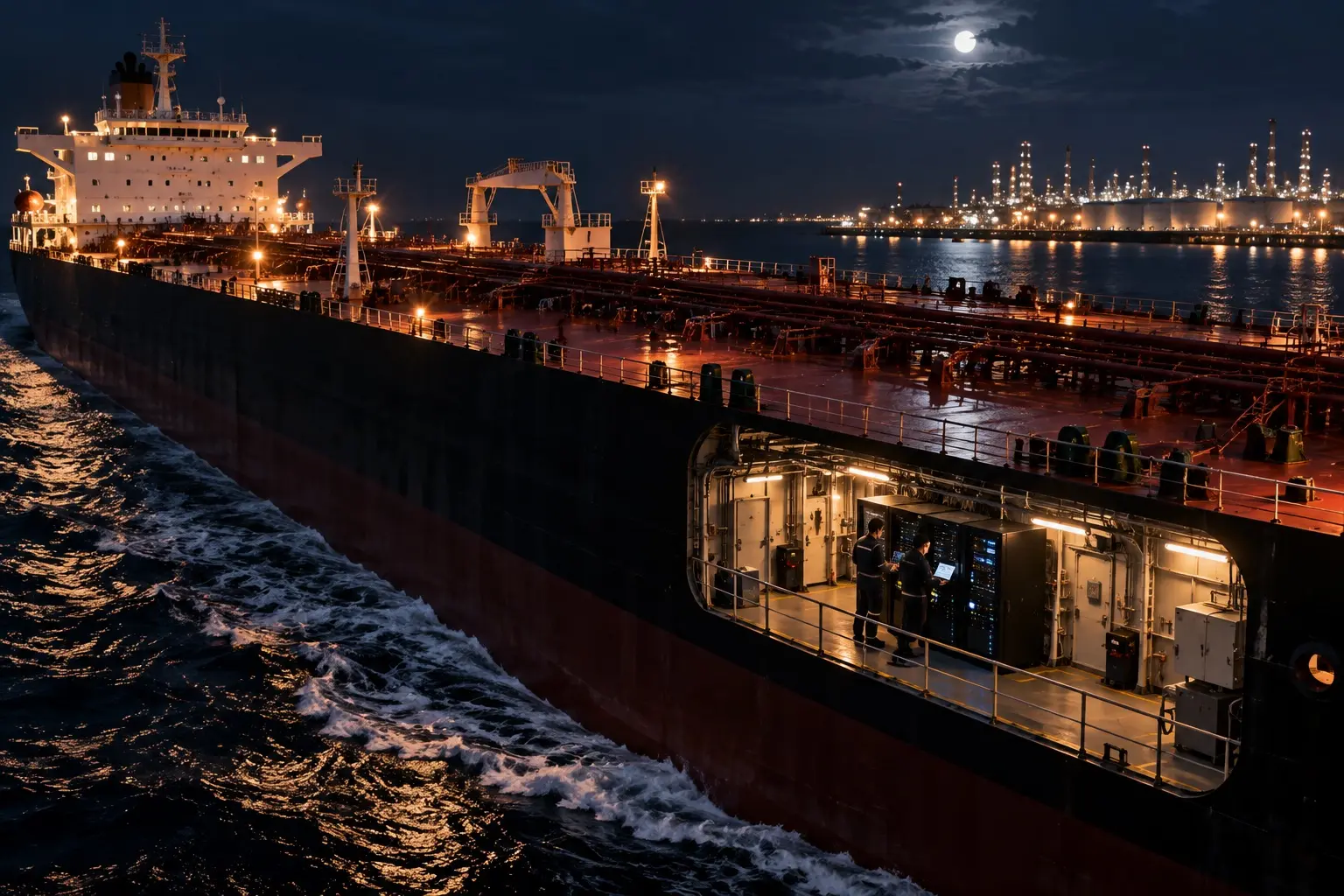
The Coast Guard Boarded an Oil Supertanker Because Hackers Got Inside
The next tanker attack may begin with a keyboard.
Picture a massive oil tanker crossing the Atlantic.
Hundreds of thousands—or potentially millions—of barrels of energy cargo aboard.
Navigation systems.
Communications.
Engine controls.
Cargo-management systems.
Satellite connectivity.
Crew computers.
Industrial equipment.
And somewhere inside that enormous floating industrial facility, investigators believe hackers got into the network.
The response wasn’t simply:
Call the IT department.
The United States sent people aboard.
On August 21, U.S. Coast Guard personnel and FBI agents boarded the foreign-flagged VL Prosperity, a Very Large Crude Carrier headed toward Texas.
According to the Coast Guard, there were indications that the vessel’s network had been compromised by overseas cyber actors.
That makes this much more than another ransomware story.
Cybersecurity just became a boarding operation.
Meet the VL Prosperity
The VL Prosperity is what’s known as a VLCC—Very Large Crude Carrier.
These aren’t ordinary ships.
They’re enormous pieces of floating critical infrastructure designed to transport crude oil across oceans.
The VL Prosperity is currently positioned near Galveston, Texas, according to ship-tracking information cited by Bloomberg.
The Coast Guard says the captain, crew and shore-based personnel cooperated with investigators.
Importantly, officials reported no operational disruptions or injuries resulting from the incident.
That’s reassuring.
But the reason federal investigators boarded the vessel should get considerably more attention.
The Attack Apparently Happened Thousands of Miles Away
Iran’s semi-official Mehr News Agency previously reported that the VL Prosperity suffered a cyberattack while around the Strait of Gibraltar in August and that communications were disrupted for roughly 30 hours.
That account should be treated cautiously because the Coast Guard has not publicly confirmed all of those details.
What the U.S. government has confirmed is considerably simpler:
There were indications that overseas cyber actors compromised the vessel’s network.
And investigators considered that serious enough to physically board the ship.
Think about the geography.
A potential attacker doesn’t necessarily have to be standing in Galveston.
They don’t have to board the tanker.
They don’t have to plant explosives.
They may potentially attack digital infrastructure while the ship is thousands of miles away.
The ocean stopped being a security perimeter when the ship connected to the internet.
And Apparently This Isn’t the Only Tanker
This is where the story gets considerably bigger.
The Wall Street Journal reports that U.S. authorities are investigating cyberattacks involving at least two foreign tankers carrying oil or liquefied natural gas toward American ports.
Specialized Coast Guard and FBI personnel reportedly boarded the vessels after they arrived in the Gulf of Mexico.
That’s an important distinction.
We’re potentially no longer looking at:
One ship. One hacker. One strange incident.
Investigators are trying to understand whether multiple energy vessels were targeted.
And that raises an obvious national-security question:
Why energy tankers?
An Oil Tanker Is Basically a Floating Industrial Network
Most people picture ships mechanically.
Engines.
Propellers.
Rudders.
Pumps.
Valves.
But modern commercial vessels increasingly depend upon interconnected digital systems.
Navigation.
Communications.
Cargo monitoring.
Engineering systems.
Business networks.
Satellite connections.
Electronic charts.
Sensors.
Crew devices.
Remote vendor access.
And potentially operational technology controlling physical machinery.
The U.S. Coast Guard has been warning about exactly this convergence.
Its 2025 Cyber Trends and Insights in the Marine Environment report says the boundary between the physical and cyber domains continues to blur across America’s maritime transportation system.
That’s the same transformation we’ve watched happen inside factories.
Hospitals.
Power plants.
Water utilities.
Warehouses.
The computer isn’t merely sitting next to the machine anymore.
The computer increasingly operates the machine.
That’s When Cyberattacks Become Physical
Steal the payroll spreadsheet and you have an IT incident.
Disable a cargo pump and you potentially have an industrial incident.
Disrupt navigation and you potentially have a maritime incident.
Interfere with communications and you can potentially create an emergency.
The Wall Street Journal reports that investigators are examining the possibility of compromises involving operational and information-technology systems aboard the affected ships.
That doesn’t mean hackers actually seized control of the engines, steering or cargo systems on the VL Prosperity.
There is currently no public evidence establishing that.
That’s an important line not to cross.
But it’s precisely what investigators have to rule out.
Because once attackers penetrate one network aboard an industrial vessel, the critical question becomes:
What else can they reach?
Imagine Ransomware on a Laptop
Now imagine ransomware on something carrying crude oil.
The fundamental cybersecurity techniques may not necessarily be exotic.
Phishing.
Stolen credentials.
Unpatched systems.
Compromised vendors.
Remote-access software.
Weak segmentation.
Misconfigured firewalls.
Exposed services.
Old operating systems.
The difference is blast radius.
When an accountant’s computer stops working, payroll might be delayed.
When technology aboard a massive energy vessel stops working, you’re potentially dealing with:
Navigation.
Cargo.
Safety.
Ports.
Environmental consequences.
Supply chains.
Human lives.
That’s why critical-infrastructure cybersecurity is fundamentally different.
The vulnerability can be digital while the consequences are physical.
The Coast Guard Has Been Preparing for This
There’s a fascinating piece of context to this story.
Earlier this year, the Coast Guard revealed that its Cyber Command had already begun deploying Cyber Protection Teams alongside traditional law-enforcement boarding teams during maritime interdiction operations.
During previous Dark Fleet vessel operations, Coast Guard Cyber specialists established what the service calls “cyber positive control” over relevant digital systems to ensure cyber threats couldn’t compromise operational safety.
Think about what that means.
A traditional boarding team secures:
The bridge.
The crew.
The cargo.
The vessel.
A modern boarding team may also have to secure:
The network.
That’s an extraordinary evolution in maritime security.
The Hacker Can Become Another Passenger
There’s an analogy I love for this.
Imagine authorities seize a ship.
They search every cabin.
Check every crew member.
Inspect the cargo.
Secure the bridge.
Everything looks good.
Except nobody checks the computers.
A malicious actor sitting 5,000 miles away still has remote administrative access.
You secured every person aboard the vessel.
Except the person who wasn’t physically aboard.
That’s modern cybersecurity.
Physical possession doesn’t necessarily mean digital control.
And Ships Are Particularly Difficult to Secure
A vessel isn’t a normal corporate office.
It travels between countries.
It can spend weeks at sea.
Connectivity varies.
Equipment may remain installed for decades.
Systems come from multiple manufacturers.
Third-party technicians need access.
Crew members rotate.
Operational equipment can’t always be casually rebooted or patched.
Legacy technology may have been designed during an era when engineers never imagined it would eventually be connected to outside networks.
The Coast Guard has repeatedly warned that maritime operators face increasing cybersecurity risks as vessels and facilities become more interconnected.
That’s exactly the same problem we see with industrial control systems everywhere.
A machine designed to operate for 30 years eventually gets connected to a network designed to change every 30 days.
The Iran Question
Given the current Middle East conflict, there’s going to be enormous temptation to immediately attribute these incidents to Iran.
Don’t.
At least not yet.
The Wall Street Journal reports that U.S. officials are considering whether Iran or another adversary could be involved.
But publicly:
No perpetrator has been established.
Cyber attribution is difficult.
Infrastructure can be routed through multiple countries.
Attackers can imitate other groups.
Malware can be reused.
Servers can be compromised.
False flags are possible.
And intelligence agencies may know considerably more than they’re willing to release publicly.
So the responsible description right now is:
Overseas cyber actors compromised or were suspected of compromising tanker networks. U.S. authorities are investigating who was responsible.
There’s a Bigger Strategic Reason This Matters
Oil tankers aren’t merely ships.
They’re part of the global energy system.
The Strait of Hormuz gets enormous attention because so much of the world’s petroleum travels through it.
But Gibraltar is another extraordinarily important maritime chokepoint connecting the Mediterranean with the Atlantic.
Now imagine cyber operations becoming another method for interfering with shipping through strategic waterways.
You don’t necessarily sink the tanker.
You don’t mine the strait.
You don’t fire a missile.
You interfere with:
Communications.
Navigation.
Scheduling.
Port systems.
Logistics.
Ship networks.
Cargo operations.
Or simply create enough uncertainty that authorities have to stop vessels and investigate.
Disruption doesn’t always require destruction.
That’s the Cybersecurity Lesson for Every Business
You probably don’t own an oil tanker.
But the principle is identical.
Every organization has systems where digital compromise can eventually affect physical operations.
Healthcare:
What happens when computers controlling medication, imaging or scheduling stop working?
Schools:
What happens when door access, cameras, HVAC and communications become unavailable?
Manufacturing:
What happens when attackers move from the employee network toward industrial equipment?
Law firms:
What happens when compromised credentials provide access to client files, escrow instructions or financial workflows?
SMBs:
What happens when an attacker reaches your cloud environment, phones, security cameras, accounting system or backups?
Cybersecurity isn’t just about protecting files anymore.
It’s about understanding what those files and computers ultimately control.
Segment the Ship
If there’s one technical lesson to take from this story, it’s segmentation.
Your guest Wi-Fi shouldn’t provide a pathway to critical servers.
Employee laptops shouldn’t have unnecessary access to operational technology.
IoT devices shouldn’t live beside sensitive systems simply because connecting everything to one network is easier.
Vendor remote access shouldn’t remain permanently open.
Administrative credentials shouldn’t work everywhere.
Critical systems should have tightly controlled communication paths.
And logs from IT and operational environments should be monitored for unusual behavior.
This is Zero Trust in its most literal form.
Compromise one thing. Don’t automatically inherit everything.
The Next Naval Threat May Not Look Like a Weapon
The VL Prosperity incident is significant precisely because nothing spectacular appears to have happened.
The tanker didn’t explode.
It didn’t run aground.
Nobody was injured.
Cargo operations weren’t publicly reported as catastrophically disrupted.
Instead, authorities discovered evidence suggesting foreign hackers had gotten into the network.
Then Coast Guard and FBI personnel physically boarded the vessel to investigate.
That’s cybersecurity crossing an important boundary.
The hacker isn’t merely attacking the company that owns the ship.
They’re potentially entering the digital systems of a gigantic moving piece of industrial infrastructure.
And once computers control enough of the physical world, the distinction between a cyberattack and a physical attack becomes increasingly difficult to maintain.
The next attack on critical infrastructure may arrive without a missile.
It may arrive as a login.
70% of all cyber attacks target small businesses, I can help protect yours.
#Cybersecurity #CriticalInfrastructure #MaritimeSecurity #CyberAttack #ManagedIT
The U.S. Coast Guard and FBI just BOARDED a massive oil tanker because foreign hackers may have gotten inside its network. No missile. No pirates. No explosives. Just a cyberattack on a floating piece of critical infrastructure. And investigators are reportedly looking at more than one tanker.