
By
Gigabit Systems
October 27, 2026
•
20 min read
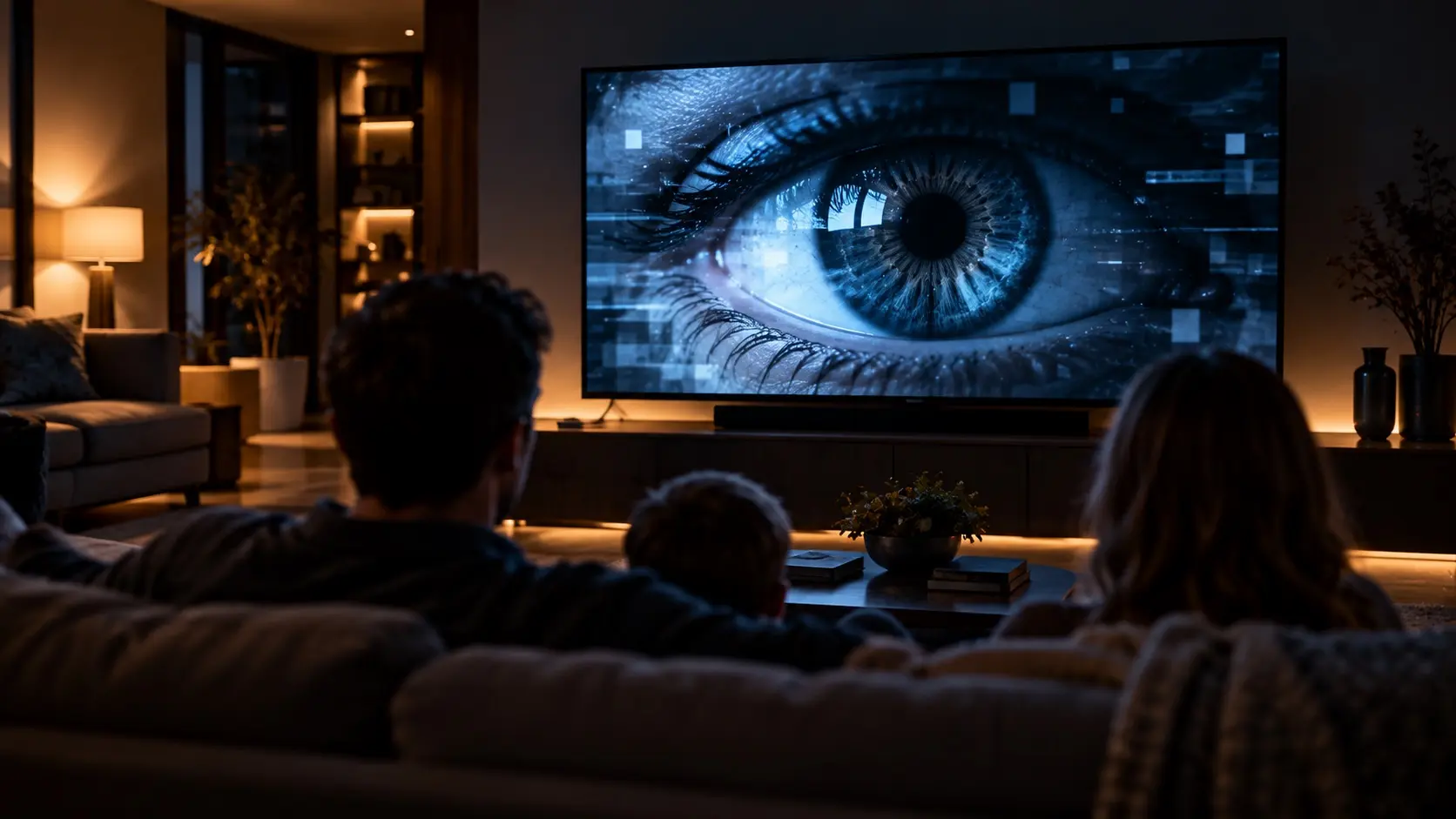
Your Smart TV May Be Watching You More Closely Than You Think
You Bought the Television. You May Be the Product.
Imagine sitting in your living room, watching television, completely unaware that the device in front of you may be analyzing what appears on your screen and sharing information with an advertising ecosystem.
Now imagine discovering that the tools capable of exposing those practices are becoming harder to use.
That is the controversy surrounding Samsung’s smart television advertising technology and the growing debate over artificial intelligence tools used for reverse engineering.
The implications extend far beyond television manufacturers.
This story raises an uncomfortable cybersecurity question: When consumers purchase a connected device, how much control do they actually retain over what that device collects, transmits, and reveals about them?
The Technology That Knows What You’re Watching
The technology at the center of the controversy is called Automatic Content Recognition (ACR).
ACR allows a smart television to identify content displayed on its screen, potentially including programming delivered through external devices such as cable boxes, streaming sticks, and gaming consoles.
Depending on the implementation, ACR can periodically sample visual or audio information and compare digital fingerprints against databases of known content.
This does not necessarily mean the television continuously uploads full screenshots or records private conversations.
The distinction matters.
A digital fingerprint can identify content without transmitting the original image. But that does not make the information harmless.
When viewing information is associated with persistent device identifiers, household profiles, or advertising records, it can reveal patterns about a person’s interests and behavior.
Consider what someone might infer from your viewing history:
Your preferred news programs and entertainment.
Financial products or investment services that interest you.
Health-related programming and advertisements.
Children’s programming and household viewing patterns.
Your approximate daily routines and television usage.
Your television does not need to know your name to help advertisers recognize your household.
Samsung’s Data Collection Practices Have Already Faced Legal Action
This is not merely a hypothetical privacy concern.
In February 2026, the Texas Attorney General announced an agreement requiring Samsung to obtain informed, express consent before collecting or processing ACR viewing data from Texas consumers.
The agreement followed a lawsuit challenging Samsung’s smart television data collection practices.
Samsung was also required to implement clearer disclosures and consent mechanisms.
The case demonstrates that regulators are scrutinizing whether consumers meaningfully understand and authorize the collection of television viewing information.
However, several details in the recent viral account require additional verification.
The claims that a particular researcher confirmed screen captures every 500 milliseconds, established a direct connection to Experian’s household identity records, and linked targeted advertisements to private conversations should not be presented as independently established facts without the underlying technical evidence.
The distinction between documented ACR technology and unverified claims about microphone surveillance is especially important.
The Tool That Made Reverse Engineering Accessible to Almost Anyone
The second part of this story concerns an open-source project called REA, short for Reverse Engineer Anything.
Reverse engineering is the process of examining software or hardware to understand how it functions without having access to its original source code.
For decades, cybersecurity researchers have used sophisticated tools to investigate malicious software, uncover vulnerabilities, audit proprietary applications, and examine what connected devices do behind the scenes.
One such tool is Ghidra, a software reverse-engineering framework developed by the National Security Agency.
These tools are powerful, but using them effectively traditionally requires considerable technical expertise.
REA changes that accessibility.
By connecting AI agents to established reverse-engineering frameworks through the Model Context Protocol (MCP), REA allows researchers to investigate software using natural-language instructions.
Instead of manually navigating thousands of functions, a researcher can ask an AI assistant to locate code associated with network communications, identify data collection mechanisms, or trace how particular information moves through an application.
The underlying analysis tools still perform the technical work.
AI makes that work easier to direct and interpret.
The open-source project supports integrations with tools such as Ghidra and Hopper and can work with multiple AI coding assistants.
Why This Matters for Consumer Privacy
Imagine purchasing a smart television and wanting to understand exactly what information it sends to its manufacturer.
Traditionally, answering that question might require specialized knowledge of firmware extraction, binary analysis, network traffic inspection, and software architecture.
AI-assisted reverse engineering can substantially lower that barrier.
A researcher might investigate whether the television contacts advertising servers while idle, how device identifiers are generated, or whether disabling a privacy setting actually stops particular network requests.
These are legitimate questions with important implications for consumer protection.
But the same technology can also help malicious actors analyze software for exploitable weaknesses.
That dual-use capability creates a difficult challenge for AI providers.
The Controversy Over AI Restrictions
Reports circulating in October 2026 describe researchers encountering safety restrictions while using commercial AI assistants for reverse-engineering tasks.
Some users reported that Claude interrupted detailed reverse-engineering workflows, while a researcher investigating Samsung television software reportedly described an OpenAI account restriction.
These are user-reported incidents. I could not verify an official blanket prohibition by either provider against using REA or performing legitimate reverse engineering.
In fact, REA’s documentation continues to describe compatibility with multiple commercial AI coding assistants.
The controversy nevertheless raises a serious question about cybersecurity research.
If defensive researchers cannot reliably analyze proprietary software, who independently verifies what that software does?
There are legitimate reasons to restrict assistance that would facilitate unauthorized exploitation.
But reverse engineering is not inherently malicious.
It is also used to investigate privacy violations, analyze malware, discover vulnerabilities, and assess products that manufacturers do not make transparent.
A safety system that cannot adequately distinguish legitimate investigation from harmful activity risks obstructing important defensive work.
How to Stop Your Smart TV From Tracking What You Watch
The most useful takeaway from this controversy is that consumers do not need to wait for a lawsuit or another security researcher to take action.
If you own a smart television, review its privacy settings today.
Samsung Smart TVs: Disable ACR Tracking
On many recent Samsung televisions:
Press Home on your remote.
Open Settings → All Settings.
Navigate to General & Privacy → Terms & Privacy.
Open Privacy Choices.
Find Viewing Information Services and turn it off.
Disable Interest-Based Advertising.
Review Voice Recognition Services and disable unnecessary voice-related features.
Menu locations vary by model and software version.
Samsung confirms that its ACR feature can collect viewing history, television identifiers, and IP addresses when enabled. The company maintains that the feature is optional and that consumers can disable it.
Five Additional Ways to Protect Your Privacy
1. Review privacy settings on every smart device.
Smart televisions are only one example. Streaming devices, smart speakers, cameras, and other connected products may collect information beyond what is necessary for their primary functions.
2. Separate smart devices from sensitive computers.
Create a dedicated guest or IoT network for televisions, smart speakers, and other connected appliances.
For businesses, use properly configured VLANs and firewall policies to isolate these devices from workstations, servers, and sensitive systems.
3. Monitor outbound network connections.
A DNS filtering solution or appropriately configured firewall can help identify unexpected connections to advertising, analytics, and tracking services.
Blocking individual domains is not a complete privacy solution, however. Some devices use alternative DNS mechanisms, and indiscriminate blocking can interfere with legitimate functions.
4. Disable features you don’t use.
Turn off unnecessary microphones, voice assistants, advertising personalization, and optional data-sharing services.
Remember that disabling personalized advertising does not necessarily eliminate all diagnostic or operational telemetry.
5. Keep firmware updated.
Privacy concerns should not lead consumers to abandon security updates.
Outdated firmware can expose smart devices to vulnerabilities that create considerably greater risks than advertising-related data collection.
Why Businesses Should Be Paying Attention
The same questions surrounding consumer televisions apply to corporate technology.
A healthcare practice may have internet-connected medical equipment.
A law firm may use smart conference-room displays and video systems.
A school may operate hundreds of connected classroom devices.
An SMB may have network-connected printers, cameras, access-control systems, and smart televisions.
Each device represents another system collecting, processing, or transmitting information.
And many organizations have little visibility into what those devices actually communicate.
This is why cybersecurity cannot stop at protecting laptops and servers.
A comprehensive managed IT strategy should include IoT device inventories, network segmentation, DNS filtering, vendor privacy assessments, and monitoring of unexpected outbound communications.
If you don’t know what devices are communicating outside your network, you don’t fully understand your exposure.
The Bigger Issue: Who Gets to Inspect the Technology We Own?
The Samsung controversy illustrates two closely related concerns.
First, consumers need meaningful transparency about how connected products collect and use information.
Second, independent security researchers need legitimate ways to verify manufacturers’ claims.
AI-assisted reverse engineering could make those investigations more accessible.
But increased accessibility also requires responsible safeguards against malicious use.
The challenge is establishing security boundaries without unnecessarily preventing legitimate privacy research.
For consumers and businesses, the most important lesson is straightforward:
Owning a device does not guarantee that you understand what it does with your information.
And clicking “I Agree” during setup should never substitute for understanding the permissions being granted.
As connected technology becomes increasingly embedded in everyday life, transparency, independent verification, and practical privacy controls will become even more important.
Your television should entertain you. Your network should protect you. Neither should require blind trust.
70% of all cyber attacks target small businesses, I can help protect yours.
#Cybersecurity #DataPrivacy #SmartTV #ArtificialIntelligence #DataProtection
Your TV knows what you watch. Researchers are investigating whether it knows much more. Here’s how to stop the tracking.