
By
Gigabit Systems
November 17, 2026
•
20 min read
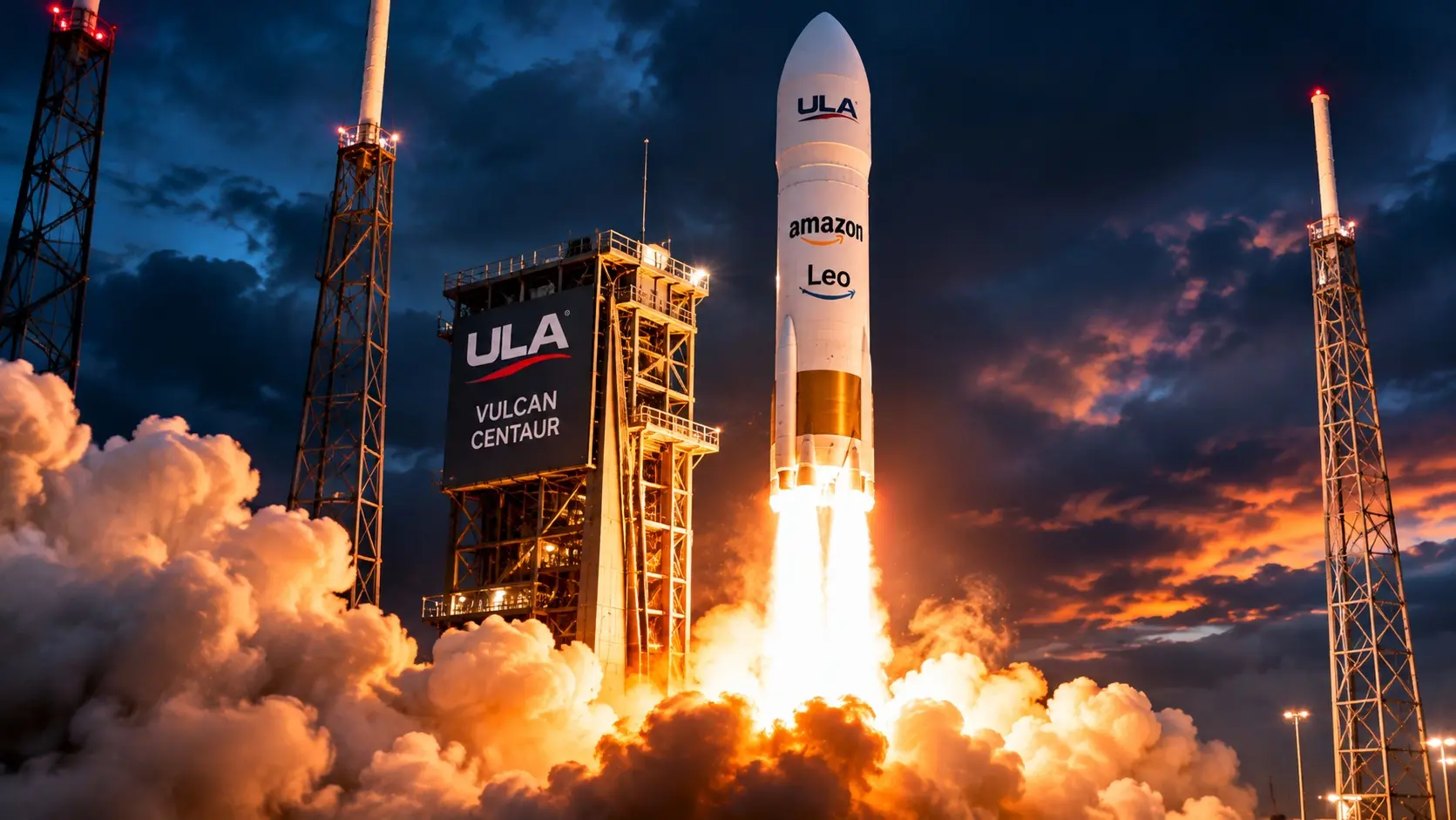
Amazon Loses 40 Satellites as Rocket Failure Threatens Its Starlink Rival
Ten Minutes Into Flight, Amazon’s Internet Ambitions Came Crashing Down.
Amazon wants to challenge SpaceX’s Starlink and fundamentally change how millions of people connect to the internet.
But on Sunday, November 15, 2026, that ambition suffered a costly setback.
A Vulcan rocket operated by United Launch Alliance (ULA) malfunctioned approximately ten minutes after lifting off from Cape Canaveral, Florida.
Its payload: 40 Amazon Leo internet satellites.
None reached orbit.
The failure marked the first complete mission loss in ULA’s 20-year history, a remarkable setback for a company known for its reliability in the space industry.
For Amazon, the loss goes beyond the satellites themselves.
It threatens to delay a multibillion-dollar effort to build a global satellite internet network capable of competing directly with SpaceX’s Starlink.
But the bigger story isn’t simply about rockets.
It’s about the future of internet connectivity, competition, and how much businesses will depend on infrastructure orbiting hundreds of miles above Earth.
What Happened to Amazon’s Rocket?
On November 15, a United Launch Alliance Vulcan Centaur rocket lifted off from Space Launch Complex 41 at Cape Canaveral Space Force Station.
The mission, called Vulcan Leo 1, was carrying 40 satellites for Amazon’s expanding broadband network.
The rocket initially appeared to be performing its planned ascent.
Its solid rocket boosters separated, and the vehicle continued toward space.
But approximately ten minutes after liftoff, something went wrong.
ULA subsequently confirmed that the rocket had experienced an anomaly and failed to deliver its payload into orbit.
The company has not yet identified the precise cause.
Investigators will analyze flight telemetry, vehicle performance, and other technical information before determining what failed.
The incident is especially significant because the rocket was returning to flight after a nine-month interruption associated with earlier technical concerns.
It was also the first of 38 Vulcan launches Amazon had contracted with ULA.
Instead of beginning a major new phase of satellite deployment, the mission ended with the loss of its entire payload.
What Is Amazon Leo?
Amazon Leo is Amazon’s satellite broadband initiative, previously known as Project Kuiper.
Its objective is to deliver high-speed internet connectivity using thousands of satellites operating in low Earth orbit.
Unlike traditional internet service delivered through underground fiber-optic cables, coaxial connections, or cellular towers, satellite internet transmits data between ground equipment and satellites overhead.
The concept isn’t new.
Satellite internet has existed for decades.
But modern low-Earth-orbit satellite networks are changing what’s technically possible.
Traditional Satellite Internet vs. Low-Earth-Orbit Internet
Older satellite internet systems often rely on satellites positioned approximately 22,000 miles above Earth’s surface.
That enormous distance creates significant communication delays.
Those delays are known as latency.
Latency affects activities such as video conferencing, remote desktop access, online gaming, and other applications requiring quick responses.
Low-Earth-orbit networks operate much closer to Earth.
Starlink satellites, for example, commonly operate at altitudes of several hundred miles.
Amazon Leo is designed around a similar general concept.
By placing large numbers of satellites in relatively low orbits, providers can reduce communication delays and deliver more responsive internet connections.
However, operating closer to Earth creates another challenge.
A single satellite covers a smaller area and moves quickly across the sky.
To provide consistent service, the network needs many satellites working together.
That’s why Amazon is planning a constellation of thousands.
How Far Along Is Amazon?
Amazon’s initial constellation is planned to include more than 3,200 satellites.
Before Sunday’s failed launch, the company had deployed approximately 400.
That means the network remains in the early stages of its planned deployment.
The failed mission would have added another 40 satellites to the constellation.
That represents roughly 10% of the satellites Amazon had already deployed.
But the more serious concern may be what happens next.
If Vulcan remains grounded during the investigation, future launches could be delayed.
And Amazon needs a sustained launch schedule to build out its planned global coverage.
Why Amazon Wants to Compete With Starlink
SpaceX has established a substantial lead in low-Earth-orbit satellite broadband.
Its Starlink network already serves customers across many parts of the world.
For consumers and businesses in areas without reliable wired broadband, satellite connectivity can offer a practical alternative.
Amazon sees an opportunity to compete in that market.
But Amazon’s ambitions extend beyond residential internet access.
The company also has a major cloud computing business through Amazon Web Services.
That creates potential opportunities to connect remote locations, business applications, cloud infrastructure, and enterprise networks.
Imagine a manufacturing facility located far from major cities.
Or a construction site without reliable fiber connectivity.
Or a retail business operating in an area where traditional internet providers offer limited service.
Satellite broadband could provide another way to connect those locations to critical business systems.
The technology may also offer additional connectivity options for emergency response, remote healthcare, maritime operations, and other environments where terrestrial networks are unavailable.
But satellite connectivity is not automatically superior to fiber.
Performance, capacity, weather sensitivity, equipment requirements, service availability, and cost all matter.
The real opportunity is giving organizations more connectivity choices.
Why Losing One Rocket Is Such a Big Problem
At first glance, losing 40 satellites may not sound catastrophic for a company planning to deploy thousands.
Amazon can manufacture replacement satellites.
And it has contracted launches with multiple providers.
But rocket launches are not interchangeable deliveries.
Each mission requires manufacturing, testing, transportation, scheduling, regulatory coordination, and launch preparation.
A failure can interrupt that entire process.
The Three Major Consequences
First: Lost hardware.
The 40 satellites represent equipment that required significant engineering, manufacturing, and testing.
The exact financial loss associated with Sunday’s mission has not been publicly established.
Second: Lost launch capacity.
Amazon has reserved dozens of launches with ULA.
If the Vulcan rocket is grounded for an extended investigation, those planned missions may need to be rescheduled.
Third: Lost time.
Amazon is competing against an established provider that continues expanding its own network.
Every delayed launch can affect Amazon’s ability to increase capacity, expand coverage, and begin serving additional customers.
For a business trying to enter a highly competitive infrastructure market, time can be extremely valuable.
What Makes This Failure Especially Significant for ULA?
United Launch Alliance was established in 2006 as a joint venture between Boeing and Lockheed Martin.
The company has spent two decades launching satellites for government, military, and commercial customers.
Its reputation has been built around reliability.
That makes Sunday’s failure particularly consequential.
The Vulcan rocket is intended to become a major launch vehicle for national security and commercial missions.
It is also central to Amazon’s satellite deployment strategy.
A failure involving such an important vehicle can affect more than the customer whose satellites were lost.
It may also influence launch scheduling for other customers while investigators determine the cause and required corrective actions.
The rocket’s earlier flights had already encountered technical concerns involving solid rocket boosters, although those missions still delivered their payloads.
However, there is currently insufficient evidence to conclude that Sunday’s failure was caused by the same problem.
That determination belongs to the ongoing investigation.
Amazon Has Other Launch Providers—but That Doesn’t Eliminate the Risk
Amazon has diversified its launch arrangements.
In addition to ULA, it has contracted missions with other providers, including SpaceX, Blue Origin, and Arianespace.
That is an important form of risk management.
If one launch provider experiences delays, others may provide additional deployment opportunities.
But diversification does not eliminate every dependency.
Launch vehicles have limited capacity.
Launch schedules can be booked far in advance.
Different rockets require different mission planning and payload integration.
And other providers can experience technical problems of their own.
In other words, Amazon has multiple ways to reach orbit.
But it cannot necessarily replace dozens of scheduled launches overnight.
This is a useful business lesson.
Having multiple suppliers reduces dependency risk. It doesn’t guarantee that one supplier’s failure will have no consequences.
What This Means for Businesses and Managed IT
At first glance, a failed rocket launch may seem unrelated to cybersecurity or managed IT services.
But the connection becomes clearer when we examine how businesses depend on infrastructure.
A modern company might rely on Microsoft 365, cloud applications, VoIP phone systems, remote access, payment processing, and online backups.
All those services depend on reliable connectivity.
If the primary internet connection fails, business operations may be disrupted.
Satellite internet introduces another possible connectivity option.
For certain organizations, it could serve as a primary connection where wired broadband is unavailable.
For others, it could provide backup connectivity.
But it also introduces a different set of dependencies.
Instead of relying exclusively on local cables and telecommunications providers, the business may depend on satellites, ground stations, network gateways, and launch schedules.
That doesn’t make satellite internet inherently unreliable.
It means the organization must understand the technology’s strengths and limitations.
The Importance of Internet Redundancy
Consider a medical office with a fiber internet connection.
The connection supports its electronic health record system, cloud-based phone service, email, and payment processing.
If construction crews accidentally cut the fiber cable, the office could lose access to critical services.
A properly designed secondary connection might allow essential operations to continue.
That backup could be a separate wired provider, a cellular connection, or satellite broadband, depending on availability and requirements.
But the backup must be configured and tested.
Simply purchasing a second internet service doesn’t guarantee automatic failover.
A business needs appropriate firewall configuration, routing policies, monitoring, and a recovery plan.
And where possible, backup connectivity should avoid sharing the same physical or operational dependencies as the primary connection.
Could Satellite Internet Eventually Replace Traditional Broadband?
For some locations, satellite broadband may become an increasingly attractive primary internet service.
But for many businesses, fiber will remain an excellent option because of its high capacity, low latency, and predictable performance.
Satellite networks face their own constraints.
They must manage limited radio spectrum, satellite capacity, ground infrastructure, and environmental conditions.
They also require expensive ongoing maintenance.
Low-Earth-orbit satellites do not remain operational indefinitely.
They eventually need to be replaced.
That means providers must continue manufacturing and launching satellites long after their initial networks are established.
Amazon’s launch failure illustrates why this is a significant operational challenge.
A satellite broadband company isn’t simply selling internet service.
It’s operating a constantly evolving infrastructure network in space.
Why Competition Between Amazon and Starlink Matters
Competition can encourage providers to improve service quality, expand coverage, and develop new technologies.
For businesses, having more than one satellite broadband provider could eventually create greater flexibility.
Organizations may be able to compare coverage, performance, service-level commitments, pricing, and integration options.
For remote locations, that could be particularly valuable.
But competition also depends on the ability of providers to deploy and maintain their networks.
SpaceX has the advantage of operating its own launch vehicles and satellite constellation.
Amazon relies on contracted launch capacity from multiple providers.
Those are different operational models, each with its own advantages and dependencies.
Sunday’s failure demonstrates one of the risks Amazon faces as it works to close the gap.
The Bigger Lesson: Infrastructure Reliability Begins Long Before the Customer Connects
Most people think about internet reliability in terms of routers, modems, cables, and service outages.
But the reliability of a satellite internet service begins much earlier.
It begins with spacecraft manufacturing.
Launch vehicle engineering.
Mission planning.
Ground infrastructure.
Network design.
And the ability to recover when something fails.
A satellite that never reaches orbit cannot provide internet service.
A constellation that expands more slowly than expected may take longer to deliver its planned coverage.
And a launch provider that must suspend operations can affect customers who depend on its future missions.
For businesses evaluating emerging technology, this is a reminder to consider not only what a service promises, but also the infrastructure and operational dependencies required to deliver it.
The Bottom Line: The Future of Internet Connectivity Is Being Built in Space
Amazon’s loss of 40 satellites is a significant setback in its effort to challenge Starlink.
The failure also creates uncertainty for ULA, whose Vulcan rocket is expected to support numerous commercial and government missions.
The cause remains under investigation.
There is no basis yet to identify a specific defective component or assign responsibility for the failure.
But the broader significance is clear.
Satellite internet is becoming an increasingly important part of global telecommunications.
For businesses in underserved locations, it could provide connectivity options that were previously impractical.
For organizations seeking greater resilience, it may eventually become another useful component of a diversified internet strategy.
And for consumers, competition between Amazon and SpaceX could help shape the future of broadband.
But getting thousands of satellites into orbit is a complicated, expensive, and technically demanding undertaking.
Amazon wants to compete with the world’s most established satellite internet network. First, it has to get its own network into space.
70% of all cyber attacks target small businesses, I can help protect yours.
#AmazonLeo #SatelliteInternet #ManagedIT #BusinessContinuity #Technology