
By
Gigabit Systems
November 16, 2026
•
20 min read
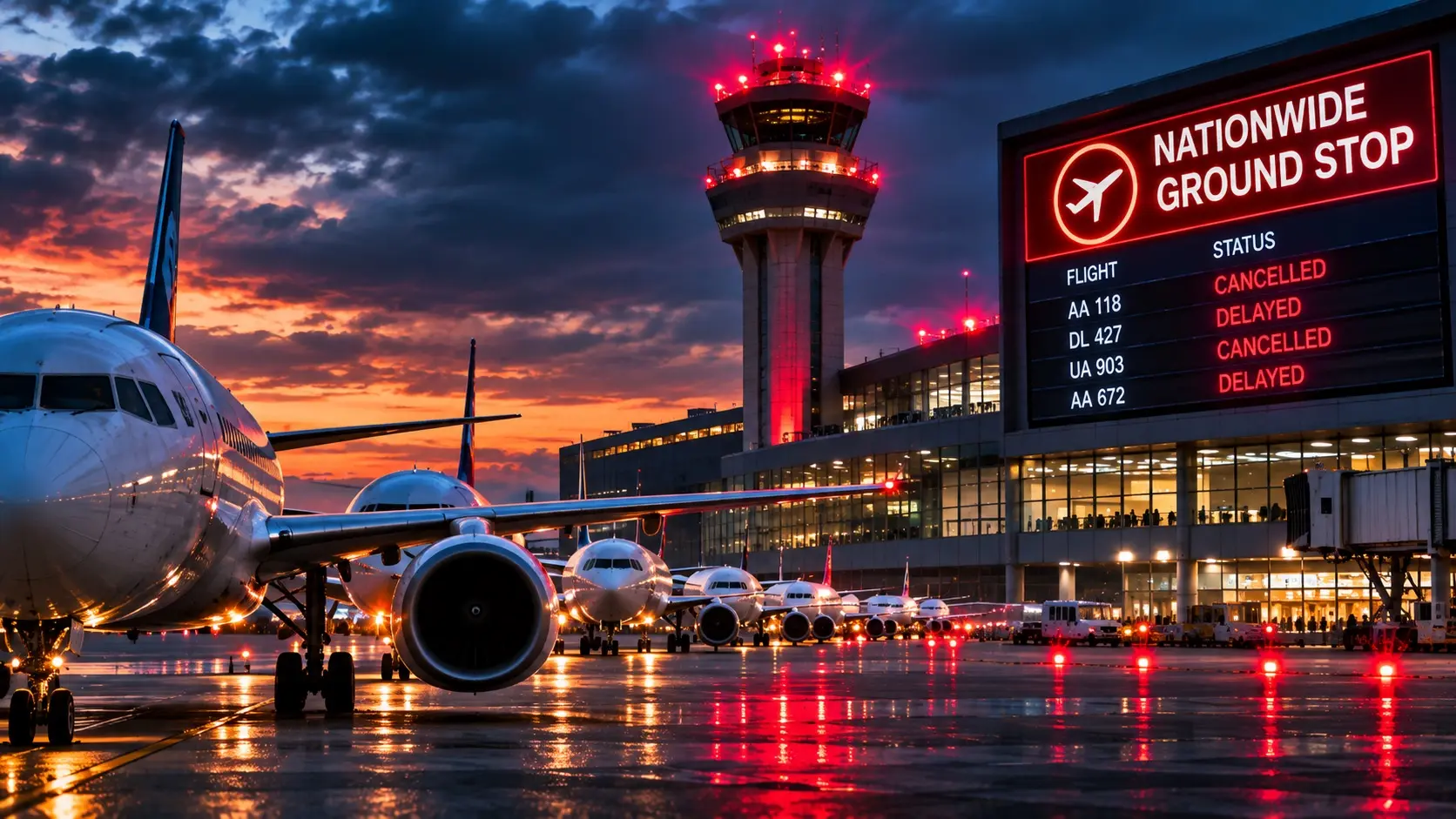
How Can One Router Ground Every Flight In America?
To understand what happened, we need to understand what a router actually does.
A router is a networking device responsible for directing information between computer networks.
Think of it as a traffic controller for digital information.
Every time one system needs to communicate with another, routers help determine where that information should go.
In a business, routers help connect computers, servers, cloud services, and internet connections.
In the FAA’s environment, telecommunications infrastructure supports the systems air traffic controllers rely on to coordinate aircraft movements.
Now imagine a highway interchange that suddenly begins sending thousands of vehicles toward the same exit.
The roads haven’t disappeared.
The cars haven’t stopped working.
But the traffic becomes so congested that normal movement is disrupted.
Something similar can happen to a computer network.
If a device begins generating excessive traffic, it can overwhelm network equipment or supporting systems.
Legitimate communications may be delayed, interrupted, or become unreliable.
In the FAA incident, investigators reported approximately 1,000 connection attempts every four to five seconds.
That traffic destabilized portions of the FAA’s telecommunications network.
And because the network supported facilities across the country, a problem originating at a remote location had nationwide consequences.
The router wasn’t necessarily the most important piece of equipment in the network. But its failure affected systems that were critically important.
Why Was the FAA Replacing the Equipment?
The incident occurred during routine work to modernize aging telecommunications infrastructure.
For decades, many communication networks relied on copper wiring and older transmission technologies.
Today, most organizations have transitioned to fiber-optic connections and modern internet-based networking.
Fiber provides substantial advantages in capacity, performance, and long-term scalability.
But transitioning between older and newer technologies introduces complexity.
The FAA was replacing aging copper telecommunications connections with fiber at the Arkansas location.
Government contractor L3Harris was performing the work.
According to Transportation Secretary Sean Duffy, the transition involved moving from older time-division multiplexing technology, commonly called TDM, toward modern IP-based communications.
The process itself is not unusual.
Businesses have been making similar transitions for decades.
But the FAA’s infrastructure is unusually complex because it must support critical communications across an enormous geographic area.
The exact technical failure remains under investigation.
What is clear is that a routine infrastructure change triggered instability far beyond the location where the work was performed.
The Bigger Problem: Aging Infrastructure and Modern Technology
This incident exposes a challenge that exists in organizations of every size.
Businesses frequently modernize individual pieces of their infrastructure while leaving other components unchanged.
A company might install a new firewall but continue using an old core switch.
It might migrate its email to Microsoft 365 while maintaining a legacy authentication server.
Or it might replace copper networking with fiber while retaining older applications and communications systems.
Each upgrade may appear relatively straightforward.
But modern and legacy technologies must still work together.
And when dependencies are poorly understood, even routine changes can produce unexpected results.
The danger isn’t simply that old equipment can fail. It’s that changing one part of an aging environment can expose weaknesses throughout the entire system.
Why Didn’t the FAA’s Backup Systems Prevent the Disruption?
This is perhaps the most important technical question.
Large organizations invest in redundant systems so that the failure of one component doesn’t bring down an entire operation.
But redundancy is not the same as resilience.
Imagine a business with two internet connections.
One connection comes from Verizon.
The other comes from Optimum.
Management assumes the company is protected because it has two independent providers.
But both connections feed into the same firewall.
If that firewall fails, both internet connections become useless.
The business has redundant internet service but still has a single point of failure.
The same concept can apply to enterprise networks.
An organization may have multiple routers, servers, or communication links.
But if they all depend on the same underlying service or share the same vulnerability, one problem can affect them simultaneously.
This is called a common-mode failure.
The FAA has not yet published a complete technical explanation of why the network instability propagated so widely.
But the incident demonstrates why redundancy must be tested against realistic failure scenarios.
Simply having backup equipment isn’t enough.
The Business Lesson: One Bad Network Change Can Shut Down Everything
Imagine a medical practice with 40 employees.
Its IT provider schedules a firewall replacement.
The new firewall is installed, but a configuration problem prevents the practice’s computers from communicating with its cloud-based medical records system.
Suddenly, staff cannot access patient information.
Appointments are delayed.
Billing systems become unavailable.
The internet connection itself may be functioning perfectly.
But the network isn’t operating correctly.
Or consider a law firm replacing its network switches.
An incorrect configuration creates a network loop that generates excessive traffic.
Computers begin losing connectivity.
Phones stop registering.
Document management applications become inaccessible.
The problem isn’t ransomware.
It isn’t a hacker.
It’s a routine technology change that went wrong.
And from the business owner’s perspective, the consequences can be just as disruptive.
What Is a Network Broadcast Storm?
One useful concept for understanding this category of failure is a broadcast storm.
In some networks, devices send messages intended for multiple systems.
If those messages are repeatedly forwarded or generated excessively, network traffic can grow rapidly.
That can consume bandwidth and processing resources, making normal communications unreliable.
Think of a conference room where everyone begins speaking simultaneously.
Nobody can hear the person they need to speak with.
Network engineers use controls such as loop prevention, storm control, rate limiting, and traffic segmentation to reduce these risks.
However, the FAA has not confirmed that its incident was a conventional Ethernet broadcast storm.
The reported failure involved excessive connection attempts and network flooding.
The distinction matters because different technical mechanisms require different corrective measures.
The broader lesson is that uncontrolled network traffic can destabilize critical systems even without a malicious attack.
Why the FAA Disabled Dozens of Similar Routers
Following the incident, officials disabled the problematic broadcasting functionality across similar routers in the FAA network.
Transportation Secretary Duffy said 69 routers of the relevant type were involved.
The purpose was to prevent similar traffic from destabilizing the network while investigators determined the underlying cause.
This is an example of containment.
Cybersecurity professionals use containment when responding to malware infections and unauthorized access.
But containment is equally important during nonmalicious infrastructure failures.
When a component is behaving unpredictably, administrators may need to isolate it, disable a feature, or revert a configuration before completing the investigation.
The priority is restoring stability and preventing the problem from spreading.
Five Questions Every Business Owner Should Ask Their IT Provider
The FAA incident presents an opportunity for businesses to evaluate their own resilience.
1. What Happens if Our Main Firewall Fails?
Does the business have a replacement available?
Is there a high-availability configuration?
How long would restoration take?
2. Do We Have a Documented Network Diagram?
Your IT provider should understand how the internet connections, firewalls, switches, wireless networks, servers, and critical applications depend on one another.
Without accurate documentation, troubleshooting becomes significantly more difficult.
3. How Are Major Changes Tested?
Firewall replacements, switch upgrades, internet migrations, and server changes should follow documented procedures.
Those procedures should include backups, validation steps, maintenance windows, and rollback plans.
4. Are Our Backup Systems Truly Independent?
A secondary internet connection may not provide meaningful protection if it depends on the same equipment as the primary connection.
Likewise, two servers may not provide resilience if both depend on a single storage system.
5. How Quickly Can We Recover?
Businesses should establish realistic recovery objectives.
For example, if the network goes down at 10:00 AM, can critical operations resume within 30 minutes?
Two hours?
The next business day?
The answer should be based on tested capabilities, not assumptions.
The Importance of Change Management
One of the most overlooked disciplines in managed IT is formal change management.
It sounds complicated, but the concept is straightforward.
Before making a significant technology change, an IT team should understand what is being modified, what systems depend on it, and what could go wrong.
A proper change process should include:
Document the existing environment. Understand the current configuration and dependencies.
Identify the potential impact. Determine which users, applications, and services could be affected.
Back up configurations. Preserve the ability to restore the previous working state.
Schedule appropriately. Perform disruptive work during an approved maintenance window whenever practical.
Prepare a rollback plan. Establish how to reverse the change if problems occur.
Monitor the results. Verify that critical systems remain stable after implementation.
Document the outcome. Record what changed and any issues encountered.
Not every failure can be predicted.
But disciplined change management reduces the likelihood that a routine upgrade becomes a business-wide emergency.
Why Cybersecurity and IT Reliability Are Connected
Cybersecurity is often discussed in terms of preventing unauthorized access.
But information security has three fundamental objectives:
Confidentiality: Preventing unauthorized disclosure of information.
Integrity: Ensuring information and systems remain accurate and trustworthy.
Availability: Ensuring authorized users can access systems and information when needed.
The FAA incident primarily illustrates an availability failure.
The system became unreliable enough that officials suspended departures as a safety precaution.
No attacker was required.
No ransomware was necessary.
And there is no current evidence of sabotage.
Yet the disruption affected airlines, airports, travelers, employees, and businesses across the country.
This is why effective cybersecurity must include infrastructure reliability, disaster recovery, and business continuity planning.
A secure system that cannot stay operational is not meeting the needs of the business it was built to protect.
What Healthcare, Law Firms, Schools, and SMBs Should Learn
For healthcare organizations, network availability can affect patient scheduling, medical records, and communications.
For law firms, an outage can interrupt access to case files, email, and time-sensitive court-related work.
For schools, failed networking infrastructure can disrupt administrative systems, classroom technology, and communications.
For manufacturers, an improperly configured network device can interrupt production systems and operational technology.
And for small businesses, even a few hours without reliable connectivity can mean lost revenue, frustrated customers, and employees unable to work.
The lesson is not that every business needs the same infrastructure as a national aviation network.
It’s that every organization needs to understand which systems are critical and what happens when those systems fail.
The Bottom Line: It Doesn’t Take a Hacker to Shut Down a Network
The FAA’s nationwide disruption began with an apparent technical failure during routine telecommunications work.
Investigators are still determining exactly what went wrong.
But the operational consequences are already clear.
A problem associated with remote networking equipment destabilized systems used across much of the country’s air traffic control infrastructure.
Thousands of flights were canceled or delayed.
Travelers were stranded.
And the aviation industry spent days recovering.
For businesses, this is a powerful reminder that technology resilience cannot be an afterthought.
Document your infrastructure.
Eliminate unnecessary single points of failure.
Test your backups and failover systems.
Implement disciplined change management.
And make sure your IT provider understands not only how to keep your systems secure, but how to keep them running.
The most expensive IT failure may not come from a cybercriminal. It may come from a routine change nobody expected to go wrong.
70% of all cyber attacks target small businesses, I can help protect yours.
#ManagedIT #Cybersecurity #NetworkInfrastructure #BusinessContinuity #ITResilience