
By
Gigabit Systems
November 12, 2026
•
20 min read
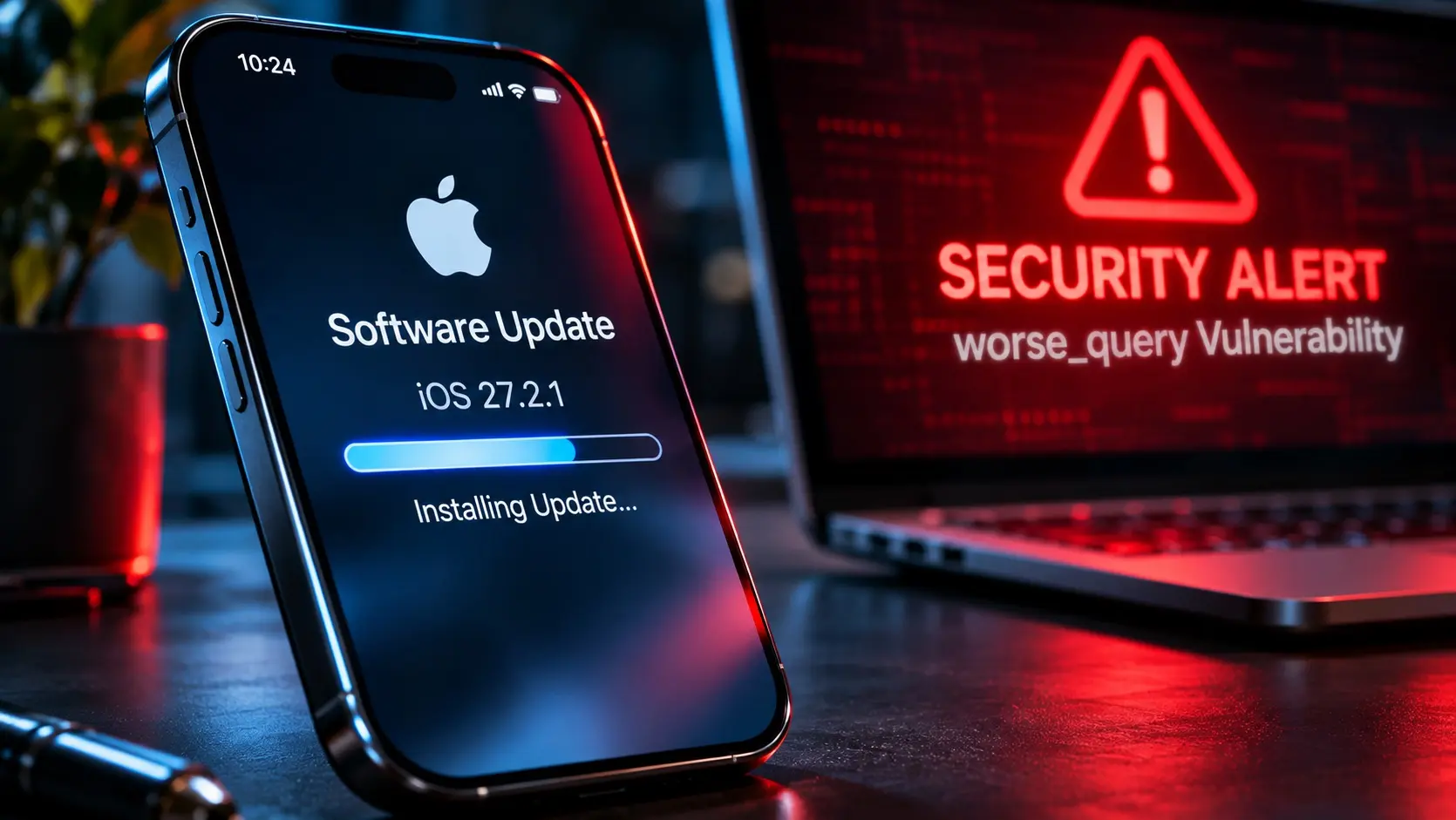
Update Your iPhone: A New Security Flaw Could Expose Your Private Data
Your iPhone’s Security Walls May Not Be Protecting Everything.
For years, Apple has promoted the iPhone as one of the most secure consumer devices available.
One of its most important protections is something most users have never heard of: application sandboxing.
It’s the technology that prevents one application from accessing another application’s private information.
Your weather app shouldn’t be able to read your banking data.
A game shouldn’t be able to access confidential documents stored by another application.
And an unfamiliar application shouldn’t be able to inspect the private files belonging to your cryptocurrency wallet.
That’s how the system is supposed to work.
But a newly disclosed iOS vulnerability called worse_query is raising serious questions about those protections.
On November 10, 2026, cryptocurrency exchange Binance warned iPhone users that the vulnerability could allow malicious applications to access files belonging to other applications.
Potentially exposed information could include cryptocurrency recovery phrases, private keys, login credentials, and other locally stored data.
And this isn’t a vulnerability limited to Binance.
The weakness exists in iOS itself, meaning its potential impact extends across the Apple application ecosystem.
The good news is that there are currently no confirmed reports of cryptocurrency theft linked to this vulnerability.
The concerning news is that the exploit has been publicly demonstrated, and a confirmed Apple fix has not yet been announced.
What Exactly Is worse_query?
The vulnerability was publicly disclosed by a security researcher using the name forcequitOS.
On November 8, the researcher published proof-of-concept code on GitHub demonstrating a way to bypass certain iOS application sandbox restrictions.
The project is called worse_query and is described as the successor to an earlier technique known as bad_query.
To understand why this matters, consider how applications normally operate on an iPhone.
How Apple’s Sandbox Is Supposed to Work
Imagine an office building containing hundreds of individual offices.
Each office has its own locked door.
Employees can access their own offices, but they cannot simply walk into another company’s office and open its filing cabinets.
That’s essentially how iOS application sandboxing works.
Each application receives a restricted environment where it can store information and perform its assigned functions.
The operating system controls access between those environments.
An application generally cannot read another application’s private files unless a specific authorized mechanism permits it.
This is one of the reasons iPhones have historically offered strong protection against certain categories of malicious software.
What worse_query Changes
The worse_query technique exploits weaknesses involving iOS file-container management and shared application storage.
According to the researcher’s published proof of concept, an application can manipulate how certain file locations are resolved and gain access to storage directories that should normally be restricted.
That potentially allows one application to read files belonging to other applications.
The publicly demonstrated technique reaches application data containers and certain shared storage locations.
The vulnerability does not automatically provide unrestricted access to every secret on an iPhone.
Information protected by separate encryption mechanisms, hardware-backed security, or appropriate application-level controls may remain protected.
But applications that store sensitive information in accessible local files could be exposed.
The security boundary that normally separates one application from another can no longer be assumed to hold under the demonstrated conditions.
Why Binance Is Warning Cryptocurrency Users
Cryptocurrency wallets introduce a particularly serious risk because some secrets can provide direct control over financial assets.
To understand the danger, you need to understand two terms.
Private Keys
A private key is a cryptographic secret used to authorize transactions from a cryptocurrency wallet.
If an attacker obtains the relevant private key, they may be able to transfer assets without the legitimate owner’s permission.
Seed Phrases
A seed phrase, also called a recovery phrase, is typically a sequence of words used to restore access to a cryptocurrency wallet.
Depending on the wallet, it may consist of 12 or 24 words.
Those words are extremely sensitive.
Someone who obtains the recovery phrase may be able to reconstruct the wallet and access its funds.
Unlike a traditional bank account, there may be no centralized institution capable of reversing an unauthorized blockchain transaction.
This is why Binance’s warning deserves attention.
If a malicious application can access a wallet’s locally stored recovery information, the consequences could be severe.
However, not every cryptocurrency wallet stores seed phrases or private keys in ordinary readable files.
Some use the iPhone’s Keychain, hardware-backed protections, encryption, or additional authentication controls.
The actual exposure depends on how the wallet was designed and how it protects sensitive information.
A vulnerability that allows access to application files does not automatically mean every cryptocurrency wallet can be emptied.
But it creates a potentially dangerous path for attackers when sensitive information is inadequately protected.
Which iPhones Are Affected?
The researcher’s GitHub repository identifies affected software in the iOS 26 and iOS 27 families.
The documented range includes iOS 26.0 through 26.7.2 and iOS 27.2.
Binance specifically identified iOS 26.7.1, 27.0.1, and 27.2 in its warning.
The researcher has also reported that the technique remains functional on iOS 27.2.1 and the first iOS 27.3 beta.
That creates an important complication.
Apple released iOS 27.2.1 on November 9, 2026, addressing several security vulnerabilities.
But Apple’s published security notes do not identify worse_query as one of the resolved issues.
As of November 11, there is no confirmed Apple security advisory establishing that the vulnerability has been fixed.
You should still install the latest official iOS security updates. But updating alone should not be treated as proof that worse_query has been eliminated.
Does This Mean Someone Can Hack Your iPhone Just by Visiting a Website?
Not based on the publicly demonstrated technique alone.
This is an important distinction because alarming cybersecurity headlines can create unnecessary confusion.
The reported worse_query technique involves an application operating on the device.
The researcher’s proof of concept requires specific application capabilities involving shared application storage.
In practical terms, the concern is that someone installs or runs a malicious application capable of exploiting the weakness.
The publicly documented technique is not, by itself, a demonstration that visiting an ordinary website remotely compromises an iPhone.
It is also not a traditional jailbreak.
A jailbreak generally involves bypassing multiple iOS restrictions to gain broader control over the operating system.
Worse_query focuses on escaping particular application sandbox restrictions.
That distinction matters when evaluating how an attack might occur.
The Real Danger: A Malicious App You Thought Was Harmless
Imagine downloading a seemingly ordinary utility application.
Perhaps it’s a document converter, file manager, productivity tool, or unofficial version of a popular application.
The app appears to work normally.
But behind the scenes, malicious functionality attempts to access information stored by other applications.
If the device is vulnerable and the attack succeeds, the malicious app could potentially obtain information it was never supposed to see.
That might include locally stored authentication material, application data, or other sensitive files.
The attacker could then attempt to transmit the information elsewhere.
The public research does not establish that every application can successfully exploit the vulnerability under all circumstances.
But it demonstrates why installing software from untrusted sources creates additional risk.
And because the exploit technique is now public, other researchers and attackers can study it.
The availability of proof-of-concept code does not prove widespread exploitation.
It does, however, increase the importance of appropriate defensive measures.
Why This Matters Beyond Cryptocurrency
The cryptocurrency implications have attracted the most attention because financial losses can be immediate and irreversible.
But the underlying security issue has broader implications.
Modern smartphones contain enormous amounts of personal and professional information.
Consider the applications on a typical business owner’s iPhone.
Microsoft Outlook.
Microsoft Teams.
OneDrive.
Banking applications.
Password managers.
Customer relationship management platforms.
Document management systems.
Cloud storage applications.
Even if those applications implement strong security controls, a weakness in the operating system’s isolation mechanisms deserves attention.
The potential consequences depend on what each application stores locally and whether that information is independently protected.
An attacker obtaining an encrypted file is not necessarily equivalent to obtaining the information inside it.
Similarly, reading an application’s local data does not automatically provide access to its cloud accounts.
But local files can sometimes contain authentication tokens, cached information, configuration details, or other material useful to an attacker.
The more sensitive information we carry on our phones, the more important the operating system’s security boundaries become.
What Small Businesses Need to Understand
Many organizations have invested heavily in protecting their computers and servers.
They deploy endpoint detection, multifactor authentication, email security, backup systems, and access controls.
But smartphones often receive less attention.
Employees use personal and company-issued iPhones to access corporate email, confidential documents, cloud applications, and internal systems.
Some organizations allow employees to install applications without meaningful oversight.
That creates a potential security gap.
A compromised mobile application may become a pathway to sensitive information that would otherwise be protected inside a corporate environment.
For managed IT providers and cybersecurity professionals, this incident reinforces the importance of mobile device security.
A smartphone is not simply a communication device.
It is a fully functional endpoint with access to valuable business systems and confidential information.
And it deserves appropriate protection.
Healthcare, Law Firms, and Schools Face Additional Concerns
Healthcare Organizations
Healthcare employees may access scheduling systems, patient communications, and clinical applications through mobile devices.
Any weakness that could expose locally stored application information should be evaluated carefully.
Organizations should confirm that sensitive data is appropriately encrypted, access is restricted, and mobile devices comply with security policies.
Law Firms
Attorneys frequently use smartphones to review confidential communications, client documents, and case-related information.
The possibility of cross-application file access reinforces the importance of managed devices, approved applications, and strong authentication.
Schools
School administrators and staff may use mobile devices to access student records, internal communications, and educational platforms.
Mobile application controls and device management should form part of the organization’s broader cybersecurity program.
Across all three sectors, the lesson is consistent.
Security cannot stop at the desktop.
Seven Steps Every iPhone User Should Take
1. Update iOS Immediately
Open:
Settings → General → Software Update
Install the latest official update available for your device.
Even though a fix for worse_query has not been confirmed, current updates address other known vulnerabilities.
Keeping your device updated remains essential.
2. Remove Applications You Don’t Trust
Review the applications installed on your iPhone.
Pay particular attention to software installed outside normal trusted distribution channels, including manually signed or sideloaded application packages.
Delete applications you no longer need or cannot verify.
Remember that the App Store’s review process reduces certain risks but does not guarantee that every application is harmless.
3. Update Your Applications
Open the App Store and review available updates.
Application developers may improve how they store and protect sensitive information.
Updating apps can help ensure you receive those protections.
4. Protect Cryptocurrency Recovery Phrases
Never store cryptocurrency seed phrases in ordinary notes, screenshots, unencrypted documents, or other easily accessible files.
Consider appropriate offline backup methods and reputable hardware wallets for significant holdings.
Do not enter recovery phrases into websites or applications unless you have independently verified that doing so is necessary and legitimate.
5. Review Your Business Device Security
If your iPhone accesses company email, cloud storage, or internal applications, follow your organization’s mobile device policies.
Businesses should consider mobile device management, application restrictions, device compliance requirements, and conditional access controls.
6. Take Suspected Compromise Seriously
If you believe a malicious application has accessed your information, remove the device from sensitive workflows and contact your IT or security provider.
For cryptocurrency wallets, Binance recommends transferring assets to a new wallet created on a clean device when compromise is suspected.
Resetting active sessions and reviewing account security may also be necessary.
Do not generate replacement wallet credentials on a device you believe remains compromised.
7. Watch for Apple’s Confirmed Security Fix
Monitor official Apple security updates.
When Apple confirms that worse_query has been addressed, install the relevant update promptly.
Until then, avoid assuming that any specific iOS version is immune solely because it is the latest release.
What Businesses Should Do Right Now
For organizations managing multiple iPhones, this is an opportunity to review mobile security policies.
IT administrators should identify devices running affected software versions and ensure that supported security updates are installed.
They should also evaluate whether employees can install unapproved applications.
Where appropriate, mobile device management solutions can enforce application restrictions, minimum operating system versions, and compliance requirements.
Organizations should review how sensitive business applications store authentication information and cached data.
They should also maintain procedures for revoking sessions and credentials when a mobile device is suspected of being compromised.
For Microsoft 365 environments, conditional access policies and managed-device requirements can provide additional protection against unauthorized access.
However, these controls do not directly repair an operating system vulnerability.
They reduce the potential consequences of compromised devices and credentials.
That is an important distinction.
Has Anyone Actually Been Hacked?
As of November 11, 2026, there are no confirmed public reports of cryptocurrency theft directly attributed to worse_query.
That matters.
A demonstrated vulnerability is not the same as a documented campaign of active attacks.
Security researchers regularly publish proof-of-concept code to demonstrate weaknesses and encourage remediation.
The public availability of an exploit does not establish that attackers are already using it successfully against victims.
But organizations should not wait for confirmed financial losses before taking reasonable precautions.
The correct response is to evaluate the exposure, reduce unnecessary risk, and monitor for confirmed fixes and evidence of exploitation.
The Bigger Picture: Apple’s Security Is Strong, but Not Invulnerable
Apple’s application sandbox remains an important security mechanism.
Its existence significantly limits what ordinary applications can do.
But no operating system is immune to vulnerabilities.
Security depends on multiple layers working together.
Application sandboxing.
Encryption.
Secure credential storage.
Hardware-backed protections.
Application permissions.
Operating system updates.
And user decisions about which software to install.
When one layer fails, the remaining protections become especially important.
That is why sensitive information should never depend on a single security mechanism.
The Bottom Line: Your Phone Holds Too Much to Ignore This Warning
The worse_query vulnerability illustrates how a weakness in a fundamental operating system protection can create risks across many different applications.
Binance’s warning focuses on cryptocurrency because exposed private keys or recovery phrases could result in serious financial losses.
But the underlying lesson applies to anyone using an iPhone to store or access sensitive information.
Update your device.
Remove untrusted applications.
Protect sensitive credentials.
Follow appropriate business mobile security policies.
And watch for Apple’s confirmed remediation.
There is no evidence that every iPhone has been compromised.
There is also no reason to dismiss a publicly demonstrated security weakness simply because confirmed attacks have not yet been reported.
Your iPhone doesn’t have to be completely hacked for one malicious application to become a serious problem.
The security of your most important information may depend on protections you never knew existed.
And right now, one of those protections is under scrutiny.
70% of all cyber attacks target small businesses, I can help protect yours.
#iPhoneSecurity #Cybersecurity #AppleSecurity #MobileSecurity #ManagedIT