
By
Gigabit Systems
November 11, 2026
•
20 min read
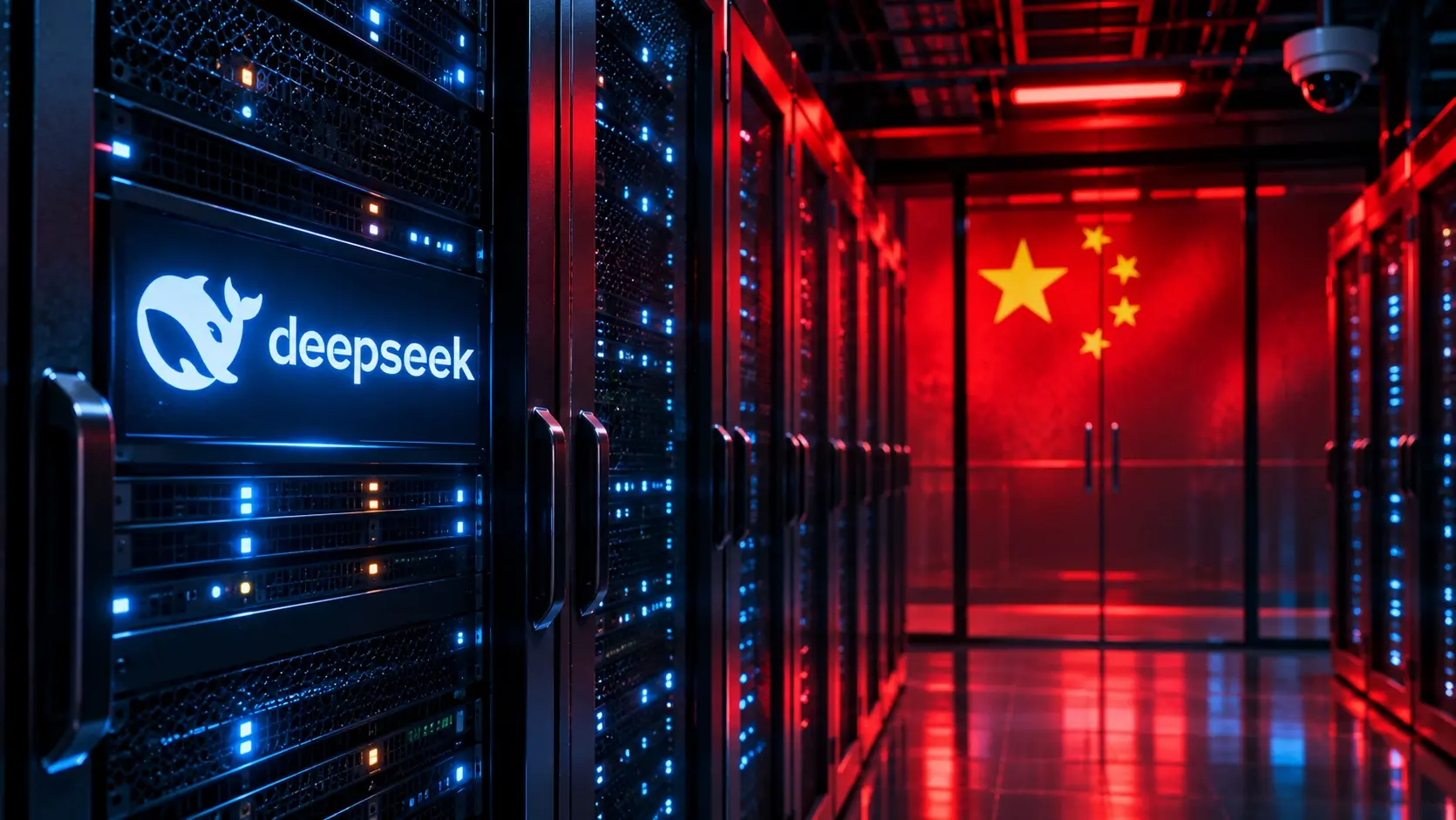
Who Really Owns DeepSeek? The Chinese AI Company Raising Billions of Dollars and Serious Security Questions
This AI Is Cheap. Your Data May Be the Bigger Cost.
When DeepSeek burst onto the global artificial intelligence scene in January 2025, it accomplished something few technology companies have ever managed.
It shook Wall Street, challenged the economics of artificial intelligence, and forced some of the world’s most valuable technology companies to reconsider how much money they needed to spend developing powerful AI systems.
The Chinese company’s DeepSeek-R1 model demonstrated that sophisticated AI capabilities could be delivered using techniques designed to reduce computing costs.
Investors reacted dramatically.
On January 27, 2025, Nvidia lost approximately $589 billion in market value in a single trading session as investors reconsidered assumptions about future demand for expensive AI hardware.
DeepSeek had become a serious competitor.
But behind the impressive technology lies another important story.
Who owns DeepSeek, who finances it, and what happens to the information users share with its AI?
Those questions have become increasingly important as DeepSeek attracts major Chinese investors, including technology companies and state-backed institutions.
For individuals, the concern is personal privacy.
For businesses, it involves confidential information, intellectual property, regulatory obligations, and cybersecurity.
And the answers deserve more attention than DeepSeek’s remarkably low prices.
Who Owns DeepSeek?
DeepSeek was founded in 2023 by .
Liang is a Chinese entrepreneur and engineer who studied at Zhejiang University and previously helped establish High-Flyer, a quantitative hedge fund.
High-Flyer uses mathematical models, computing infrastructure, and artificial intelligence to support investment strategies.
The hedge fund’s resources and technical expertise played an important role in DeepSeek’s early development.
Unlike many AI startups that depend heavily on outside investors from the beginning, DeepSeek initially benefited from its founder’s existing financial and computing resources.
That helped the company pursue advanced AI research before becoming internationally famous.
However, DeepSeek’s ownership and financing structure has evolved significantly.
In 2026, the company attracted billions of dollars in new investment.
Reports from The Information describe major financial backing from Chinese technology companies and state-linked investment organizations.
Among the reported investors are Tencent, battery manufacturer CATL, and China’s National Artificial Intelligence Industry Investment Fund.
A June 2026 financing reportedly raised more than $7 billion through an unusual structure designed to preserve Liang’s control.
An October 2026 report described another financing round approaching $16 billion, involving additional corporate and state-backed participants.
The exact ownership percentages and voting arrangements are not fully available through independently verified public disclosures.
But the central distinction is important.
DeepSeek is not simply a government-owned AI company. It is a Chinese company founded and led by Liang Wenfeng, with substantial private-sector investment and reported state-backed participation.
And ownership alone does not tell the entire story.
Where a company operates, which laws govern it, and how it handles user information can matter just as much as who owns its shares.
Why DeepSeek Became Such a Big Deal
To understand the attention surrounding DeepSeek, consider the economics of artificial intelligence.
Developing and operating advanced AI models requires enormous computing resources.
Major AI companies invest heavily in specialized processors, data centers, electricity, networking equipment, and research.
For years, the assumption was that building increasingly capable AI systems would require increasingly expensive infrastructure.
DeepSeek challenged that assumption.
Its researchers developed techniques that allowed their models to use computing resources more efficiently.
One of those techniques is called Mixture of Experts, or MoE.
What Is Mixture of Experts?
Imagine a large company employing hundreds of specialists.
One specializes in mathematics.
Another specializes in programming.
Another handles language.
Another focuses on scientific problems.
When a customer asks a question, the company doesn’t need every specialist working on the answer.
It selects the experts most relevant to the task.
Mixture of Experts follows a similar principle.
Rather than activating every component of a large AI model for every request, the system activates selected components.
That can significantly reduce the computing resources required to generate a response.
DeepSeek has also used techniques involving reinforcement learning, model distillation, and hardware optimization.
The combined effect has helped it deliver competitive AI capabilities at relatively low operating costs.
But an important distinction is often overlooked.
Lower reported training or inference costs do not necessarily represent the full cost of developing, researching, and operating an AI platform.
Training runs, earlier experiments, hardware purchases, engineering salaries, and infrastructure investments can all contribute to the total expense.
DeepSeek’s efficiency achievements are significant without assuming that every published cost comparison represents the complete financial picture.
DeepSeek’s Newer Models Are Making AI Even Cheaper
DeepSeek continued developing its technology throughout 2026.
In April, it introduced the V4 family, including V4-Pro and V4-Flash.
In September, the company announced V4.1-Flash, an updated architecture designed to deliver stronger capabilities with reduced computing requirements.
According to DeepSeek, V4.1-Flash uses a large Mixture-of-Experts architecture while activating only a fraction of its total parameters for individual processing tasks.
The company also reported significant reductions in the memory and storage requirements associated with processing long conversations.
Those improvements matter because operating costs can determine whether businesses can afford to deploy AI across hundreds or thousands of workflows.
For example, a company using AI to summarize 100 documents might not notice a modest difference in processing costs.
A company processing millions of documents could see substantial financial implications.
But lower cost should not be the only purchasing consideration.
The cheapest AI model is not necessarily the most appropriate AI service for confidential business information.
The Question Businesses Should Ask: Where Does the Data Go?
This is where DeepSeek’s cybersecurity implications become particularly important.
When you use an online AI chatbot, the information you enter may be transmitted to the service provider’s infrastructure.
That can include questions, documents, uploaded files, code, and other information.
DeepSeek’s published privacy policy states that information collected through its services may be processed and stored on servers in the People’s Republic of China.
That is not speculation.
It is disclosed in the company’s own documentation.
For an individual asking about a recipe or requesting help writing a birthday greeting, that may not be especially concerning.
For a business uploading customer records, confidential contracts, internal financial statements, or proprietary source code, it creates a substantially different risk profile.
The issue isn’t that every interaction with DeepSeek is necessarily exposed or misused.
The issue is that organizations must understand the jurisdiction, data-handling practices, and legal obligations associated with the service they use.
Once confidential information is uploaded to a third-party AI service, your organization may no longer have exclusive control over where that information is processed or retained.
Why Chinese Jurisdiction Matters
Companies operating in China are subject to Chinese laws and regulatory requirements.
Those requirements differ from the legal frameworks governing companies in the United States and other countries.
This raises legitimate questions about government access to data, lawful disclosure obligations, regulatory oversight, and the ability of foreign users to enforce privacy rights.
However, it is important to distinguish between potential legal access and evidence that a particular conversation has actually been accessed.
DeepSeek’s Chinese jurisdiction creates considerations that organizations should evaluate.
It does not establish that every user’s information is automatically delivered to Chinese authorities.
The appropriate response is a documented risk assessment based on the data involved, the service architecture, and the organization’s legal obligations.
For businesses subject to contractual confidentiality requirements, data residency restrictions, or industry regulations, these considerations may be decisive.
The Difference Between Using DeepSeek’s Website and Running Its Models Privately
One of the most important distinctions in this discussion is frequently overlooked.
DeepSeek’s AI models and DeepSeek’s hosted chatbot are not necessarily the same security proposition.
Some DeepSeek models are available with downloadable model weights.
That means technically capable organizations may be able to deploy compatible models within infrastructure they control.
For example, a business could potentially operate a supported DeepSeek model on its own servers or through a carefully selected hosting provider.
In that arrangement, the organization may be able to keep its prompts and documents within its chosen environment.
But that requires proper configuration and validation.
A model downloaded from a public repository does not automatically become secure simply because it runs locally.
Organizations must still consider software supply-chain risks, dependencies, model behavior, access controls, infrastructure security, and licensing requirements.
And a third-party service offering DeepSeek models may have its own data collection and retention policies.
The important question is not merely which AI model is being used.
It’s who operates the infrastructure, who can access the information, and which security controls govern the environment.
Five Real-World Risks for Businesses
1. Employees Uploading Confidential Documents
Imagine an employee at a law firm using DeepSeek to summarize a confidential client agreement.
The employee uploads the complete document.
The AI produces a useful summary in seconds.
But the document may now have been transmitted to a third-party service that the firm never approved.
The employee may have unintentionally created a confidentiality problem while trying to save time.
2. Exposure of Customer Information
A small business owner wants help analyzing sales trends.
They upload a spreadsheet containing customer names, email addresses, purchase histories, and financial information.
Even if the intended task is harmless, the upload may expose personal information to an external processor.
Depending on the data and applicable requirements, that could create contractual or regulatory concerns.
3. Intellectual Property and Source Code
Software developers increasingly use AI to review code, troubleshoot errors, and suggest improvements.
But proprietary source code may contain confidential algorithms, internal infrastructure details, credentials, or security-sensitive information.
Uploading that code to an unapproved AI service could expose valuable business information.
4. AI-Generated Answers That Reflect Content Restrictions
DeepSeek’s hosted services operate within a regulatory environment that can affect how the system responds to certain subjects.
Users may encounter refusals, omissions, or constrained answers concerning politically sensitive topics.
That creates an information-integrity consideration.
Businesses using AI for research, geopolitical analysis, or other sensitive subjects should verify important claims against independent sources.
This concern is not unique to DeepSeek. All AI systems can exhibit biases, limitations, and inaccuracies.
5. Unmanaged AI Applications
Employees may install AI applications or use web-based services without notifying their IT department.
This is often called Shadow AI.
It resembles the longstanding problem of Shadow IT, where employees adopt unauthorized applications to complete work more conveniently.
The danger is not necessarily malicious intent.
It’s the absence of security review, centralized oversight, data classification, and approved usage policies.
An employee may believe they’re simply using a helpful productivity tool.
The organization may see an unauthorized pathway for confidential information to leave its environment.
What Healthcare Organizations, Law Firms, and Schools Should Know
Certain industries face particularly sensitive risks.
Healthcare: Patient information should not be uploaded to an AI service without confirming that the processing arrangement satisfies applicable privacy, security, and contractual requirements. Consumer AI access does not automatically establish HIPAA compliance.
Law firms: Attorneys must consider confidentiality obligations, privilege, client expectations, and professional responsibility requirements before sharing matter-related information with external AI services.
Schools: Student records and other protected information require careful evaluation under applicable privacy laws and organizational policies.
Financial services: Customer financial information, account details, internal risk assessments, and regulated records may be subject to additional security and data-handling obligations.
The appropriate solution isn’t necessarily to prohibit all AI use.
It’s to establish approved services, define permissible information, and enforce appropriate controls.
How Businesses Can Use AI Without Unnecessarily Exposing Their Data
The goal should be to benefit from artificial intelligence without sacrificing cybersecurity.
Here are six practical safeguards.
1. Establish an Approved AI Policy
Identify which AI platforms employees may use for business purposes.
Explain which information can and cannot be entered into those systems.
Include customer information, employee records, confidential contracts, financial data, and intellectual property.
2. Classify Information Before Uploading It
Not all information requires the same level of protection.
Public marketing materials may be appropriate for a wide range of AI services.
Confidential client documents, medical records, and proprietary information require stricter handling.
Employees should understand the difference.
3. Evaluate the Provider’s Data Practices
Before approving an AI service, determine where information is processed, how long it is retained, whether it may be used for training, and which organizations can access it.
Review contractual terms and available administrative controls.
4. Consider Private AI Deployments
For certain workloads, an organization may benefit from hosting an appropriate AI model within an environment it controls.
This can provide greater control over data residency, access permissions, logging, and retention.
However, self-hosting introduces infrastructure and security management responsibilities.
5. Use Data Loss Prevention and Monitoring
Organizations using Microsoft 365 and other business platforms should evaluate whether their existing security tools can identify or restrict unauthorized transfers of sensitive information.
Depending on the environment, endpoint protection, web filtering, data loss prevention, and cloud application monitoring may help enforce approved AI usage.
6. Train Employees
Most AI-related information exposure does not require a sophisticated cyberattack.
Sometimes an employee simply copies confidential information into an unapproved chatbot.
Security awareness training should address this behavior directly.
Explain what information is sensitive, which AI tools are authorized, and how employees can request approval for new applications.
Is DeepSeek Safe to Use?
There is no universal answer.
A person using DeepSeek to ask general questions or generate nonconfidential content faces a different risk profile from a healthcare organization uploading patient records.
Likewise, an organization running a compatible DeepSeek model inside properly secured private infrastructure faces different data-handling considerations from one using DeepSeek’s public chatbot.
The technology itself may be capable and economically attractive.
But capability, affordability, privacy, and security are separate considerations.
Businesses should evaluate all four.
DeepSeek’s ownership and jurisdiction are relevant to that assessment, but they should not replace a technical review of the actual service and deployment.
The Bigger Picture: The AI Race Is Also a Data Security Race
DeepSeek demonstrated that developing competitive AI technology is not exclusively the domain of American companies with enormous infrastructure budgets.
Its emergence challenged assumptions about computing costs, investment requirements, and the global distribution of AI expertise.
The company’s subsequent financing illustrates how strategically important AI development has become.
Chinese technology companies and state-backed institutions are investing substantial resources into the industry.
American technology companies are doing the same.
But for everyday users and small businesses, the most important question isn’t which country wins the AI race.
It’s whether the AI tools they use are appropriate for the information they handle.
The greatest cybersecurity risk may not be that a foreign AI company steals your information. It may be that your own employees voluntarily upload it.
The Bottom Line: Know Who You’re Trusting With Your Information
DeepSeek’s technology deserves serious attention.
Its efficiency improvements have influenced the economics of artificial intelligence and increased competition across the industry.
But businesses cannot evaluate AI services on performance and price alone.
They must understand who operates the service, where information is processed, what legal obligations apply, and how confidential information is protected.
For organizations adopting AI, the lesson is straightforward.
Use approved platforms.
Limit unnecessary data sharing.
Review provider security practices.
Establish clear employee policies.
And never assume that because an AI service is free or inexpensive, there is no meaningful cost associated with using it.
AI can save your business money. But one careless upload could cost far more than the subscription you were trying to avoid.
70% of all cyber attacks target small businesses, I can help protect yours.
#DeepSeek #ArtificialIntelligence #Cybersecurity #DataPrivacy #ManagedIT