
By
Gigabit Systems
November 18, 2026
•
20 min read
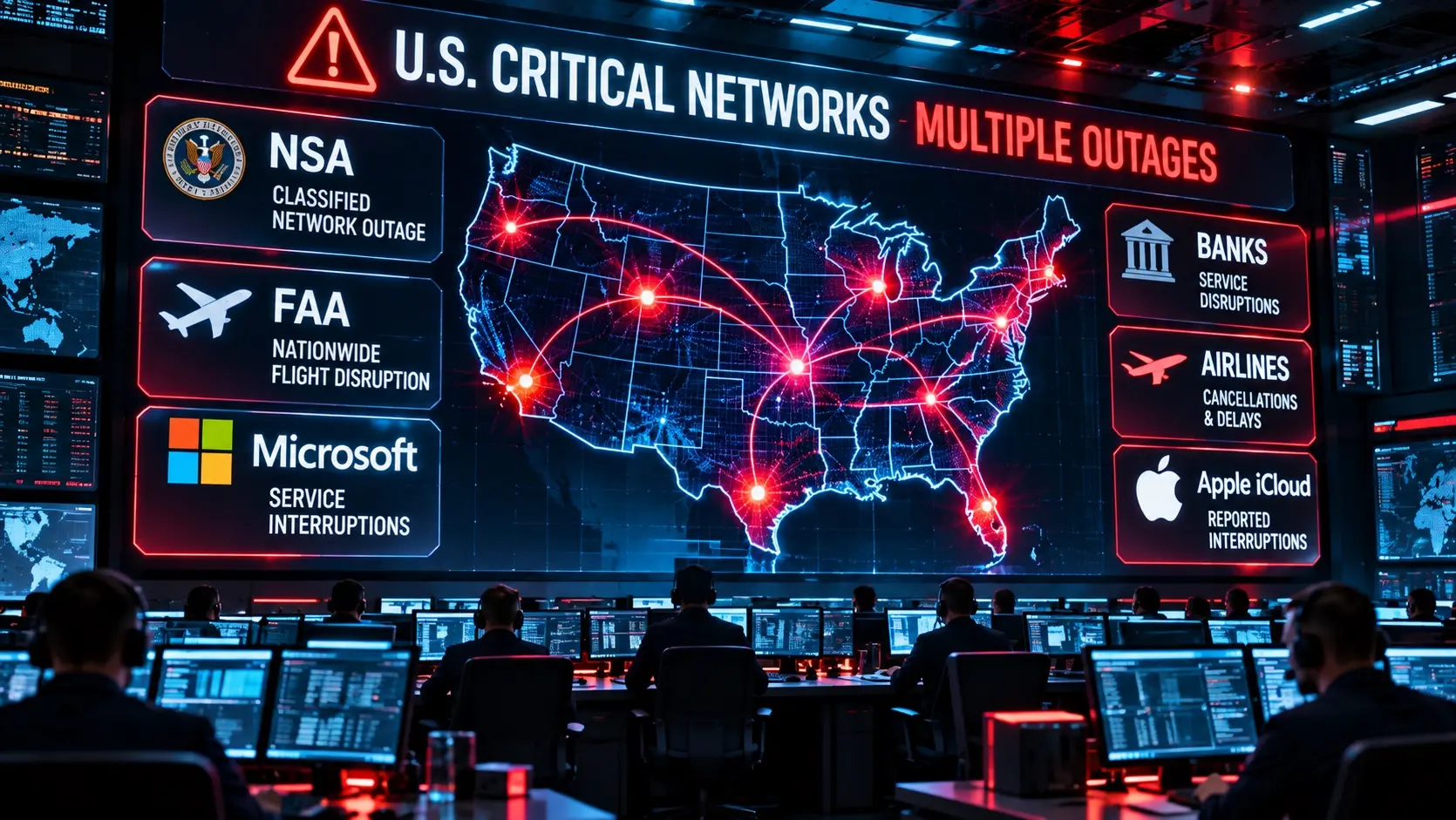
America’s Digital Infrastructure Is Experiencing a Troubling Series of Failures
Over a remarkably short period, several important American institutions have experienced technology disruptions.
Microsoft services have experienced outages affecting email and collaboration.
The Federal Aviation Administration experienced a network failure that led to a nationwide ground stop.
Financial institutions and airlines have faced their own service interruptions.
And now, the National Security Agency has acknowledged an outage affecting internal classified communications infrastructure.
The incidents are not necessarily connected.
But collectively, they reveal how dependent modern society has become on technology that most people never see.
Routers.
Authentication servers.
Cloud infrastructure.
Software updates.
Telecommunications networks.
And thousands of interconnected systems operating behind the scenes.
When those systems work, nobody thinks about them.
When they fail, the consequences can reach across an entire country.
The NSA Outage: What Actually Happened?
On November 17, CNN reported that NSA Net, the highly classified internal communications network used by the National Security Agency, had experienced a significant outage.
The network supports the exchange of classified information within the agency.
Six sources familiar with the situation told CNN about the disruption.
The agency reportedly implemented staggered employee arrival times while investigating the problem.
Why would an intelligence agency tell employees to arrive at different times?
Because thousands of employees simultaneously attempting to access an unstable network could potentially place additional strain on systems that were already experiencing problems.
Staggering arrivals allows technical personnel to manage demand while troubleshooting.
CBS News reported that the measure was known as Code Gray and involved a modified reporting schedule.
Some activities were redirected to other NSA facilities.
The agency subsequently confirmed that internal systems experienced temporary degradation during scheduled maintenance.
It emphasized that mission-critical capabilities remained operational.
That distinction matters.
A classified network experiencing an outage does not necessarily mean the nation’s intelligence capabilities have been disabled.
The NSA maintains multiple systems, operational capabilities, and continuity arrangements.
The precise technical cause remains incompletely documented publicly.
But available reporting points toward a maintenance-related disruption rather than an external cyberattack.
The FAA Outage: One Router Disrupts an Entire Country
Just days earlier, the Federal Aviation Administration experienced a separate and highly visible infrastructure failure.
On November 13, the FAA ordered a nationwide ground stop after instability developed in the telecommunications network supporting air traffic control operations.
The problem was traced to equipment associated with an infrastructure upgrade in El Dorado, Arkansas.
Contractor L3Harris was working on replacing aging copper telecommunications connections with fiber-optic technology.
During the work, a router reportedly began generating approximately 1,000 connection attempts every four to five seconds.
That activity destabilized portions of the network.
Communications and radar information became unreliable at multiple air traffic control facilities.
The FAA temporarily halted departures nationwide.
Thousands of flights were delayed or canceled, and the disruption continued affecting airline schedules afterward.
Transportation Secretary Sean Duffy said investigators were examining whether the cause involved equipment failure or installation problems.
The FBI joined the investigation.
But federal officials reported no indication of malicious activity.
This is an important distinction.
The FBI’s participation in an investigation does not establish that a cyberattack occurred.
Federal agencies may assist with investigations involving critical infrastructure because the potential consequences are significant.
The FAA incident illustrates how an unexpected technical problem can propagate through interconnected systems.
Microsoft: When the Cloud Stops Working
Microsoft’s recent service interruptions add another dimension to the discussion.
Millions of organizations depend on Microsoft 365 for email, file storage, collaboration, authentication, and productivity.
When Outlook or Teams becomes unavailable, businesses may lose access to essential communication tools.
For some organizations, even a short outage can interrupt customer service, internal coordination, and time-sensitive operations.
A Microsoft service outage does not automatically indicate a security breach.
Cloud platforms can experience disruptions caused by configuration changes, infrastructure failures, authentication problems, software defects, or other operational issues.
And because Microsoft operates infrastructure used by enormous numbers of customers, a single service problem can have widespread consequences.
The issue isn’t that cloud computing is inherently unsafe.
It’s that concentrating critical operations within a small number of technology platforms creates shared dependencies.
Thousands of companies may have independent networks, but still depend on the same cloud service to operate.
What About Chase, United Airlines, Apple, and Other Recent Incidents?
Reports of disruptions involving financial institutions, airlines, and technology platforms have added to public concern.
However, it is important not to treat every reported outage as a confirmed breach.
A bank’s website becoming unavailable does not establish that customer accounts were compromised.
An airline experiencing a technology interruption does not prove attackers accessed its systems.
And a cloud service outage does not necessarily involve stolen information.
These are different categories of incidents.
A service outage means a system or service is unavailable or degraded.
A cyberattack involves malicious activity directed at a system or organization.
A data breach involves unauthorized access to or disclosure of information.
An incident can involve more than one category, but they are not interchangeable.
Claims about specific companies must be evaluated individually using official disclosures and credible reporting.
At present, there is no verified evidence establishing that the recent NSA, FAA, Microsoft, airline, and banking disruptions are part of one coordinated campaign.
Could These Outages Be Connected?
It’s reasonable to ask.
When multiple important institutions experience disruptions close together, people naturally look for a common explanation.
And in cybersecurity, coordinated attacks against infrastructure are a legitimate concern.
But there is a difference between investigating a possibility and presenting it as a fact.
Consider the available evidence.
The NSA has attributed its disruption to scheduled maintenance.
The FAA has identified a router-related failure during infrastructure modernization.
Microsoft’s service interruptions have not been established as part of the same incident.
There is no publicly demonstrated technical connection linking these failures.
That doesn’t mean investigators should ignore potential patterns.
It means conclusions should follow evidence.
A cluster of outages can reveal systemic weaknesses without being the result of a coordinated cyberattack.
In some ways, that possibility deserves just as much attention.
Because it suggests that ordinary technical failures can disrupt critical services on a scale once associated primarily with sophisticated attacks.
The Real Threat: Systems That Have Become Too Interconnected
Modern technology depends on layers of infrastructure.
A business may use Microsoft 365 for email.
Microsoft 365 depends on authentication services, data centers, networking equipment, and internet connectivity.
The business’s internet connection depends on telecommunications providers, routing infrastructure, and physical connections.
Its employees may also depend on mobile networks, cloud applications, and external software vendors.
Each layer introduces dependencies.
And those dependencies can create unexpected points of failure.
Imagine a company with a sophisticated firewall, strong endpoint protection, multifactor authentication, and reliable backups.
The organization may be well protected against many cyberattacks.
But if its identity provider becomes unavailable, employees might still be unable to access critical applications.
If a network provider experiences a major routing problem, the company’s cloud services may become unreachable.
If a software update disrupts a shared infrastructure component, multiple applications may fail simultaneously.
The business hasn’t necessarily been hacked.
But it may still be unable to operate.
Why Redundancy Doesn’t Always Prevent Failure
Organizations often assume that having backup systems guarantees availability.
But redundancy must be designed carefully.
Imagine a business with two internet providers.
Both connections terminate at the same firewall.
If that firewall fails, both connections become unusable.
The business has two internet connections but still has a single point of failure.
Or consider a company that stores backups in the same cloud environment as its production systems.
If that environment becomes unavailable, both the primary systems and their backups may be inaccessible.
Another example is an organization with multiple applications that all rely on the same authentication service.
If that service fails, the applications may become unavailable together.
This is known as a common-mode failure.
Multiple systems appear independent but share an underlying dependency.
The lesson is straightforward.
Having backups is not the same as having a tested recovery strategy.
The Problem With Aging Infrastructure
The FAA incident also highlights the risks associated with modernizing old technology.
Many critical systems were designed decades ago.
They may rely on aging telecommunications equipment, specialized software, or custom integrations.
Replacing these components can be complicated.
A seemingly minor change may affect systems that depend on undocumented behavior.
Modernization is necessary.
But modernization itself introduces risk.
Organizations need accurate documentation, change management procedures, testing, monitoring, and rollback plans.
Otherwise, replacing old technology can create the very disruptions the upgrade was intended to prevent.
The challenge is particularly serious in environments that must remain operational continuously.
Air traffic control.
Healthcare.
Financial services.
Utilities.
Manufacturing.
And government communications.
In these environments, reliability is not simply a convenience.
It is a fundamental operational requirement.
What This Means for Small Businesses
It’s tempting to view these incidents as problems affecting only enormous institutions.
But the underlying risks exist in organizations of every size.
Consider a law firm that relies entirely on Microsoft 365 for email and document access.
If the service becomes unavailable, attorneys may struggle to retrieve important files or communicate with clients.
Or consider a medical practice using a cloud-based electronic health record system.
A network outage could prevent staff from accessing scheduling, billing, and clinical information.
A retailer might lose access to its payment processing platform.
A manufacturer could experience production delays if a critical network device fails.
A school might lose access to its student information system.
None of these situations necessarily requires a cyberattack.
But each can produce substantial operational disruption.
That is why managed IT and cybersecurity strategies must address both malicious threats and ordinary technology failures.
Seven Questions Every Business Should Ask Its IT Provider
1. What Are Our Critical Technology Dependencies?
Identify the services your business cannot operate without.
That may include internet access, Microsoft 365, phone systems, cloud applications, payment processing, and authentication services.
2. What Happens if Microsoft 365 Goes Down?
Determine which business functions remain available during a cloud outage.
Consider alternative communication methods and access to critical documents.
3. Do We Have Genuine Internet Redundancy?
A secondary internet connection can be valuable.
But it must be properly configured, monitored, and tested.
Where practical, it should avoid sharing the same physical dependencies as the primary connection.
4. Are Our Firewalls and Network Devices Redundant?
Evaluate whether a single firewall, switch, or router failure could interrupt the entire business.
For critical environments, consider appropriate high-availability configurations.
5. How Are Software Updates and Infrastructure Changes Managed?
Significant changes should follow documented procedures.
That includes backups, testing, maintenance windows, monitoring, and rollback plans.
6. Can We Operate During a Major Cloud Outage?
Establish procedures for communicating with employees and customers if primary systems are unavailable.
Maintain appropriate access to essential business continuity information.
7. Have We Actually Tested Our Recovery Plan?
A disaster recovery plan that has never been tested is an assumption.
Organizations should periodically simulate failures and verify that recovery procedures work as expected.
Cybersecurity Is More Than Preventing Hackers
Information security is built around three fundamental principles.
Confidentiality: Protecting information from unauthorized access.
Integrity: Ensuring information and systems remain accurate and trustworthy.
Availability: Making sure authorized users can access systems when needed.
Most cybersecurity headlines focus on confidentiality.
Stolen passwords.
Data breaches.
Ransomware.
Unauthorized access.
But availability is equally important.
A business that cannot access its systems may experience serious financial and operational consequences even when no information has been stolen.
The recent disruptions involving government agencies and major technology providers demonstrate why availability deserves greater attention.
A resilient organization must prepare for both cyberattacks and nonmalicious failures.
Are We Entering an Era of More Frequent Technology Disruptions?
There is not enough evidence from this cluster of incidents alone to conclude that technology outages are becoming statistically more frequent.
That would require consistent historical data covering comparable systems, incident types, and reporting practices.
However, modern organizations are becoming increasingly dependent on complex, interconnected technology.
Cloud computing, centralized identity services, software-defined networking, automation, and third-party integrations can improve efficiency and security.
They can also create shared dependencies.
When a widely used component fails, the consequences may affect many organizations simultaneously.
The result is a paradox.
Technology has become more sophisticated and capable.
But that sophistication can also make failures more difficult to predict, diagnose, and contain.
The solution isn’t to abandon modern technology.
It’s to design systems with resilience in mind.
The Bigger Question Isn’t Whether Someone Is Attacking America
The question is whether America’s critical digital infrastructure can withstand failures without widespread disruption.
That includes malicious attacks.
But it also includes faulty hardware, software bugs, maintenance mistakes, network congestion, and aging infrastructure.
The NSA outage is significant because it affected a highly classified communications environment.
The FAA disruption is significant because it temporarily interrupted nationwide aviation operations.
Microsoft’s outages are significant because so many businesses depend on its cloud services.
These incidents involve different technologies and different operational environments.
But they share an important lesson.
The consequences of technology failure are growing as society becomes more dependent on interconnected systems.
The Bottom Line: A Network Doesn’t Have to Be Hacked to Become a National Emergency
The recent wave of outages has understandably raised questions.
And those questions deserve serious investigation.
But speculation should not replace evidence.
There is currently no confirmed connection establishing that the NSA, FAA, Microsoft, banking, and airline disruptions are part of a coordinated cyberattack.
In fact, available reporting points toward maintenance and infrastructure failures in at least some of the incidents.
That may be the more important warning.
Because it means critical systems can experience widespread disruptions even without an adversary deliberately targeting them.
For businesses, the lesson is clear.
Don’t measure cybersecurity solely by whether your systems have been hacked.
Measure it by whether your organization can continue operating when something goes wrong.
The next major technology outage may not be caused by hackers. But your business still needs to survive it.
70% of all cyber attacks target small businesses, I can help protect yours.
#Cybersecurity #ITResilience #ManagedIT #BusinessContinuity #CriticalInfrastructure