
By
Gigabit Systems
September 6, 2026
•
20 min read
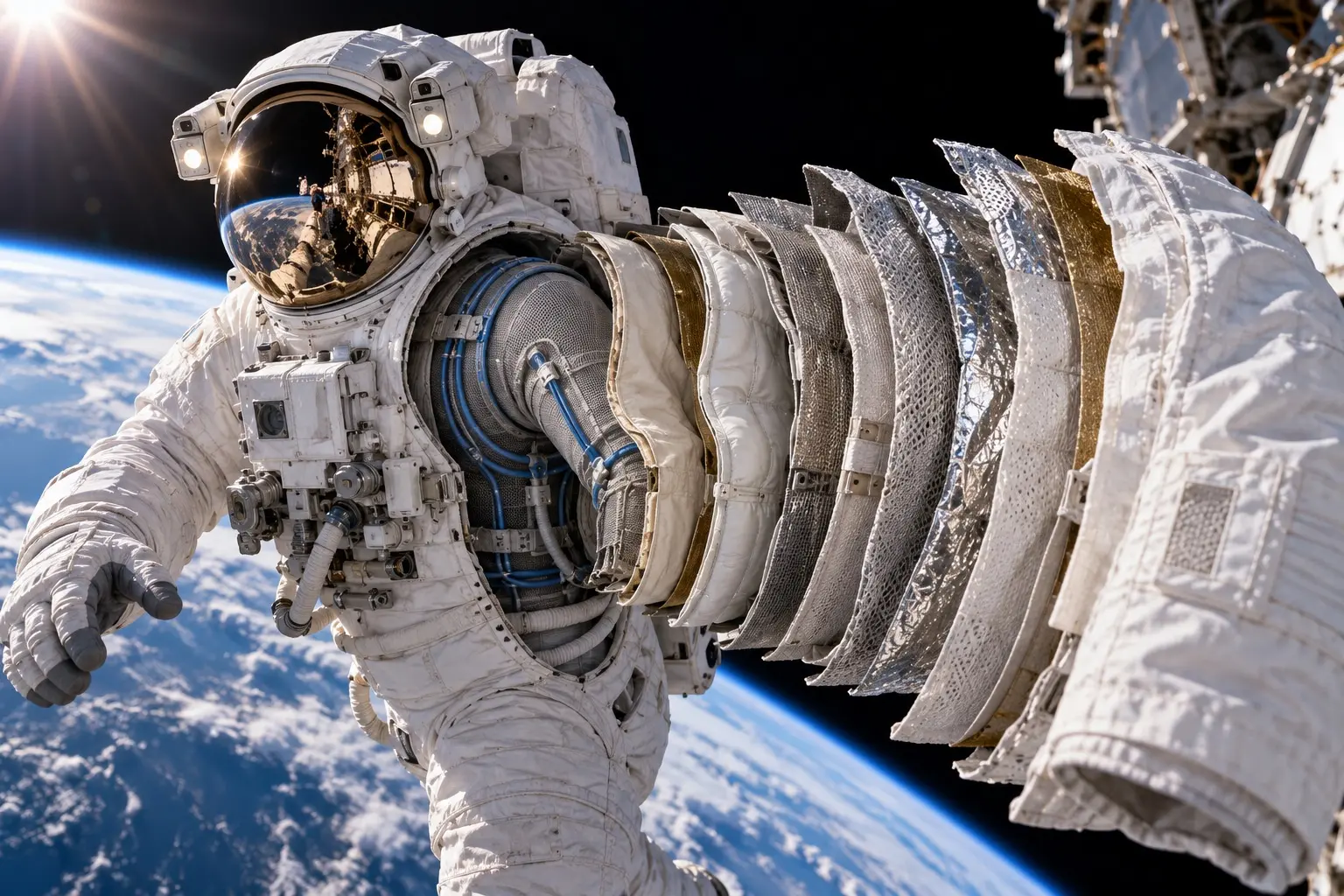
An Astronaut Isn’t Wearing a Suit. They’re Wearing a Spacecraft.
Between a human body and death are layers of fabric.
Look at an astronaut floating outside the International Space Station and your brain sees clothing.
Very complicated clothing.
But clothing nonetheless.
That’s completely wrong.
NASA describes a fully equipped spacesuit as essentially a one-person spacecraft.
And once you understand what is actually happening inside that white suit, it’s easy to understand why.
Outside is a vacuum.
There is no breathable atmosphere.
There is no atmospheric pressure keeping the human body functioning normally.
Temperatures during a spacewalk can range from approximately -250°F to +250°F depending on exposure to sunlight. Tiny pieces of debris can be moving many times faster than a bullet.
And inside all of that:
A human being has to stay alive.
Breathe.
Remain pressurized.
Control body temperature.
Move.
See.
Communicate.
Drink.
Operate tools.
And perform extremely complicated work.
So engineers effectively wrapped a tiny spacecraft around the astronaut.
Start With the Human
The first problem is surprisingly ordinary.
Astronauts get hot.
Space may be cold in the popular imagination, but an astronaut doing strenuous physical work inside a sealed pressure suit produces metabolic heat.
Sweat isn’t going to solve that problem normally.
So underneath the pressure suit, astronauts wear the Liquid Cooling and Ventilation Garment, or LCVG.
It looks somewhat like long underwear.
Except woven through it is a network of small tubes carrying water around the astronaut’s body.
NASA explains that the garment covers most of the body, excluding the head, hands and feet, and circulating water removes excess heat during the spacewalk.
You’re essentially wearing your cooling system.
And that’s only the beginning.
Then You Need to Bring an Atmosphere With You
Your body evolved to operate inside Earth’s atmosphere.
Take that atmosphere away and you have a serious problem.
So the suit has to create one.
The pressure bladder contains the gas inside the suit and maintains the pressure necessary around the astronaut’s body.
NASA engineers have a wonderfully simple analogy for it:
Think of a balloon.
The bladder wants to expand when pressurized.
Which immediately creates another engineering problem.
You don’t want your astronaut walking around inside a human-shaped balloon.
So Another Layer Has to Hold the Balloon Together
Outside the bladder is a restraint layer.
Its job is structural.
The bladder contains the gas.
The restraint layer contains the bladder.
NASA describes this as an extremely strong fabric structure that prevents the pressurized bladder from expanding uncontrollably and maintains the suit’s shape.
That’s an important distinction.
One layer doesn’t have to solve everything.
One component creates the pressure environment.
Another component handles the structural forces created by that pressure.
The system survives because the jobs are separated.
Then There’s Space Trying to Destroy Everything
Now that we’ve created a pressurized environment around our astronaut, we have to protect it.
NASA’s EMU includes a Thermal Micrometeoroid Garment, or TMG.
Its job is right there in the name.
Thermal protection.
Micrometeoroid protection.
NASA technical documentation describes multiple insulation layers, including aluminized Mylar, along with an outer protective fabric designed for abrasion and flame resistance.
So now we’re building outward.
Human.
Cooling.
Pressure.
Structural restraint.
Thermal protection.
Impact protection.
Outer protection.
Layer after layer.
Because Space Doesn’t Need a Big Hole
When we think about something threatening an astronaut, we imagine a dramatic collision.
That’s not necessarily the danger.
NASA specifically designs suits to protect against tiny particles traveling at tremendous velocity.
Something doesn’t have to be large when it’s moving incredibly fast.
NASA describes space dust as potentially moving many times faster than a bullet.
And there is another uncomfortable fact:
The astronaut is surrounded by vacuum.
A tiny failure matters.
The integrity of the pressure system matters continuously for the entire spacewalk.
The White Exterior Isn’t a Fashion Decision Either
Even the iconic appearance of a spacesuit is functional.
NASA explains that the white outer layer helps reflect heat from sunlight.
The outer fabric itself combines materials selected for different properties, including water resistance, strength and fire resistance.
Virtually everything you’re looking at exists for a reason.
Then Put a Backpack on the Spacecraft
The layers themselves aren’t enough.
Look at the enormous backpack on an astronaut’s back.
That’s the Primary Life Support Subsystem.
It carries oxygen.
It removes the carbon dioxide the astronaut exhales.
It supplies electricity.
A fan circulates oxygen through the suit.
A water tank supports the cooling system.
Think about what that means.
The astronaut isn’t connected to some giant building HVAC system.
They’re carrying the mechanical systems keeping them alive.
Air supply.
CO₂ removal.
Cooling.
Power.
Ventilation.
All on their back.
That’s not a jacket.
That’s infrastructure.
And There’s Even a Tiny Emergency Spacecraft Attached to the Spacecraft
There is one more fascinating component.
Attached to the EMU is something called SAFER:
Simplified Aid for EVA Rescue.
It contains small thrusters.
If an astronaut became untethered and began floating away from the station, SAFER provides a means of maneuvering back.
So an astronaut on a spacewalk is wearing a personal spacecraft…
with a tiny emergency propulsion system attached to it.
And Somehow the Astronaut Still Has to Work
This may be the most impressive engineering challenge.
Keeping a person alive inside a rigid protective container would be relatively useless.
Astronauts need to:
Bend their arms.
Move their fingers.
Turn.
Grab handrails.
Manipulate tools.
Connect equipment.
Perform repairs.
And sometimes spend hours doing it.
Pressure makes all of this harder.
Imagine trying to bend an inflated balloon.
The suit is constantly resisting movement.
So spacesuit engineering isn’t simply:
How do we keep someone alive in space?
It’s:
How do we keep someone alive in space while allowing them to remain useful?
Those are very different problems.
It’s a Perfect Example of Layered Security
And this is where spacesuit engineering becomes a beautiful cybersecurity analogy.
There isn’t one magical layer protecting the astronaut.
Cooling doesn’t provide pressure.
Pressure doesn’t stop micrometeoroids.
Micrometeoroid protection doesn’t remove carbon dioxide.
The outer garment doesn’t supply oxygen.
The oxygen system doesn’t provide emergency propulsion.
Each system assumes other systems exist around it.
Survival comes from layers.
Cybersecurity works exactly the same way.
A firewall isn’t cybersecurity.
MFA isn’t cybersecurity.
Endpoint protection isn’t cybersecurity.
Backups aren’t cybersecurity.
Employee training isn’t cybersecurity.
Email filtering isn’t cybersecurity.
Monitoring isn’t cybersecurity.
Incident response isn’t cybersecurity.
They’re layers.
Each Layer Is Designed for a Different Failure
That’s the important part.
Your firewall may stop one attack.
MFA may stop the stolen password that gets through.
Endpoint security may detect malicious code that reaches the computer.
Application controls may prevent it from executing.
Network segmentation may limit where it can travel.
Monitoring may detect abnormal behavior.
Immutable backups may help you recover.
Incident response determines what happens when everything before it wasn’t enough.
No individual layer has to be perfect.
The architecture has to survive imperfection.
That’s exactly what makes layered engineering so powerful.
Good Engineering Assumes Something Will Eventually Go Wrong
This is a principle that appears everywhere.
Aviation.
Nuclear power.
Medicine.
Spaceflight.
Cybersecurity.
Critical infrastructure.
You don’t design around the assumption that every component will behave perfectly forever.
You ask:
What happens when this component fails?
What’s behind it?
Can another system contain the failure?
Will we detect it?
Can the system continue operating?
Can the human survive?
That’s resilience.
The Spacesuit Makes the Concept Visible
NASA says flexible portions of the ISS EMU can contain as many as 16 layers of material.
Not because NASA engineers enjoy adding complexity.
Because space presents multiple problems.
Pressure.
Temperature.
Abrasion.
Micrometeoroids.
Mobility.
Heat generated by the astronaut.
Oxygen.
Carbon dioxide.
Communication.
Visibility.
Radiation.
Every threat requires a response.
And often that response requires another layer.
Your Business Should Look More Like a Spacesuit
Not literally.
But architecturally.
Ask yourself:
If this control fails, what happens next?
If an employee gives away their password, does MFA stop the attacker?
If MFA is bypassed, does Conditional Access notice something unusual?
If a computer becomes compromised, can it freely reach everything else?
If ransomware reaches a server, can it destroy the backups?
If someone compromises Microsoft 365, will anybody notice?
If your security provider misses an alert, does another control catch the behavior?
If the internet disappears, can the company function?
If your primary server fails, what happens Monday morning?
That’s defense in depth.
The Goal Isn’t an Impenetrable Layer
Because it probably doesn’t exist.
The goal is making sure failure of one layer doesn’t automatically become failure of the entire system.
That’s why the spacesuit is such a good engineering lesson.
If all NASA needed was one miraculous fabric that could simultaneously manage pressure, temperature, abrasion, impacts, mobility and life support, spacesuit engineering would be much simpler.
Instead, engineers divided the problem.
Different materials.
Different systems.
Different responsibilities.
All working together.
And All of It Sits Between a Human Being and Nothing
That’s what makes the spacesuit so extraordinary.
Take away the white exterior and you’re looking at an incredibly sophisticated combination of:
Materials science.
Mechanical engineering.
Thermal engineering.
Fluid systems.
Electrical engineering.
Life-support engineering.
Human factors.
Communications.
Safety engineering.
Redundancy.
All compressed into something a person can wear.
NASA has been developing and refining this technology for more than half a century, and current spacesuit development continues to build on those lessons.
So the next time you see an astronaut floating outside a spacecraft, don’t think:
That’s an incredible suit.
Think:
That’s a human being who brought a tiny piece of Earth with them.
Pressure.
Oxygen.
Temperature control.
Water.
Protection.
Communication.
Mobility.
All engineered into a personal environment separating a living person from the vacuum of space.
NASA’s description really is the best one:
They’re not wearing clothes.
They’re wearing a spacecraft.
70% of all cyber attacks target small businesses, I can help protect yours.
#Cybersecurity #SpaceTechnology #Engineering #Technology #ManagedIT
An astronaut’s spacesuit can have up to 16 layers between their body and the vacuum of space. It’s not clothing. It’s a spacecraft you wear.