
By
September 14, 2026
•
20 min read
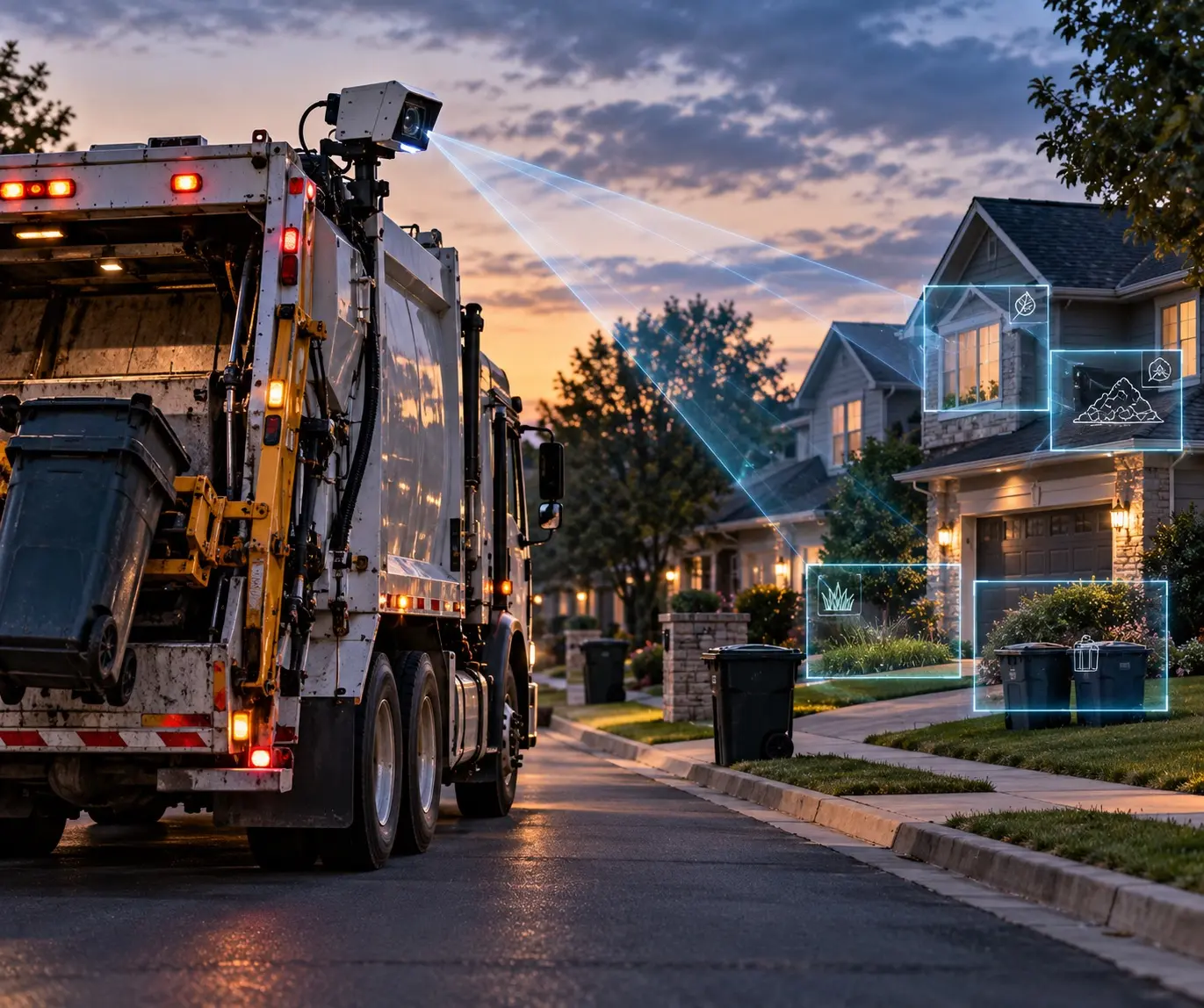
Dallas Put AI Cameras on Garbage Trucks. Now They’re Scoring Your House.
The garbage truck isn’t just collecting trash anymore.
Every week, a garbage truck drives down your street.
You barely notice it.
It picks up the trash, moves to the next house, and disappears around the corner.
But in Dallas, some of those trucks are doing something else.
They’re photographing homes.
Artificial intelligence analyzes the images.
And each property can receive a score indicating how serious its potential code violations appear to be.
The city says the technology will help identify neglected properties, illegal dumping and other neighborhood problems.
Privacy advocates see something different:
A government surveillance system that turns an ordinary sanitation route into a citywide property-inspection network.
More Than 21,000 Properties Photographed
According to a September 4 Cybernews report citing city records obtained by NBC 5, Dallas has photographed more than 21,000 properties since April using AI-powered cameras mounted on garbage trucks.
The system looks for potential code violations, including overgrown grass and weeds, litter, debris, illegal dumping, graffiti and signs of property deterioration.
Each property receives a “blight score” from 1 to 4, with 4 representing the most severe problems.
The city has already sent approximately 1,800 courtesy notices to homeowners whose properties were flagged.
Those notices ask residents to address the identified problems. Unresolved violations can eventually lead to enforcement action and fines.
That’s the part that changes the story.
The AI isn’t simply taking photographs.
Its assessments can become the beginning of a government enforcement process.
How the System Works
Garbage truck drives its route
Cameras capture properties visible from public roads.
AI analyzes the images
Potential property issues are identified and scored from 1 to 4.
City employee reviews the case
The score does not automatically trigger a penalty.
Courtesy notice or enforcement
Residents may be asked to correct issues; unresolved violations can lead to fines.
The city says human employees review potential violations before enforcement action. That distinction is important: the source does not support claiming that AI automatically issues fines.
But the AI is still determining which properties deserve attention in the first place.
A $2.56 Million Contract
Dallas is using technology from City Detect under a three-year contract worth approximately $2.56 million.
The city plans to equip 50 brush-and-bulky-waste trucks with 100 cameras, allowing the vehicles to scan properties while following their normal routes.
City officials say the cameras capture what is visible from public roads and that the system blurs faces and license plates.
Those safeguards matter.
But they don’t resolve the central question:
Should the government be continuously evaluating private property simply because it can see it from the street?
The Argument for the Cameras
There is a legitimate public-service argument here.
Cities have code-enforcement departments for a reason.
Illegal dumping can attract pests and create health hazards.
Abandoned debris can block sidewalks.
Severely neglected properties can create safety problems.
Overgrown vegetation can obstruct visibility or violate local ordinances.
Traditionally, inspectors have to drive through neighborhoods, respond to complaints and document potential violations manually.
That takes time and money.
AI-assisted cameras could help identify problems earlier, prioritize serious cases and make inspections more consistent.
The city can argue that it is using existing sanitation routes to improve services without sending separate inspection vehicles down every street.
That’s not an unreasonable objective.
But the technology introduces a new kind of power.
The Difference Between Seeing and Scoring
A city employee driving past your house can observe that your lawn is overgrown.
A camera can photograph it.
An AI system can classify it.
A database can retain the result.
And software can compare that result with thousands of other properties.
Those are not equivalent capabilities.
The important shift is from observation to automated classification.
A human inspector might notice a problem.
An AI system can systematically search for problems across an entire city.
That changes the scale of enforcement.
It also changes the relationship between residents and government.
Your House Now Has a Score
The term “blight score” is particularly interesting.
A score makes something subjective appear objective.
One.
Two.
Three.
Four.
It feels scientific.
But what exactly distinguishes a 2 from a 3?
How does the system account for a property undergoing renovation?
What about a homeowner who is elderly, disabled or temporarily unable to maintain the property?
What about a neighborhood where vegetation is intentionally maintained differently?
What happens when the camera captures a pile of materials that will be removed tomorrow?
How often is the AI wrong?
The source does not provide the model’s accuracy rate, training data, appeal process or detailed scoring methodology.
Those are questions the city should be able to answer.
Because once a score influences enforcement, the scoring system becomes part of government decision-making.
Human Review Is Important—but Not a Complete Answer
Dallas says employees review potential violations before action is taken.
That’s a meaningful safeguard.
It means the AI isn’t supposed to be judge, jury and ticket writer.
But human review can still be affected by automation bias.
If a system tells an employee that a property has a severe problem, the employee may approach the image expecting to find one.
The AI has already framed the case.
This is why responsible AI governance requires more than placing a human at the end of the workflow.
The reviewer needs enough information and authority to challenge the system.
They should be able to see the original image, understand the reason for the flag and reject an incorrect assessment without pressure to simply approve the recommendation.
Human oversight only works when the human is actually allowed to disagree.
The Garbage Truck Is an Ingenious Platform
From an engineering perspective, the choice of garbage trucks is clever.
They already travel through residential neighborhoods.
They already follow predictable routes.
They already operate regularly.
They already have access to streets that dedicated inspection vehicles would otherwise need to visit.
Adding cameras turns an existing municipal service into a data-collection platform.
That is efficient.
And it’s precisely why privacy advocates are concerned.
The infrastructure is already there.
The routes are already there.
The vehicles are already there.
The city only needs to add sensors and software.
The cost of expanding surveillance drops dramatically when the government can attach it to something it already operates.
This Is the Same Mission-Creep Question as Flock
We’ve been discussing automated license-plate readers and the way surveillance systems can expand beyond their original purpose.
The Dallas garbage-truck program raises a related question, although it is a different technology.
A garbage truck’s original purpose is sanitation.
Now it can collect property imagery.
AI can analyze that imagery.
The city can use the results to prioritize code enforcement.
What happens next?
Could the same cameras identify parking violations?
Unpermitted construction?
Vehicles associated with unpaid fines?
Other municipal compliance issues?
The source does not say Dallas plans to do any of those things.
But the governance question is legitimate:
What prevents a system approved for one purpose from being expanded to another?
The answer should be enforceable policy, not merely a promise that the city currently has no plans to expand it.
The Privacy Issue Isn’t Just the Camera
City officials say faces and license plates are blurred.
That’s good data minimization.
But a photograph of a home can still reveal information.
The condition of the property.
Vehicles in the driveway.
Construction activity.
Personal belongings visible from the street.
Patterns of occupancy.
Potentially sensitive details about a household.
The source doesn’t establish that Dallas is collecting or using all of those categories. The point is that property imagery can contain more information than the specific code violation the system is designed to detect.
That’s why retention and access rules matter.
Who can view the original images?
How long are they stored?
Does City Detect retain copies?
Can the images be used to train AI models?
Can other city departments access them?
Can law enforcement request them?
Are searches logged?
Can residents see and challenge the images associated with their property?
The attached report doesn’t answer those questions.
And those answers are essential to evaluating the system responsibly.
The Cybersecurity Risk Is the Database
Imagine the city eventually photographs hundreds of thousands of properties.
Each image may be associated with a location, timestamp and AI-generated assessment.
That becomes a valuable municipal dataset.
Not necessarily because every image is sensitive on its own.
But because the collection is searchable, structured and potentially comprehensive.
Cybersecurity professionals know what happens when large datasets accumulate.
They become attractive targets.
They require access controls.
They require retention policies.
They require vendor security reviews.
They require monitoring.
They require incident-response planning.
And they require a clear understanding of who owns the data.
A system designed to identify neighborhood problems can create a new cybersecurity problem if the collected information isn’t protected.
Businesses Should Recognize This Pattern
This isn’t only a government-surveillance story.
It’s also a warning about how AI is being deployed inside businesses.
A company installs cameras for security.
Then someone realizes they can measure employee productivity.
A call-recording system is installed for quality assurance.
Then AI begins scoring employees’ conversations.
A customer-support platform collects messages.
Then the company uses those messages to train an AI model.
A building-access system records entry times.
Then management begins using it to evaluate attendance.
Each expansion may have a business justification.
But the original purpose doesn’t automatically authorize every future use.
That’s why organizations need AI governance and data-use policies before the technology becomes deeply embedded.
What an AI Governance Policy Should Require
For any system that observes, scores or classifies people or property, the organization should define its purpose, data collection, retention, access and oversight before deployment.
The important questions are whether the AI’s output can trigger consequences, whether a human can meaningfully override it, how errors are corrected, whether the data can be reused for other purposes and what approval is required before the system’s scope expands.
Those principles apply to municipal code enforcement, employee monitoring, healthcare AI, school technology and customer-data analytics.
The technology may be different.
The governance problem is the same.
Efficiency Isn’t the Only Measurement
Dallas may find that the cameras help identify genuine problems more quickly.
They may reduce the workload on inspectors.
They may improve neighborhood conditions.
Those benefits should be measured.
But so should the costs.
False positives.
Resident complaints.
Disproportionate enforcement.
Privacy concerns.
Data retention.
Vendor access.
Appeals.
And whether the system changes how residents experience their own neighborhoods.
A technology can be operationally efficient and still require significant safeguards.
The fact that AI can do something cheaply doesn’t automatically mean it should do it everywhere.
The Bigger Question
The attached article ends by asking how much power automated systems should have to watch, classify and target citizens.
That’s the right question.
Not because every camera is inherently abusive.
Not because code enforcement is illegitimate.
And not because AI cannot improve government services.
But because automated systems make it possible to perform ordinary government functions at a scale that was previously impractical.
A human inspector can drive down a street.
An AI-equipped fleet can systematically evaluate thousands of properties.
The difference is not merely speed.
It’s the creation of a persistent, scalable classification system.
And once that system exists, the rules governing it become just as important as the technology itself.
The Lesson
Dallas has photographed more than 21,000 properties, assigned AI-generated blight scores and sent approximately 1,800 courtesy notices.
The city says humans review potential violations before enforcement and that faces and license plates are blurred.
Those are important facts.
But they don’t eliminate the need for transparency about accuracy, retention, vendor access, appeals and future uses.
The public should know exactly what the system is allowed to do—and what it is prohibited from doing.
Because the next time a garbage truck drives past your house, it may not simply be collecting what you put at the curb.
It may be deciding whether your property deserves a closer look.
70% of all cyber attacks target small businesses, I can help protect yours.
#Cybersecurity #ArtificialIntelligence #DataPrivacy #Surveillance #ManagedIT
Dallas put AI cameras on garbage trucks. They’ve photographed 21,000+ homes, assigned blight scores and sent 1,800 notices. Your trash route may now be a surveillance route.