
By
Gigabit Systems
October 1, 2026
•
20 min read
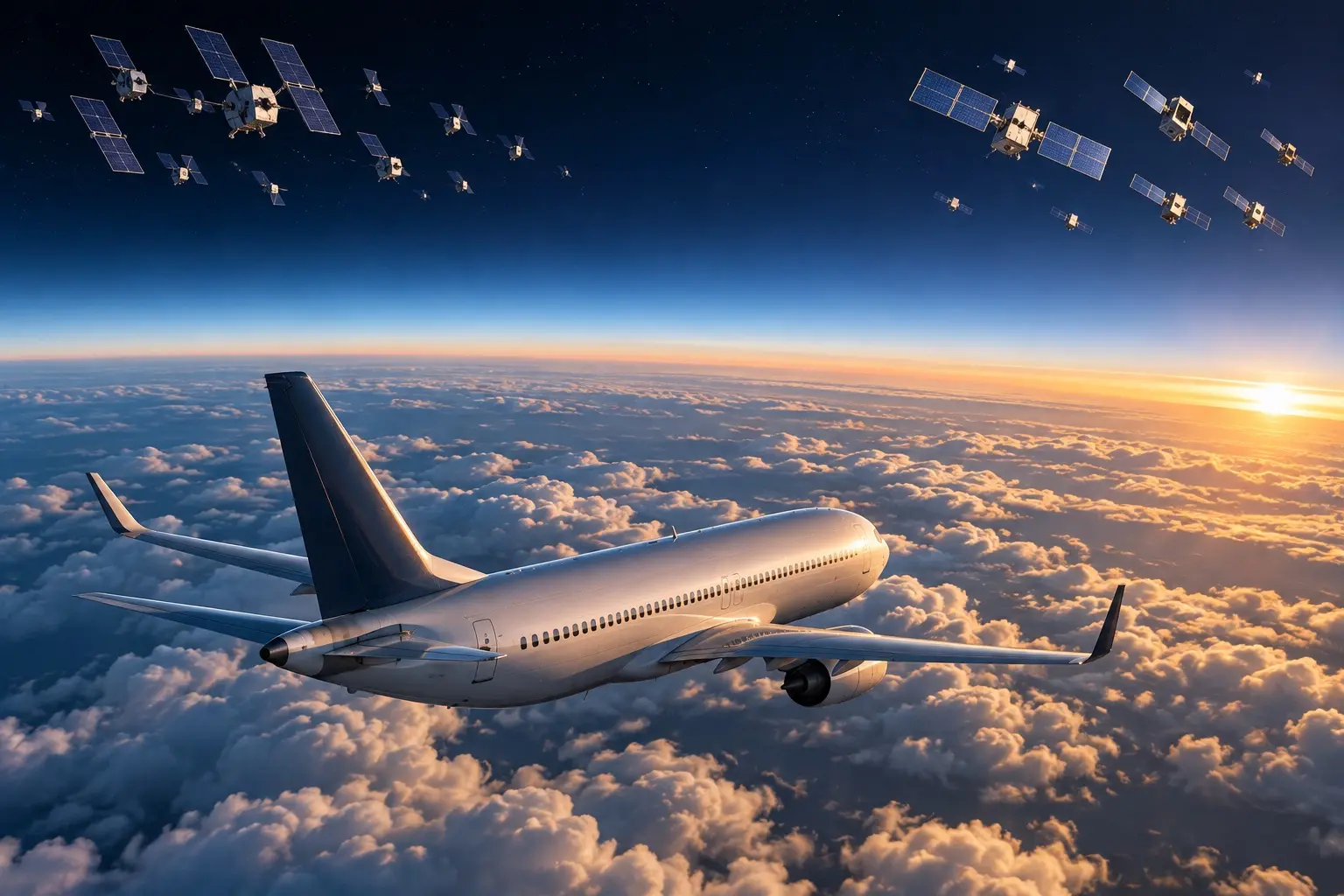
Elon Musk Says the best place to test a dangerous new AI, is on a Delta Flight.
The joke lands because airplane Wi-Fi has become infrastructure.
Elon Musk has found a new use for Delta Air Lines’ in-flight internet.
AI containment.
Amid an increasingly public fight between Musk and Delta over the airline’s decision to choose Amazon’s satellite network instead of SpaceX’s Starlink, Musk posted on X:
“Best way to sandbox an AI is to put it on a Delta flight, it will have no chance of accessing the Internet!”
It’s a very good cybersecurity joke.
A sandbox is an isolated environment designed to let software operate without giving it unrestricted access to the outside world.
Musk’s punchline is simple:
Delta’s Wi-Fi is so bad, apparently, that it could contain artificial intelligence.
But behind the joke is a surprisingly important technology battle.
Delta Chose Amazon Instead of Starlink
Delta announced in March that it had selected Amazon Leo, Amazon’s low-Earth-orbit satellite network, for its next generation of in-flight connectivity.
The airline plans to begin installing Leo on 500 aircraft starting in 2028. Amazon says each aircraft will use a purpose-built phased-array antenna supporting theoretical speeds of up to 1 Gbps downstream and 400 Mbps upstream.
That’s important context.
Delta didn’t simply decide it doesn’t want fast satellite internet.
It picked Musk’s competitor.
Amazon Leo—previously known as Project Kuiper—is Amazon’s attempt to build a low-Earth-orbit satellite broadband network competing in the same broad market as Starlink.
And Amazon already has a substantial relationship with Delta through Amazon Web Services. Delta says parts of its reservation systems, operational tools and customer-facing applications use AWS.
So Delta is effectively betting that its existing Amazon technology relationship can extend all the way from the data center to 35,000 feet.
Musk Hasn’t Taken the Rejection Quietly
Musk has repeatedly criticized Delta’s decision.
After reports circulated that Delta CEO Ed Bastian had made critical remarks about Musk and said Delta didn’t want to work with him, Musk escalated the dispute publicly, including predicting that Bastian would lose his job over the decision.
Those reported remarks from Bastian have not been independently confirmed by a recording, and Delta has not publicly authenticated the quotations.
The Wi-Fi criticism, however, is unmistakably Musk’s.
His AI sandbox joke is clever marketing because it attacks Delta’s existing connectivity while simultaneously promoting one of SpaceX’s most important products.
When your CEO owns the satellite company and the social network, customer acquisition can look a lot like trolling.
But Delta’s Current Wi-Fi Isn’t Exactly Nonexistent
Musk’s joke shouldn’t be confused with a performance test.
Delta says its existing Delta Sync Wi-Fi, presented by T-Mobile, is available across more than 1,200 aircraft and has recorded more than 160 million customer sessions since its 2023 launch. It is free to SkyMiles members on equipped flights.
Delta currently relies on multiple connectivity technologies rather than Amazon Leo, which isn’t scheduled to begin its Delta deployment until 2028.
So if you’ve recently had terrible Wi-Fi on a Delta flight, that wasn’t Amazon Leo failing.
It isn’t installed yet.
And if you’ve had excellent Delta Wi-Fi, that doesn’t tell us how Leo will perform either.
The two systems shouldn’t be conflated.
United Is Making the Opposite Bet
The airline comparison becomes particularly interesting when you look at United.
United went aggressively in the other direction.
It chose Starlink.
By July, United reported Starlink installed on 450 mainline and United Express aircraft. The airline says it expects the technology across its entire fleet by the end of 2027.
United also reported something worth watching: customer-satisfaction scores on Starlink-equipped flights were twice as high as on its other connected flights.
That’s United’s own measurement—not an independent head-to-head technical test—but it suggests passengers notice the difference.
United is therefore betting on infrastructure that already exists at enormous scale.
Delta is betting partly on what Amazon Leo is expected to become.
Starlink Has an Enormous Head Start
This is the biggest technical distinction between the two strategies.
Amazon says Leo will ultimately consist of thousands of low-Earth-orbit satellites.
But Starlink already has a huge operational constellation.
Recent reporting puts Starlink above 11,000 satellites in orbit, while Amazon Leo had fewer than 400 as of late September after launch delays.
That doesn’t determine which system will ultimately provide better service on Delta.
Technology changes.
Constellations expand.
Antennas improve.
Capacity changes.
Commercial agreements matter.
And 2028 is still a long way away.
But Delta isn’t choosing between two equally mature networks today.
It’s making a long-term infrastructure bet.
United bought what exists. Delta bought what Amazon says is coming.
Why Low-Earth Orbit Matters on an Airplane
Traditional satellite internet has often relied on satellites orbiting roughly 22,000 miles above Earth.
That distance creates latency.
Your request travels from the airplane toward space.
Then back to Earth.
The response makes another trip.
Even at approximately the speed of light, distance matters.
Low-Earth-orbit systems put satellites dramatically closer.
Amazon says its Leo satellites operate roughly 370 miles above Earth, more than 50 times closer than traditional geostationary satellites.
Starlink uses the same basic LEO advantage.
That can make satellite internet behave much more like terrestrial broadband.
Lower latency.
Higher bandwidth.
Better streaming.
Video calls.
Cloud applications.
Large uploads.
And eventually something airlines probably weren’t thinking much about five years ago:
AI workloads.
Musk’s AI Joke Accidentally Makes a Serious Point
Modern AI increasingly assumes persistent connectivity.
Chatbots can work offline in limited circumstances.
AI agents are different.
An agent may need to:
Search the internet.
Access cloud storage.
Read email.
Query company databases.
Use APIs.
Connect to remote computers.
Execute cloud workloads.
Coordinate with other agents.
A laptop running an AI agent without internet access can suddenly become much less capable.
Which makes Musk’s joke technically accurate in one narrow sense:
Disconnecting an AI agent from the network really is one way to dramatically constrain what it can do.
Not because Delta Wi-Fi is an actual cybersecurity control.
But because connectivity is part of an agent’s capability.
The Network Is Part of the AI
We’ve spent years thinking about internet connectivity as transportation for information.
Increasingly, it transports authority.
Your laptop isn’t merely downloading a webpage.
It’s reaching:
Microsoft 365.
AWS.
Azure.
Salesforce.
Your bank.
Your company VPN.
GitHub.
Remote servers.
AI services.
An autonomous agent connected to those systems can potentially act on them.
Remove connectivity and you’ve removed a substantial portion of that capability.
This is exactly why high-security environments use network segmentation and, in extreme circumstances, air gaps.
Sometimes the strongest firewall is no connection at all.
That’s the cybersecurity concept hiding inside Musk’s joke.
Airplane Wi-Fi Has Gone From Luxury to Infrastructure
Twenty years ago, internet access on an airplane sounded almost absurd.
Then it became a novelty.
Then a paid convenience.
Then something passengers expected.
Now airlines are competing over whose satellite constellation should carry the traffic.
The next stage could be more significant.
If AI agents become normal workplace tools, passengers won’t merely want connectivity so they can watch Netflix.
Their software may continue working while they’re flying.
Research.
Coding.
Document processing.
Cloud administration.
Customer support.
Security monitoring.
AI assistants.
A four-hour flight no longer disconnects an employee from their company’s computing environment.
And that means airline connectivity starts becoming part of enterprise IT.
Which Creates Another Security Problem
Public Wi-Fi advice used to be relatively straightforward:
Be careful what network you connect to.
Use encrypted services.
Keep devices patched.
Don’t blindly trust captive portals.
AI agents complicate that.
Imagine an employee boarding a flight with a company laptop containing an autonomous agent connected to corporate systems.
The employee falls asleep.
The agent keeps working.
It can access files.
Cloud applications.
Maybe email.
Maybe code.
Maybe infrastructure.
The fact that the human isn’t actively touching the computer doesn’t necessarily mean the computer isn’t doing anything anymore.
Always-on connectivity plus always-on AI creates always-on attack surface.
Organizations deploying agents need policies that account for where those agents operate, what networks they use and what authority remains available when the human isn’t actively supervising them.
Delta’s Bet Won’t Really Be Tested Until 2028
For now, the Musk-Delta fight is partly theater.
Starlink is already flying on hundreds of United aircraft.
Amazon Leo still has substantial constellation deployment ahead of it.
Delta’s first 500 Leo installations aren’t scheduled to begin until 2028.
So we don’t yet have the most important comparison:
A Delta aircraft running Amazon Leo versus a United aircraft running Starlink under comparable real-world conditions.
Latency.
Reliability.
Coverage.
Upload speeds.
Capacity under a full cabin.
Performance over oceans.
Weather resilience.
Actual passenger experience.
Those numbers will eventually matter more than tweets.
But Musk has already won one small part of the battle.
He turned an airline procurement decision into an AI joke that millions of people immediately understand.
And inadvertently summarized a very real cybersecurity principle in the process:
An intelligent machine becomes considerably less dangerous when you unplug the network cable.
Apparently, according to Musk, Delta can handle that part for you.
70% of all cyber attacks target small businesses, I can help protect yours.
#Cybersecurity #ArtificialIntelligence #Starlink #Technology #DataProtection
Elon Musk says the safest place to test a dangerous AI is… a Delta flight. His reason: “it will have no chance of accessing the Internet!” The joke comes after Delta rejected Starlink and chose Amazon’s competing satellite network for 500 aircraft. But there’s actually a very real cybersecurity principle hiding inside the insult.