
By
Gigabit Systems
September 17, 2026
•
20 min read
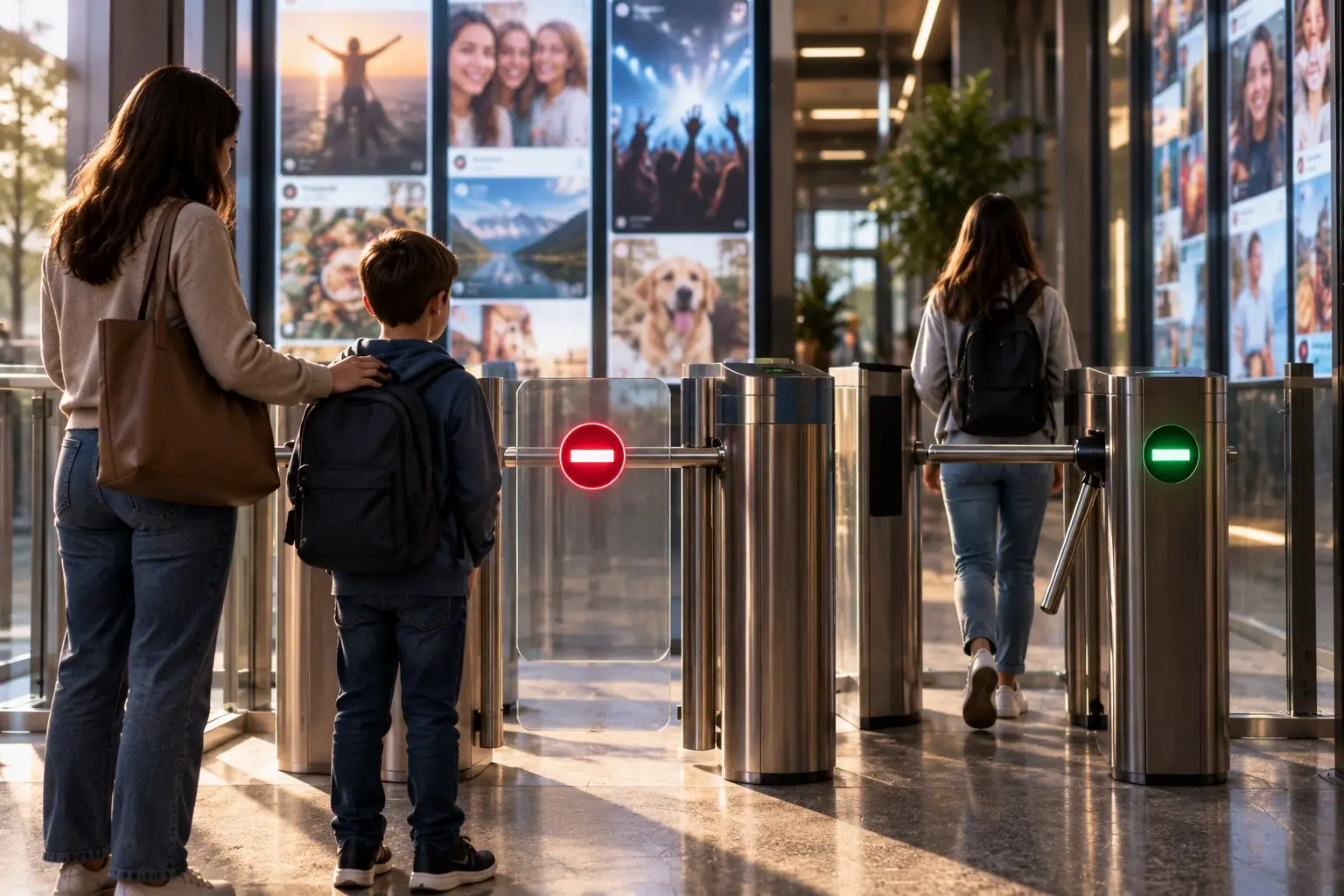
Europe Wants to Ban Social Media for Children Under 13 and Limit Access for teens Does that plan Sacrifice Privacy?
Europe may be about to put childhood behind an age gate.
For years, parents have been told that protecting children online is their responsibility.
Monitor the phone.
Set Screen Time.
Check the apps.
Talk about strangers.
Watch what they’re watching.
Keep them off inappropriate websites.
And somehow compete with some of the most sophisticated recommendation algorithms ever created.
Europe is preparing to change that equation.
European Commission President Ursula von der Leyen announced plans for an EU-wide law that would prohibit children under 13 from having ordinary social-media accounts and heavily restrict access for children between 13 and 15.
The proposal is part of a forthcoming EU Kids Act designed to fundamentally change how technology companies treat children online.
And the philosophy behind it is significant:
Maybe children shouldn’t be responsible for defending themselves against systems specifically engineered to hold their attention.
Under 13: No Ordinary Social Media
The proposal uses a graduated system rather than treating a 7-year-old and a 17-year-old identically.
For children under 13, ordinary social-media access would essentially be prohibited.
Children could still use appropriate child-oriented services under adult supervision, depending on the final legislation.
Between 13 and 15, teenagers could receive restricted “mini accounts.”
Those accounts would operate with parental controls and limited functionality.
From 15 onward, teenagers could have their own accounts, but platforms would still have obligations to provide safer experiences for minors.
That represents a significant philosophical shift.
Today, the internet often works like this:
Prove you’re old enough by clicking a button saying you’re old enough.
Europe wants something much harder to circumvent.
The Real Problem Is Obvious: How Do You Know They’re 12?
That’s where this becomes a cybersecurity and privacy story.
Writing:
“Nobody under 13 may use Instagram”
is easy.
Enforcing it is extraordinarily difficult.
A twelve-year-old can simply enter a different birthday.
So an enforceable age restriction eventually requires some mechanism for determining:
How old are you?
And suddenly a child-safety law creates an identity-verification problem.
The Internet May Need to Know Your Age Without Knowing Your Identity
That’s the technical challenge Europe is trying to solve.
The EU has already been developing privacy-preserving age-verification systems intended to let someone prove that they satisfy an age requirement without unnecessarily disclosing their complete identity.
That’s an important distinction.
A website doesn’t necessarily need to know:
Your name.
Home address.
Birthday.
Passport number.
Driver’s-license number.
It may only need an answer to:
Is this person at least 13?
That’s called attribute verification.
Instead of proving:
“I am John Smith, born January 3, 1990.”
you prove:
“I satisfy the required age threshold.”
That distinction could become enormously important.
Because the worst possible solution to protecting children’s privacy would be creating a gigantic new database containing everybody’s identity documents.
Imagine Uploading Your Passport to TikTok
That’s the nightmare version of age verification.
Every social-media company begins demanding:
Upload your driver’s license.
Scan your passport.
Take a selfie.
Submit your birthday.
Perform facial-age estimation.
Now multiply that by:
Instagram.
TikTok.
YouTube.
Discord.
Gaming platforms.
AI assistants.
Dating platforms.
Adult websites.
Streaming services.
Suddenly society has solved one privacy problem by creating another.
To prove that children are children, everybody may have to prove who they are.
That would create incredibly valuable identity databases.
And hackers would notice.
We’ve Already Seen Why Identity Databases Are Dangerous
A password can be changed.
A credit-card number can be replaced.
An API key can be rotated.
Your birthday can’t.
Your face can’t.
Your government-issued identity history can’t easily be replaced.
That’s why cybersecurity professionals should care enormously about how age verification gets implemented.
If the solution to online safety requires millions of people to repeatedly surrender identity documents, we’ve created another extremely attractive attack surface.
The better architecture is:
Verify the minimum fact necessary. Store the minimum information necessary.
That’s data minimization.
Why Is Europe Doing This?
Von der Leyen commissioned a panel of experts to examine children’s online safety.
The Commission says European young people average approximately 4.5 hours online during school days and 6.1 hours during weekends, while 14% report more than 10 hours of daily screen use.
The concerns go considerably beyond screen time.
The EU points to risks involving:
Addictive product design.
Cyberbullying.
Grooming.
Self-harm content.
Body-image pressure.
Violence.
Predatory behavior.
And algorithmic recommendation systems that can repeatedly expose children to harmful material.
But the Commission also acknowledges something important:
Social media isn’t universally harmful.
Young people use digital platforms for friendship, education, creativity, information and community.
The policy question isn’t simply:
Internet good or internet bad?
It’s whether the same product should be offered in essentially the same way to an adult and an eleven-year-old.
Because Social Media Isn’t Just Content
This is where the conversation often goes wrong.
People say:
“I watched television when I was a kid.”
Sure.
But television didn’t watch you back.
TikTok can potentially know what you stopped scrolling on.
What you replayed.
What you skipped.
What you searched.
Who you followed.
What held your attention.
What you shared.
And recommendation systems can continuously optimize what comes next.
That’s a fundamentally different relationship.
A television program was created for an audience.
An algorithm can continuously construct an audience of one.
For a developing child, Europe is increasingly questioning whether that optimization should have limits.
This Isn’t Just a European Movement
Europe isn’t acting in isolation.
Australia has already moved aggressively toward age restrictions on social-media access.
France has pushed for stronger European restrictions.
European Parliament lawmakers previously called for a harmonized European minimum age of 13, while suggesting parental authorization below a higher threshold.
French President Emmanuel Macron recently pushed von der Leyen for an EU-wide ban for children under 15.
Europe’s proposal ultimately lands somewhere between unrestricted access and an outright ban through the mid-teen years.
But Don’t Call It Law Yet
This is the biggest correction I’d make to viral posts circulating today.
The EU has not banned children under 13 from social media today.
Von der Leyen announced the Commission’s plan.
The legislation still has to move through the European Union’s political and legislative process, involving the European Parliament and member states.
Details can change.
Requirements can change.
Timelines can change.
Technology requirements can change.
And enforcement mechanisms will matter enormously.
So the accurate headline today is:
Europe wants to ban ordinary social-media access for children under 13.
Not:
Europe just banned social media for children.
That distinction matters.
The Hardest Part Comes After the Law Passes
Suppose Europe ultimately adopts it.
Now TikTok receives a new account registration.
The user claims to be 16.
How does TikTok know?
Ask for identification?
Use a government digital-identity system?
Estimate age from a face?
Rely on the phone?
Have Apple or Google attest to the age?
Require parental authorization?
Use a third-party age-verification company?
Each option creates different cybersecurity and privacy risks.
And each can fail differently.
A centralized database can be breached.
Facial estimation can make mistakes.
Documents can be forged.
Parent accounts can be compromised.
Children can borrow adult devices.
VPNs can alter geography.
Third-party verification providers become enormous supply-chain targets.
The policy is simple. The identity architecture underneath it is not.
There’s an Important Security Principle Here
When designing any identity system, don’t ask:
“How much information can we collect?”
Ask:
“What’s the smallest fact we actually need?”
A bar needs to know you’re legally old enough to drink.
It doesn’t need your medical history.
A website verifying adulthood may need proof you’re over a threshold.
It doesn’t necessarily need your home address.
A social network determining whether someone qualifies for a teenage account needs an age classification.
It shouldn’t automatically need a permanent copy of that person’s passport.
That’s least privilege applied to identity.
And Europe has an opportunity to make that principle part of the architecture from the beginning.
Parents Shouldn’t Have to Fight Algorithms Alone
There’s another interesting philosophical change in von der Leyen’s approach.
In July, she said children need time to form their own identities before algorithms shape them and argued that platforms themselves must bear greater responsibility for making their services safe.
That’s different from saying:
Parents need to supervise better.
Both can be true.
Parents have responsibility.
But companies designing products for millions of children also have responsibility.
We don’t tell parents:
“Make sure the car manufacturer installed the seat belt correctly.”
We establish safety standards.
Europe increasingly wants digital products used by children to operate under a similar principle.
This Could Change the Internet Far Beyond Europe
If the EU Kids Act ultimately becomes law, the consequences probably won’t stop at Europe’s borders.
Technology companies generally don’t want dozens of completely different product architectures.
If a platform has to build:
Teen accounts.
Age assurance.
Parental controls.
Restricted recommendation systems.
Safer defaults.
Time limits.
Content protections.
Reporting mechanisms.
Those capabilities can potentially be deployed elsewhere.
We’ve seen this phenomenon before with European privacy regulation.
Large markets can influence product design far beyond their borders.
But Privacy Cannot Become the Price of Safety
That’s the tension worth watching as this legislation develops.
Protecting children from predatory design is reasonable.
Giving parents better controls is reasonable.
Designing age-appropriate digital experiences is reasonable.
But implementation matters.
If protecting a twelve-year-old requires building a permanent identification infrastructure around every internet user, society may create a completely different category of risk.
The goal should not be:
Identify everybody.
It should be:
Learn only what you need to know.
Is this user under 13?
Between 13 and 15?
An older teenager?
An adult?
Then discard whatever information isn’t necessary.
Because the safest identity database isn’t the one with the strongest firewall.
It’s the database that never collected your identity in the first place.
70% of all cyber attacks target small businesses, I can help protect yours.
#Cybersecurity #OnlineSafety #DataPrivacy #SocialMedia #DigitalIdentity
Europe wants to BAN social media for children under 13. Ages 13–15 would get restricted, parent-supervised accounts. But there’s a massive cybersecurity question nobody should ignore: How does Instagram prove you’re 13 without forcing everyone to prove who they are?