
By
Gigabit Systems
•
20 min read
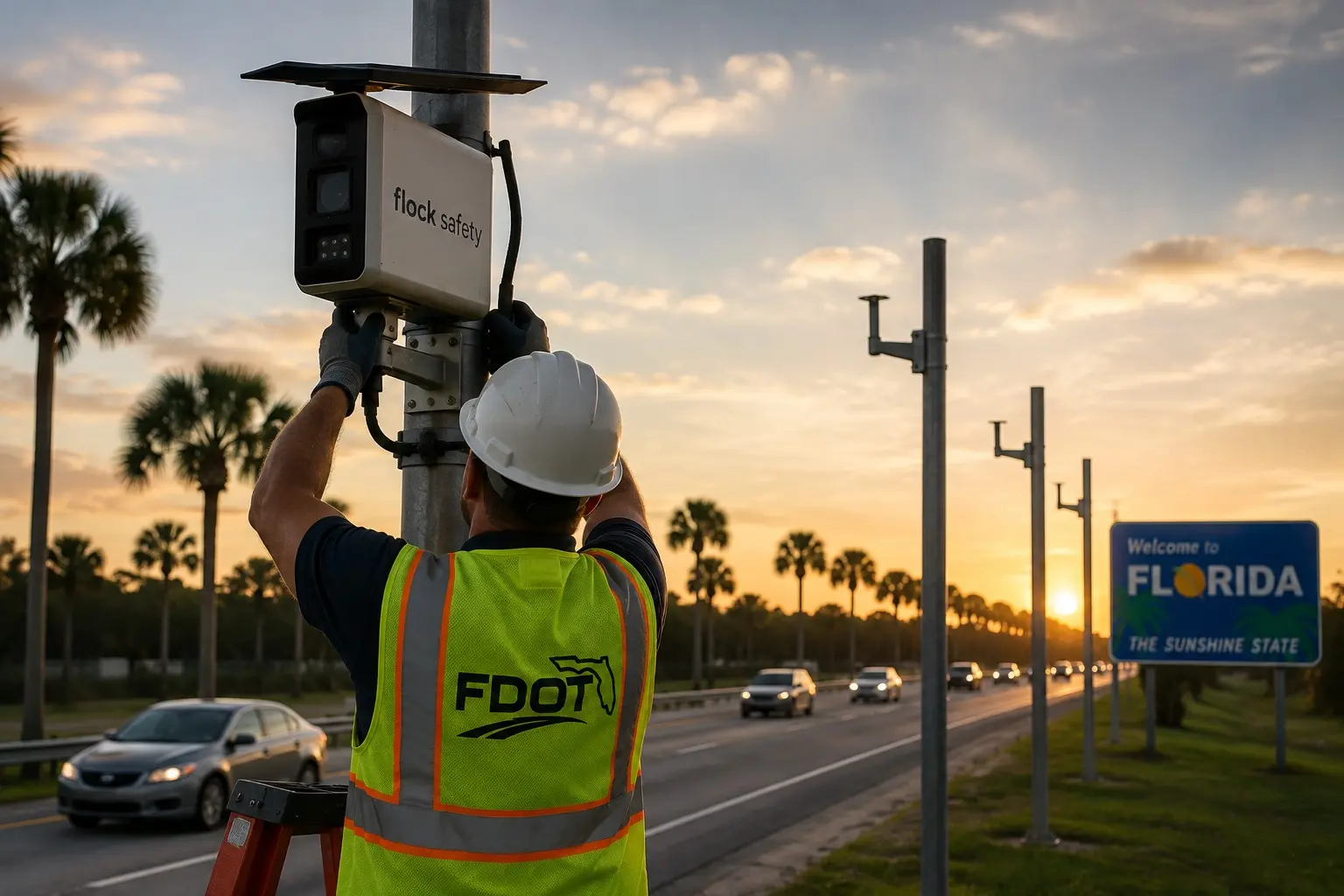
Florida Is Taking Down the Cameras Watching Your Car
The surveillance network grew faster than the rules governing it.
Remember those little solar-powered cameras we’ve been talking about?
They’re mounted on poles.
They don’t look particularly intimidating.
You drive past one.
It photographs your vehicle.
Reads your license plate.
Records identifying characteristics.
Stores the information.
And depending on policies and permissions, law enforcement can search that information later.
They’re automated license plate readers, commonly associated with Flock Safety.
We’ve written about them before because Flock has quietly built an enormous network across America.
Now Florida has decided:
Enough.
On August 31, the Florida Department of Transportation revoked permits for automated license-plate readers installed within rights-of-way on Florida’s State Highway System.
Local agencies have 30 days to remove them.
If they don’t?
FDOT says the state can remove the cameras itself.
And new applications to install them there will no longer be approved.
Read Florida’s Explanation Carefully
This wasn’t framed as a budget decision.
FDOT specifically cited the:
“exponential increase in deployments”
along with reports of misuse, data-privacy concerns and what the department called “surveillance schemes.”
The agency said immediate action was warranted to protect Floridians’ sovereignty and quality of life.
That’s unusually strong language for a transportation department talking about cameras.
And it gets directly to the problem we’ve been discussing.
The technology isn’t necessarily the frightening part.
Scale is.
One Camera Isn’t Particularly Interesting
Imagine police are investigating a kidnapping.
They know the suspect’s license plate.
A camera spots the vehicle.
Police get an alert.
They find the victim.
That’s an extraordinarily compelling use of technology.
And Florida law-enforcement agencies have cited real examples where these systems assisted in locating missing people, murder suspects and human-trafficking victims.
That’s why this debate isn’t as simple as:
Camera bad. Privacy good.
These systems can provide legitimate investigative value.
But now imagine the camera isn’t alone.
There are ten.
Then 100.
Then 10,000.
Then tens of thousands spread across the country.
Suddenly you’ve built something fundamentally different.
A Network of Cameras Can Become a Movement Database
One camera tells you:
Your car was here.
A network potentially tells you:
Your car was here Monday morning.
Here Monday afternoon.
Here Tuesday night.
Here Wednesday morning.
Here Saturday.
And here again Sunday.
Now search backward.
Instead of asking:
“Where is this suspect right now?”
you can potentially ask:
“Where has this vehicle been?”
That’s a completely different capability.
The technology crosses an invisible line.
License-plate recognition becomes location intelligence.
Flock Has Become Enormous
Recent reporting puts Flock’s network at more than 120,000 cameras nationwide.
That’s what makes the discussion so important.
No single police department necessarily sat down one morning and said:
Let’s build a nationwide vehicle-surveillance network.
One town buys cameras.
Another county buys cameras.
A sheriff’s department installs some.
Another city joins.
More agencies gain access.
More cameras appear.
Data becomes searchable.
Systems become interconnected.
Eventually you look up and discover:
The infrastructure exists.
The policy debate comes afterward.
That’s backwards.
And We’ve Already Seen What Happens When Someone Abuses It
Days before Florida’s announcement, Wired reported an extraordinary example from Georgia.
An Alpharetta police officer allegedly used Flock searches repeatedly to track vehicles associated with his former romantic partner and another officer.
According to the internal investigation reported by Wired, he searched his former partner’s vehicle 56 times and the other officer’s vehicle 29 times.
Search justifications reportedly included things such as “Wanted Person” and “Traffic Infraction,” despite investigators finding no legitimate law-enforcement basis for the searches.
The officer resigned, and a criminal investigation is ongoing.
Think about what that demonstrates.
You can have:
Authorized users.
Passwords.
Logging.
Policies.
Training.
Search justifications.
Auditing.
And someone with legitimate access can still potentially misuse the system.
Cybersecurity professionals have a name for that problem:
Insider threat.
The Database Doesn’t Know Why You’re Looking
This is something every business should understand.
Technology can authenticate:
Who are you?
It can authorize:
Are you allowed to search?
But determining:
Should you be searching for this person for this reason?
is considerably harder.
That’s true whether we’re talking about:
Police databases.
Medical records.
Employee files.
Customer information.
Banking systems.
Security cameras.
Microsoft 365.
An administrator can have completely legitimate access to a system and still use that access illegitimately.
That’s why cybersecurity requires more than passwords.
It requires:
Accountability.
This Is Why Logging Matters
Imagine that officer’s searches weren’t logged.
How would anyone know?
That’s the difference between:
Access control
and
auditable access control.
Sensitive systems should record who accessed information, what they searched for, when they accessed it and—where appropriate—why.
But collecting logs isn’t enough.
Somebody has to review them.
That’s where organizations frequently fail.
They log everything.
Then nobody looks unless something goes wrong.
Good security asks another question:
What behavior should trigger an investigation automatically?
An employee repeatedly searching one person’s records?
An administrator accessing hundreds of mailboxes?
Someone downloading 50,000 customer records?
A user accessing systems at unusual times?
An account suddenly searching information unrelated to its normal job?
Logs tell you what happened.
Behavioral monitoring can tell you something strange is happening while it’s happening.
There’s Another Problem: False Matches
License-plate readers aren’t infallible.
A dirty plate.
An obscured character.
Bad lighting.
Similar characters.
Different jurisdictions.
Camera angle.
Software interpretation.
All can matter.
Recent reporting has highlighted cases in which erroneous plate reads contributed to wrongful police stops and arrests, adding another dimension to the backlash surrounding automated license-plate readers.
A computer producing an answer doesn’t make that answer true.
That’s an increasingly important lesson as artificial intelligence enters policing, healthcare, cybersecurity, hiring and financial decisions.
Automation increases speed. It doesn’t eliminate error.
Florida Isn’t Alone
The backlash is becoming national.
Tempe, Arizona has ended its relationship with Flock.
Austin allowed its agreement to expire.
Other municipalities have reconsidered or terminated deployments.
And last week, U.S. Senator Josh Hawley opened a Senate investigation into Flock, asking the company for information about data collection, retention, camera locations and law-enforcement access.
This isn’t fitting neatly into traditional partisan politics either.
Privacy concerns surrounding mass surveillance have increasingly attracted people from both the political left and right.
Different motivations.
Same question:
Who gets to know where I go?
Florida’s Decision Is Already Spreading Locally
Here’s where today’s announcement gets particularly interesting.
Florida didn’t order every local Flock camera removed.
FDOT’s authority here concerns cameras within state highway rights-of-way.
But local agencies immediately began making their own decisions.
Putnam County Sheriff H.D. DeLoach announced that his department would discontinue its Flock program entirely and remove its 18 cameras, citing concerns surrounding privacy, data sharing, governmental oversight and future regulation.
Other Florida sheriff’s departments have also announced changes following the state’s action.
So Florida’s state-highway decision may produce something considerably larger:
A chain reaction.
This Isn’t Really a Story About Cameras
It’s a story about databases.
The camera gets everyone’s attention because you can physically see it.
But the important questions happen after the photograph is taken.
What information was collected?
How long is it retained?
Where is it stored?
Who can search it?
Which other agencies can access it?
Can searches cross jurisdictions?
What constitutes a legitimate search?
Who audits those searches?
Can an employee misuse it?
Can someone export the information?
What happens if credentials are stolen?
Can the database be breached?
Can historical movement be reconstructed?
Those are fundamentally:
Data governance questions.
And businesses have exactly the same problem.
Your Company Probably Collects Too Much Too
Every organization accumulates data because storage is cheap.
Email forever.
Customer records forever.
Security footage forever.
Employee records forever.
Logs forever.
Backups forever.
Cloud files forever.
Nobody wants to delete anything because:
“We might need it someday.”
Then you get breached.
And suddenly ten years of information becomes ten years of liability.
There’s an uncomfortable cybersecurity truth:
Data you don’t have can’t be stolen.
Retention should be intentional.
Ask Why You’re Collecting It
Every organization should be able to answer four questions about sensitive information:
Why are we collecting this? How long do we need it? Who can access it? Who checks whether that access is being abused?
If nobody knows the answers, you don’t have a data-retention strategy.
You have a data collection habit.
Healthcare organizations should ask this about patient information.
Law firms about client files.
Schools about student records.
SMBs about customer and employee information.
And governments should ask exactly the same questions about surveillance data.
The Flock Debate Is Really About Power
Flock cameras can help solve crimes.
That’s real.
They can help locate stolen vehicles and missing people.
That’s real too.
But technology doesn’t have to be useless to be dangerous.
The most consequential technologies are often extremely useful.
That’s precisely why they spread.
The question isn’t:
“Can this technology do good?”
Of course it can.
The better question is:
“What happens when this technology is everywhere?”
Because capabilities change when systems reach scale.
One camera helps investigate a crime.
Thousands of interconnected cameras can potentially reconstruct movement.
One administrator can maintain a system.
Thousands of administrators with poorly governed access create an insider-risk problem.
One database solves a problem.
Enough interconnected databases can create something nobody explicitly decided to build.
We’ve Seen This Pattern Before
Technology arrives.
It’s useful.
Deployment accelerates.
Everybody celebrates the benefits.
Governance comes later.
Then somebody discovers an abuse case.
Or a breach.
Or an unintended capability.
And society finally asks:
Wait. What exactly did we build?
We did it with social media.
We’re doing it with artificial intelligence.
We’re doing it with biometrics.
We’re doing it with facial recognition.
And we’re doing it with automated license-plate readers.
The lesson isn’t:
Stop building technology.
It’s:
Build the rules before the infrastructure becomes impossible to unwind.
Florida Just Did Something Unusual
Governments usually respond to technology problems by announcing:
A study.
A committee.
A task force.
New guidelines.
Florida did something much simpler.
Take the cameras down.
Not everywhere.
Not permanently necessarily.
And not because license-plate recognition has no legitimate use.
But because, according to FDOT, deployments had increased exponentially while concerns about misuse, privacy and surveillance were mounting.
That’s what makes this moment significant.
The question surrounding Flock is shifting from:
“Should we install these cameras?”
to:
“Did we install too many before deciding what the rules should be?”
And Florida has just given its answer for state highways.
Yes.
70% of all cyber attacks target small businesses, I can help protect yours.
#Cybersecurity #DataPrivacy #Surveillance #DataProtection #IoTSecurity
Florida just ordered Flock cameras off its state highways. The question isn’t whether they catch criminals—it’s what else we built along the way?