Flock Cameras Are Watching America’s Roads. Who’s Watching Them?
Your License Plate Is Public. Your Entire Life Shouldn’t Be.
You’re driving to work.
You stop for coffee, visit a client, pick up your children, and head home.
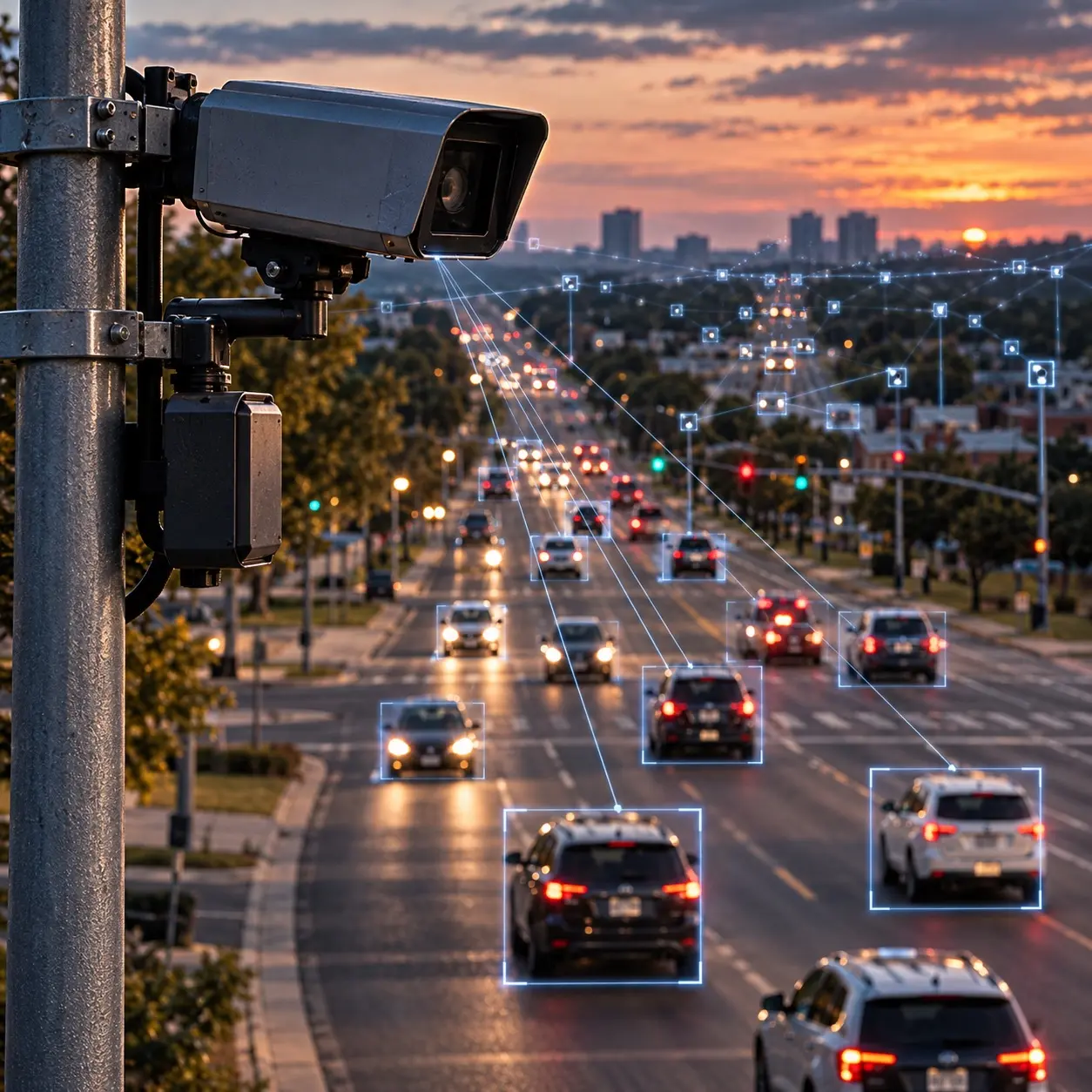
Along the way, you pass several small cameras mounted on poles beside the road.
You probably don’t notice them.
But those cameras may have recorded your license plate, the time you passed, your vehicle’s appearance, and your location.
Individually, those observations seem harmless.
After all, you’re driving on a public street. Anyone standing nearby could see your car.
But what happens when thousands of cameras collect that information, store it in searchable databases, and allow authorized users to reconstruct where vehicles have traveled?
That’s the controversy surrounding Flock Safety.
The American surveillance technology company has rapidly expanded its automated license plate reader network, helping police departments investigate crimes and locate stolen vehicles.
But the expansion has triggered an extraordinary public backlash.
According to NPR, Flock cameras have been vandalized in at least 36 states. Communities across the country have also canceled, suspended, or rejected camera programs over privacy concerns.
The conflict raises a fundamental question about modern technology.
When does ordinary observation become mass surveillance?
And perhaps more importantly, why should law-abiding citizens care?
Who Is Flock Safety?
Flock Safety is a privately held American technology company founded in 2017.
The company, led by co-founder and CEO Garrett Langley, develops surveillance and public safety technology used by law enforcement agencies, municipalities, businesses, and residential communities.
Its best-known products are automated license plate recognition cameras, commonly called ALPRs.
These cameras are designed to identify vehicles as they pass through monitored areas.
Unlike ordinary security cameras that primarily record video for later review, Flock’s technology automatically converts vehicle observations into searchable data.
A camera may record the license plate, vehicle color, make, model, distinguishing features, location, and time.
That information is transmitted to a cloud-based system.
Authorized law enforcement personnel can then search for vehicles associated with criminal investigations.
For example, if someone steals a car, police may enter the license plate into the system.
If a participating camera detects the vehicle, officers may receive an alert identifying where it was observed.
The technology can also help investigators locate vehicles associated with missing persons cases or other criminal investigations.
These are legitimate and potentially valuable public safety applications.
But the same technology also collects information about enormous numbers of people who are not suspected of committing crimes.
That’s where the controversy begins.
The Scale of the Surveillance Network
Flock cameras are no longer limited to a handful of neighborhoods.
They have become part of an extensive network spanning communities throughout the United States.
A September 2026 Congressional Research Service report cited crowdsourced mapping identifying more than 137,000 automated license plate readers nationwide, with over 80% attributed to Flock Safety.
These figures are based on third-party mapping rather than a complete official inventory, but they illustrate the scale of deployment.
Every participating camera creates records of passing vehicles.
And when data-sharing arrangements permit, information from multiple jurisdictions can be searched together.
Imagine a police department in one city searching vehicle observations collected by participating agencies elsewhere.
That capability can help investigators locate suspects who travel across jurisdictional boundaries.
But it can also make the movements of ordinary drivers easier to reconstruct.
The controversy isn’t simply about how many cameras exist.
It’s about what becomes possible when those cameras operate as a connected, searchable system.
Why Are Americans Destroying Flock Cameras?
Public resistance has grown dramatically.
NPR documented incidents of Flock cameras being vandalized in at least 36 states.
Some cameras have been damaged or removed.
Others have been painted over or otherwise disabled.
At the same time, residents have attended municipal meetings, organized demonstrations, challenged surveillance policies, and pressured local governments to cancel contracts.
More than 50 jurisdictions had reportedly canceled, suspended, or rejected Flock-related programs during 2026, according to reporting published in September.
The opposition crosses traditional political boundaries.
Some critics are concerned about government overreach.
Others worry about police misconduct, immigration enforcement, data sharing, or the long-term implications of automated surveillance.
Still others question whether the benefits justify recording so many innocent people’s movements.
The physical destruction of cameras is unlawful and can create additional public safety risks.
But the vandalism reflects the intensity of a broader debate that is increasingly playing out through legitimate public meetings, elections, and legal challenges.
If You’re Not Doing Anything Wrong, Why Should You Care?
This is the question at the heart of the entire controversy.
Most people understand why criminals might not want police tracking their movements.
But why should an ordinary citizen care?
Consider a few examples.
Example One: Your Medical Appointments
Imagine visiting a specialist every Thursday afternoon.
You haven’t committed a crime.
You’re simply receiving medical care.
But a system that records your vehicle repeatedly appearing near the same medical facility could reveal a pattern about your private life.
The camera doesn’t need to know your diagnosis.
It doesn’t even need to photograph you entering the building.
The pattern itself may reveal sensitive information.
Example Two: Your Religious or Community Activities
Imagine regularly attending religious services or community meetings.
Your participation may be perfectly lawful and publicly observable.
But there’s a difference between someone occasionally noticing your car outside a building and an authority maintaining a searchable record of your repeated attendance.
That information could potentially reveal personal associations and routines.
Example Three: A Confidential Business Negotiation
Imagine you’re negotiating the purchase of another company.
You regularly visit its headquarters.
The transaction hasn’t been announced.
A searchable history of vehicle movements could potentially reveal patterns suggesting a confidential business relationship.
This isn’t necessarily a criminal issue.
It’s a question of commercial privacy.
Example Four: A Personal Dispute
Now imagine a law enforcement officer has a personal disagreement with someone.
The officer improperly searches that person’s license plate history to learn where they regularly travel.
This is not merely a theoretical concern.
Investigations have documented allegations of officers using license plate reader systems to track acquaintances, relatives, or former romantic partners for unauthorized reasons.
Most officers may never misuse the technology.
But a system capable of revealing movement patterns creates opportunities for abuse that require meaningful oversight.
Privacy isn’t about having something illegal to hide. It’s about deciding how much of your personal life others should be able to reconstruct.
How Is This Different From a Camera Outside Your House?
This is perhaps the most interesting question in the debate.
Suppose you install a security camera above your garage.
It records your driveway and part of the public street.
Every vehicle that passes your house might appear in the footage.
Isn’t that essentially what Flock is doing?
At the most basic level, both systems observe activity in public.
But there are important differences.
A Home Camera Records a Location
Your security camera typically monitors a limited area.
If someone breaks into your car, you can review the footage.
You might identify the suspect’s vehicle or provide a recording to police.
But your camera generally cannot tell you where that vehicle traveled before reaching your house or where it went afterward.
You have one perspective.
One location.
One collection of recordings.
A Connected License Plate Network Records Movement
Now imagine thousands of cameras across a city.
Each automatically identifies passing vehicles.
Every observation receives a timestamp and location.
The information is stored in a searchable database.
An authorized user may be able to enter a license plate and retrieve multiple sightings.
Suddenly, the system isn’t merely recording what happened on one street.
It can help reconstruct where a vehicle has traveled.
That’s a fundamentally different capability.
The difference isn’t necessarily what one camera sees. It’s what thousands of connected cameras can remember.
The Difference Between Observation and Tracking
Consider a police officer standing at an intersection.
The officer sees your vehicle drive past.
That is an ordinary observation in a public place.
Now imagine thousands of officers stationed at intersections throughout the country.
Every officer records your license plate, location, and time.
All those records are uploaded into one searchable system.
Someone can enter your plate and retrieve a history of sightings.
Every individual observation occurred in public.
But the combined information reveals considerably more than any one observation.
That distinction is central to the privacy debate.
Isn’t Your License Plate Public Information?
Yes.
License plates are intentionally displayed so vehicles can be identified.
Police can generally observe and record plates visible on public roads.
But the constitutional question becomes more complicated when observations are collected and analyzed at scale.
The Fourth Amendment protects against unreasonable government searches and seizures.
Courts have long recognized that people have reduced expectations of privacy in information openly visible in public.
However, modern technology allows governments to collect and analyze public observations in ways that were previously impractical.
In 2018, the Supreme Court addressed a related issue in Carpenter v. United States.
The case involved historical cellphone location records.
The Court recognized that extensive location histories can reveal deeply personal information and held that accessing certain historical cellphone location data generally requires a warrant.
That ruling did not automatically establish the same requirement for every license plate reader search.
Courts continue to examine the constitutional implications of automated vehicle tracking.
The law is not settled uniformly nationwide.
But the underlying question is significant.
Does observing someone repeatedly over time become more intrusive than observing them once?
Technology has made that question increasingly difficult to ignore.
What Does Flock Say About Privacy?
Flock Safety maintains that its technology is designed for legitimate public safety investigations.
The company says its standard license plate reader systems do not use facial recognition and do not directly collect driver identities.
Instead, they capture vehicle-related information.
Flock also says its customers own and control the data collected through their systems.
Agencies can establish access permissions and determine which other organizations may search their records.
Search activity is logged to support auditing.
In 2026, Flock announced additional safeguards intended to reduce misuse.
These include stronger auditing requirements, controls designed to identify suspicious searches, and a recommended seven-day data retention period.
The company previously used a longer standard retention period.
However, existing customers may retain different periods depending on their policies and applicable law.
Flock’s position is that the technology can support effective law enforcement while maintaining appropriate controls over access and retention.
Critics question whether those safeguards are sufficient, particularly when information can be shared across multiple agencies.
Both the capabilities and the limitations of these protections deserve scrutiny.
The Cybersecurity Risk Nobody Should Ignore
Most of the public discussion focuses on government surveillance.
But there is another important issue.
What happens if the surveillance database itself is compromised?
Any system collecting large volumes of information becomes a potential target.
License plate data may reveal vehicle movements, locations, timestamps, and recurring patterns.
If attackers obtained unauthorized access to a sufficiently extensive dataset, they might be able to analyze information about individuals, organizations, or sensitive locations.
Potential risks could include stalking, targeted harassment, intelligence gathering, or identifying valuable targets.
That does not mean Flock’s entire network has been breached.
It means the sensitivity of the information warrants strong cybersecurity controls.
Organizations operating such systems should consider encryption, access restrictions, multifactor authentication, audit logs, retention limits, and independent security assessments.
They should also ensure that data-sharing agreements do not inadvertently expand access beyond the original purpose.
This is a familiar cybersecurity principle.
The more information you collect, the more responsibility you assume for protecting it.
Why This Matters for Businesses
Although the controversy primarily involves public surveillance, the underlying lessons apply directly to private organizations.
Businesses increasingly deploy cameras, access-control systems, employee monitoring tools, GPS tracking, and AI-powered analytics.
Each technology may serve a legitimate purpose.
Security cameras can deter theft.
Vehicle tracking can improve fleet management.
Access logs can help investigate unauthorized entry.
But combining these systems can create detailed information about employees, customers, and visitors.
A company might begin with a reasonable objective, such as protecting its parking lot.
Over time, it may accumulate information capable of revealing employee arrival times, vehicle movements, and recurring visits.
That creates privacy, cybersecurity, and data governance responsibilities.
Organizations should ask whether they truly need the information, who can access it, how long it should be retained, and what happens if it is exposed.
What Healthcare Organizations, Law Firms, and Schools Should Consider
Healthcare Organizations
Hospitals and medical practices may use surveillance technology to protect patients, employees, and facilities.
But information revealing visits to healthcare facilities can be sensitive, even when it does not constitute a medical record.
Organizations should consider camera placement, retention policies, and appropriate access controls.
Law Firms
Law offices routinely handle confidential matters.
Surveillance information could potentially reveal visits by clients, witnesses, or individuals involved in sensitive proceedings.
Security measures should account for both physical safety and confidentiality.
Schools
Schools may use cameras to monitor entrances, parking lots, and surrounding areas.
These systems can support student safety.
But information about student and family movements deserves appropriate safeguards, particularly when minors are involved.
Small Businesses
For SMBs, the lesson is not to avoid security cameras.
It’s to implement surveillance thoughtfully.
Use the technology necessary to protect the business.
Avoid collecting more information than needed.
Restrict access.
And establish clear retention and deletion policies.
Can Technology Fight Crime Without Tracking Everyone?
This is the central policy challenge.
Automated license plate readers can help police identify stolen vehicles and locate people connected to serious investigations.
Those benefits matter.
But the technology also creates opportunities for broad collection and searching of ordinary citizens’ movements.
The policy question is how to preserve legitimate investigative benefits while preventing unnecessary or abusive tracking.
Potential safeguards include requiring documented investigative purposes, restricting cross-agency access, limiting retention, auditing searches, penalizing misuse, and applying judicial oversight where appropriate.
Communities can also require public reporting about how frequently the technology is used, what types of cases it supports, and whether searches produce useful results.
That allows residents to evaluate the system based on evidence rather than assumptions.
The Bigger Picture: AI Has Changed What Surveillance Means
A camera mounted on a building isn’t new technology.
Police officers recording license plates isn’t new either.
What has changed is the ability to automate the process at enormous scale.
Artificial intelligence and cloud computing make it possible to process millions of observations, identify patterns, and search information almost instantly.
That can make law enforcement more efficient.
It can also transform isolated public observations into a powerful surveillance capability.
The same technological progress that improves convenience and public safety can introduce new privacy risks.
And those risks are not limited to government.
Businesses, technology platforms, and private organizations face similar questions about how much information they should collect and retain.
The debate surrounding Flock Safety is ultimately about who should control those capabilities.
The Bottom Line: Public Roads Shouldn’t Automatically Mean Unlimited Tracking
Flock Safety has developed technology that can help police investigate crimes and locate vehicles.
Those benefits should not be dismissed.
But neither should concerns about privacy, misuse, and the growing ability to reconstruct people’s movements.
A camera outside your house records what happens near your property.
A connected network of automated license plate readers can potentially reveal where a vehicle has been across many locations.
That difference matters.
Not because every driver has something to hide.
But because personal privacy should not depend on whether someone has committed a crime.
For businesses, the lesson extends beyond Flock.
Collect information responsibly.
Protect it carefully.
Limit who can access it.
And don’t retain sensitive information simply because technology makes it possible.
The question isn’t whether cameras should be allowed to see public streets. It’s whether every ordinary trip should become part of a searchable history.
70% of all cyber attacks target small businesses, I can help protect yours.
#Cybersecurity #DataPrivacy #FlockSafety #SurveillanceTechnology #ManagedIT