
By
Gigabit Systems
November 23, 2026
•
20 min read
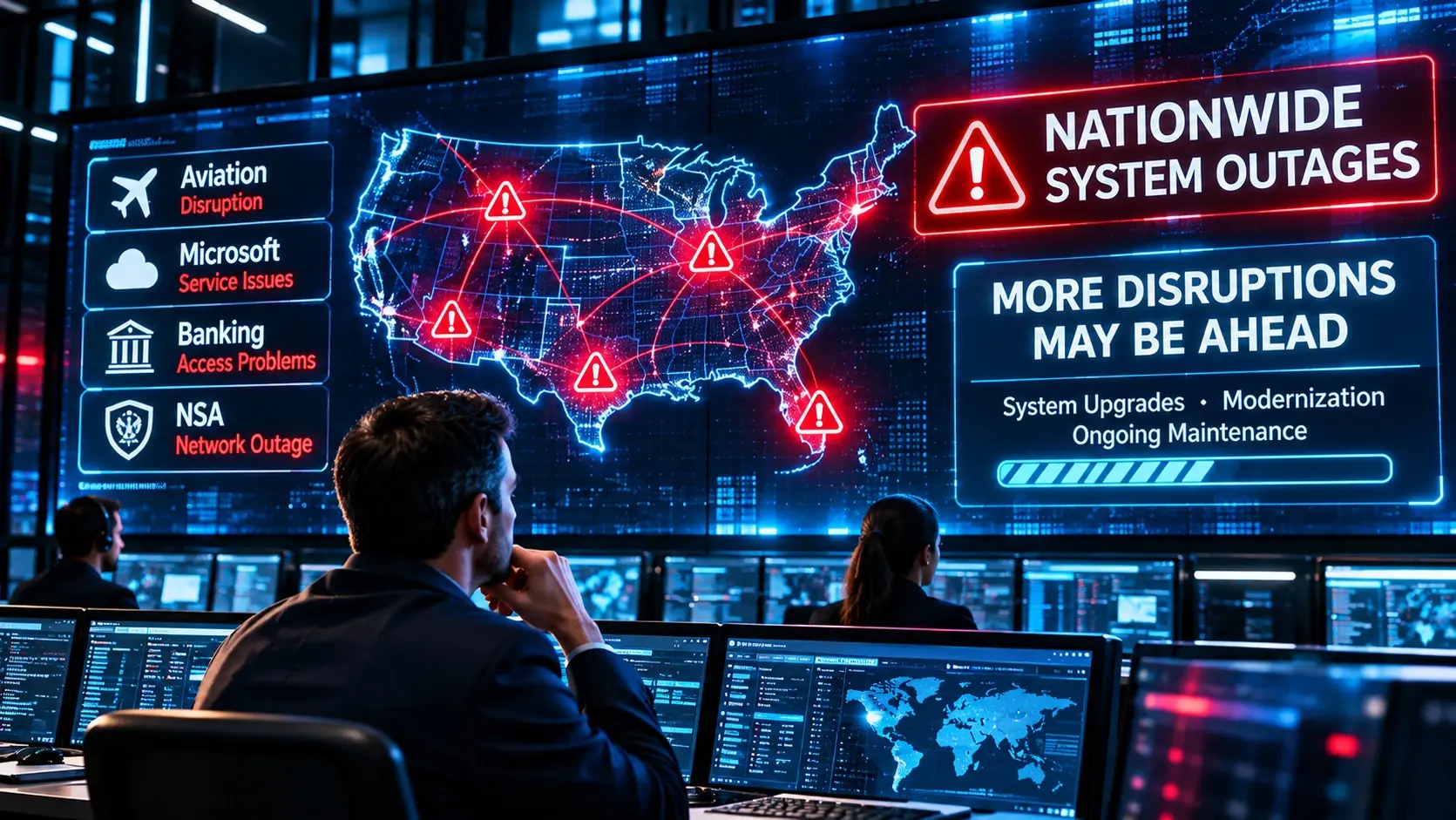
U.S. Intelligence Chief Warns Americans to Expect More Technology Outages
America’s Systems Are Being Upgraded. More Disruptions May Follow.
The Director of National Intelligence has delivered a warning that every American business owner should take seriously.
The recent wave of technology outages may not be over.
After disruptions involving air traffic control, Microsoft services, major banks, and classified government communications, U.S. intelligence chief Jay Clayton says Americans should prepare for additional interruptions as organizations modernize aging infrastructure.
Speaking on CNN’s State of the Union on November 22, Clayton explained that upgrading complex systems can produce unexpected problems.
Glitches.
Service interruptions.
Systems that don’t restart correctly.
And failures that spread beyond the equipment being upgraded.
But perhaps the most important part of his message was what intelligence officials have not found.
The recent outages do not appear to be part of a coordinated or state-sponsored cyberattack.
That doesn’t mean America’s infrastructure is operating perfectly.
It means the underlying problem may be something businesses have been struggling with for years.
Technology has become extraordinarily complex, interconnected, and difficult to modernize without disrupting the systems that depend on it.
And now, the nation’s top intelligence official is warning that more interruptions may be ahead.
What Exactly Did Jay Clayton Say?
During Sunday television appearances, Clayton discussed the recent nationwide technology disruptions and the growing need to modernize digital infrastructure.
His message was that the United States faces a substantial transition as aging systems are updated to meet modern computing and cybersecurity requirements.
He described a future involving more investment in technology, greater cybersecurity spending, and occasional service interruptions during upgrades.
Clayton also emphasized that intelligence agencies had examined whether the recent outages were connected.
According to his assessment, the incidents were neither coordinated nor state-sponsored.
That conclusion is significant.
Over the past two weeks, Americans have watched critical services become temporarily unavailable.
Airplanes were grounded.
Banking services experienced interruptions.
Microsoft applications stopped working for some customers.
And the National Security Agency reported problems involving its internal network.
When multiple major systems experience disruptions within days of one another, people naturally question whether someone is attacking the country’s infrastructure.
Federal officials say the available evidence does not support that explanation for those outages.
Instead, they point to maintenance, patching, hardware changes, and infrastructure upgrades.
Why Would Upgrading Technology Cause Outages?
This may sound counterintuitive.
A company replaces outdated equipment to make its network faster, more secure, and more reliable.
Why would that improvement cause the system to fail?
Because modern technology rarely operates in isolation.
Consider a business replacing an old network router.
The new router may support faster connections, stronger security, and better performance.
But it must also communicate correctly with the company’s existing firewall, switches, servers, and internet provider.
A configuration mistake could interrupt communication.
An unexpected software incompatibility could cause instability.
Or a change in routing behavior could overwhelm another component.
The equipment itself may be functioning exactly as designed.
But the surrounding infrastructure may not respond as expected.
An upgrade can improve one component while temporarily destabilizing the system around it.
The larger and more interconnected the environment, the more complicated these dependencies become.
The FAA Outage: A Perfect Example
On November 13, the Federal Aviation Administration experienced a nationwide telecommunications disruption.
The incident occurred during work to replace aging communications infrastructure.
At a facility in El Dorado, Arkansas, a newly installed router reportedly began generating approximately 1,000 connection attempts every four to five seconds.
That unexpected activity destabilized portions of the network supporting air traffic control.
Communications and radar information became unreliable across multiple facilities.
The FAA responded by ordering a nationwide ground stop.
Thousands of flights were affected.
The investigation involved federal authorities, including the FBI.
But officials reported no indication of malicious activity.
The incident demonstrated how a routine infrastructure upgrade can create consequences far beyond the location where the work is performed.
One problematic network component was associated with a disruption affecting the entire national aviation system.
The router didn’t have to be hacked to create a nationwide emergency.
Microsoft: When a Routine Upgrade Disrupts Millions
Microsoft has also experienced recent service interruptions.
One disruption affecting Outlook was attributed to an issue associated with an earlier network capacity upgrade.
The situation illustrates a challenge facing large cloud providers.
Microsoft operates enormous infrastructure supporting email, collaboration, cloud computing, identity management, and other services.
Customers may view these products as separate applications.
But behind the scenes, they can depend on shared networking, authentication, and infrastructure components.
A problem involving one of those shared services can affect large numbers of customers simultaneously.
For a small business using Microsoft 365, an outage can interrupt email, Teams meetings, document access, and other essential workflows.
The company may have done nothing wrong.
Its computers may be fully operational.
Its firewall may be functioning perfectly.
But if a critical cloud service becomes unavailable, employees may still be unable to work normally.
That is the challenge of modern cloud dependency.
The NSA: Even Classified Networks Require Maintenance
The National Security Agency recently acknowledged a temporary degradation affecting its internal communications network.
The disruption was associated with scheduled maintenance.
The agency stated that mission-critical capabilities remained operational.
That distinction matters because a network interruption does not necessarily mean classified information was compromised.
Nor does it establish that foreign intelligence services gained access.
But the incident demonstrates that even highly sensitive government systems require ongoing maintenance and modernization.
And maintenance can introduce operational risk.
No organization is immune from that reality.
Not Microsoft.
Not the FAA.
Not the NSA.
And certainly not the average small business.
Why the Age of Artificial Intelligence Makes This More Complicated
Clayton also connected the need for modernization to rapid changes in computing and artificial intelligence.
AI systems are increasing demand for computing resources, network capacity, data processing, and specialized infrastructure.
Organizations are adopting new applications while continuing to operate systems designed years or decades earlier.
That creates pressure to upgrade.
But AI introduces additional dependencies.
A company might deploy an AI assistant that accesses Microsoft 365, a customer database, and an internal document management system.
The assistant depends on all those services functioning correctly.
If one becomes unavailable, the AI workflow may fail.
If a software update changes how an API behaves, an automated process may stop working.
And if organizations rely heavily on automation without sufficient monitoring or manual alternatives, a technical failure can affect more business processes than expected.
AI doesn’t necessarily make every system less reliable.
But expanding automation increases the importance of understanding dependencies and designing appropriate safeguards.
The Hidden Danger: Single Points of Failure
One of the most important lessons from these outages involves a concept called a single point of failure.
Imagine a business with 50 employees.
It has two internet connections.
One from Verizon.
Another from Optimum.
Management assumes the company has complete internet redundancy.
But both connections terminate at the same firewall.
If that firewall fails, both connections become unusable.
The business has redundant internet service but still depends on one critical device.
Or consider a company with multiple cloud applications.
Its accounting system, document management platform, and internal business applications all depend on one identity provider.
If that authentication service becomes unavailable, employees may lose access to several systems simultaneously.
These shared dependencies can turn one technical problem into a much larger disruption.
Redundancy only works when the backup doesn’t depend on the same thing that failed.
What This Means for Small Businesses
The warning from America’s intelligence chief should not be interpreted as a prediction that every company will experience an outage.
But it is a reminder that organizations should prepare for disruptions involving technology providers and infrastructure they do not control.
Consider a medical practice.
Its electronic health records, appointment scheduling, billing, and phones may all depend on cloud connectivity.
An internet or cloud outage could interrupt several essential functions simultaneously.
A law firm may depend on Microsoft 365, cloud document management, and remote access.
A school may rely on online student records and communications.
A retailer may need internet connectivity to process payments.
A manufacturer may depend on networking infrastructure to support production systems.
Each organization faces different consequences.
But the common problem is dependence on technology that may occasionally become unavailable.
This is where a managed IT provider should do more than install antivirus software and respond to helpdesk tickets.
It should help the organization understand critical dependencies and prepare for failures.
Seven Steps Businesses Should Take Before the Next Outage
1. Identify Your Most Critical Systems
Determine which applications and services are essential to daily operations.
For most businesses, this includes internet connectivity, email, phone systems, accounting, and industry-specific applications.
2. Evaluate Internet Redundancy
Consider whether a secondary internet connection is appropriate.
Where possible, use connections with different physical or provider dependencies.
Make sure failover is configured and tested.
3. Review Firewall and Network Resilience
Identify whether a single firewall, switch, or router failure could interrupt the entire business.
For organizations requiring high availability, evaluate redundant hardware and appropriate failover configurations.
4. Establish Alternative Communication Methods
If Microsoft 365 or the primary phone system becomes unavailable, employees should know how to communicate.
Maintain appropriate emergency contact information and alternate procedures.
5. Test Backups and Recovery
Backups protect information, but they do not necessarily guarantee that applications remain available during an outage.
Organizations should test restoration procedures and understand realistic recovery times.
6. Implement Formal Change Management
Significant technology changes should include documentation, configuration backups, testing, monitoring, and rollback procedures.
This reduces the likelihood that a routine upgrade becomes a business-wide interruption.
7. Create a Business Continuity Plan
Determine how essential operations will continue if critical systems become unavailable.
That may involve manual procedures, alternative connectivity, offline records, or temporary workflows.
The plan should be documented and tested.
Why Cybersecurity Alone Isn’t Enough
Most businesses think of cybersecurity as preventing hackers from stealing information.
That’s important.
But information security also involves ensuring that systems remain available and that information remains trustworthy.
A company can have strong endpoint protection, multifactor authentication, email security, and backups.
Yet it can still suffer a major outage caused by a failed router or cloud service.
That doesn’t mean the security investments were wasted.
It means protection against malicious activity is only one part of operational resilience.
Businesses also need infrastructure monitoring, recovery procedures, vendor oversight, and contingency planning.
The goal is not to guarantee that nothing will ever fail.
No organization can make that promise.
The goal is to limit the consequences when failure occurs.
Does This Mean the Recent Outages Are All Connected?
No confirmed evidence establishes that the recent FAA, NSA, Microsoft, and banking disruptions were part of one coordinated cyberattack.
Federal officials have repeatedly stated that their investigations found no indication of a common state-sponsored campaign behind those service outages.
However, separate suspected cyber intrusions involving federal systems, including the FBI’s National Crime Information Center, remain distinct investigative matters.
Those incidents should not be dismissed simply because other outages were attributed to maintenance.
A suspected intrusion and a routine service failure are different events.
Each requires its own evidence and technical investigation.
This distinction is essential to accurate cybersecurity reporting.
Not every outage is a cyberattack. And not every cyberattack causes an outage.
The Bigger Question: How Much Disruption Should Americans Accept?
Clayton’s comments raise a legitimate policy and operational question.
If organizations know that upgrades may cause service interruptions, how much disruption is acceptable?
A brief outage during a scheduled maintenance window may be manageable.
A nationwide aviation ground stop is a different matter.
Critical infrastructure requires particularly careful planning because failures can affect public safety, economic activity, and essential services.
Modernization is necessary.
But the risks associated with modernization should be managed through rigorous testing, controlled deployment, independent redundancy, and transparent incident reporting.
The public should not have to choose between outdated infrastructure and unreliable upgrades.
The objective should be secure systems that can be modernized without unnecessary widespread disruption.
The Bottom Line: Prepare for Outages Before They Happen
America’s intelligence chief has warned that additional technology disruptions may occur as companies and government agencies upgrade aging infrastructure.
The warning follows a series of significant outages affecting aviation, cloud services, banking, and government communications.
There is no established evidence that those service failures were part of a coordinated cyberattack.
But their consequences reveal how dependent modern organizations have become on complex digital infrastructure.
For businesses, the message is straightforward.
Don’t wait until Microsoft 365 becomes unavailable to decide how employees will communicate.
Don’t wait until the firewall fails to discover that both internet connections depend on it.
Don’t wait until a cloud outage to learn that critical records are inaccessible.
And don’t wait until a failed upgrade to discover that nobody documented the previous configuration.
Cybersecurity protects against malicious threats.
Resilience protects your ability to keep operating when technology fails.
The next major outage may not be an attack. But without a plan, your business could still become a casualty.
70% of all cyber attacks target small businesses, I can help protect yours.
#Cybersecurity #ManagedIT #BusinessContinuity #ITResilience #CriticalInfrastructure