
By
Gigabit Systems
September 2, 2026
•
20 min read
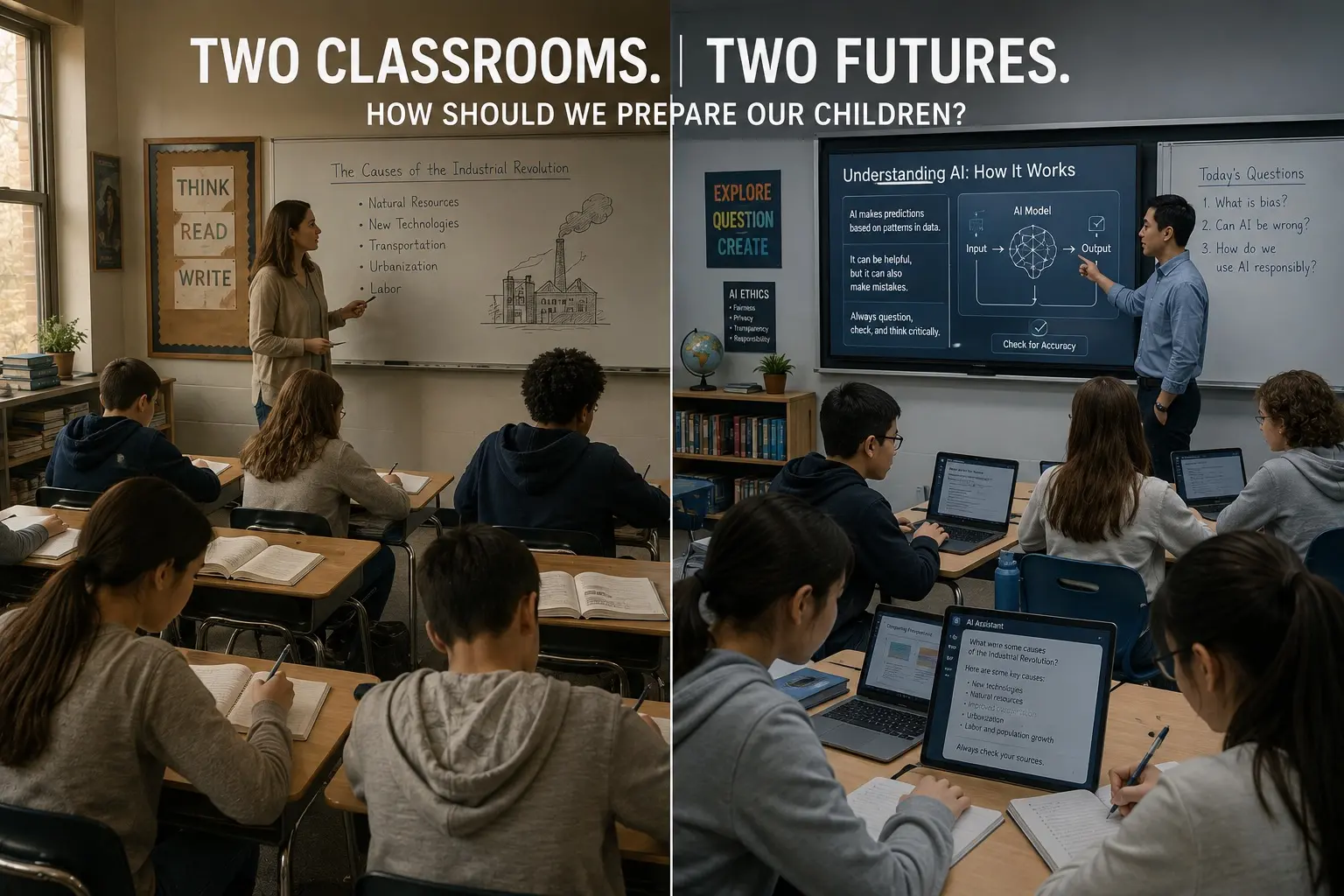
New York Is Banning AI for 600,000 Students. China Is Teaching It.
One education system sees a danger. Another sees a necessary skill.
New York City is about to make one of the biggest educational technology decisions in America.
Beginning this school year, nearly 600,000 public-school students from preschool through eighth grade will largely be prohibited from using student-facing generative AI in school.
No ChatGPT writing the essay.
No AI tutor answering the homework question.
No chatbot helping a seventh grader work through an assignment.
The restrictions cover roughly two-thirds of the nation’s largest public-school system.
And I understand why.
I’ve written recently about the MIT experiment that found substantially different cognitive engagement when people used an LLM to write essays compared with people who performed the work themselves.
Children need to learn to:
Read.
Write.
Calculate.
Remember.
Struggle.
Analyze.
Form arguments.
Solve problems.
Think.
We absolutely should not hand a seven-year-old ChatGPT and allow it to do those things for them.
But there’s another side to this decision that bothers me.
AI isn’t going away.
And while New York is restricting children from using it, China is deliberately teaching children how it works.
China Chose Almost the Opposite Approach
In 2024, China’s Ministry of Education issued guidance calling for AI education to become a regular component of primary and secondary education.
And Beijing subsequently established a particularly concrete requirement.
Beginning with the 2025 fall semester, schools across Beijing were instructed to provide at least eight class hours of AI education every school year, covering students from primary school through high school.
But here’s what’s particularly interesting.
They aren’t teaching every age the same way.
For younger primary-school students, the emphasis is awareness and exposure.
As children get older, the curriculum progresses toward understanding and using AI.
By high school, students move toward practical applications, projects and innovation.
And the curriculum explicitly incorporates AI ethics and responsible use.
That’s very different from:
Here’s ChatGPT. Have fun.
It’s education.
And that distinction matters enormously.
Maybe We’re Asking the Wrong Question
The debate in America often becomes:
Should children use AI?
I don’t think that’s the right question anymore.
The question should be:
What should a child understand about AI at each age, and when should they be permitted to use it?
Those aren’t the same thing.
A six-year-old probably shouldn’t be asking an LLM to write a book report.
But should a six-year-old begin understanding that computers can generate information and that information isn’t necessarily true?
Absolutely.
Should a ten-year-old understand that AI can fabricate convincing answers?
Yes.
Should a twelve-year-old understand prompts, hallucinations, bias, privacy and why you shouldn’t paste personal information into an AI system?
I think so.
Should an eighth grader understand how to use AI to challenge an argument without having AI create the argument for them?
I’d argue that’s becoming basic digital literacy.
We Made This Mistake With Technology Before
For years, schools treated technology as something separate from education.
Then suddenly every profession required computers.
We had to teach computer literacy.
Then the internet arrived.
Schools initially worried about students using the internet.
Understandably.
The internet contained misinformation.
Pornography.
Predators.
Distractions.
Plagiarism.
Viruses.
Scams.
So we built filters.
Created acceptable-use policies.
Taught internet safety.
Developed digital literacy.
And eventually recognized something obvious:
Protecting children from the internet could not mean raising children who didn’t understand the internet.
AI presents the same problem on a much larger scale.
The MIT Study Actually Strengthens the Argument for Teaching AI
At first glance, the recent MIT research seems like a great argument for New York’s approach.
Researchers had participants write essays using an LLM, a search engine, or no technological assistance while measuring their brain activity with EEG.
The people who performed the task without technological assistance showed the strongest neural connectivity.
LLM users showed the weakest.
They also had more difficulty recalling their own work.
That’s concerning.
But one of the experiment’s most interesting findings came when researchers changed the conditions.
Participants who first performed the intellectual work themselves and later gained access to AI showed stronger engagement and recall than those who began by outsourcing the task to an LLM.
The lesson may not be:
Don’t use AI.
It may be:
Learn to think before you learn to outsource thinking.
And that’s precisely why schools need an AI curriculum.
Teach the Brain First. Then Give It the Machine.
This is the educational model I’d rather see.
A student gets a question:
What caused the American Revolution?
Before touching AI:
What do you remember?
Write your argument.
Identify the evidence.
Organize your thoughts.
Explain your reasoning.
Then AI becomes available.
Now ask:
Challenge my argument.
What important factor did I overlook?
Give me an opposing interpretation.
Which of my claims requires stronger evidence?
Don’t rewrite this. Tell me where my reasoning is weak.
Suddenly AI isn’t doing the student’s thinking.
It’s forcing the student to think harder.
That’s an extraordinary educational tool.
But students have to be taught to use it that way.
Because They’re Going to Use AI Anyway
This is the practical problem with prohibition.
A seventh grader leaves school.
Pulls out an iPhone.
Opens ChatGPT.
Or Gemini.
Or another AI application.
Or uses AI embedded inside software that doesn’t even look like an AI chatbot.
The school hasn’t eliminated AI.
It has simply moved AI use outside the environment where a teacher can teach the student how to use it properly.
That’s what concerns me.
Banning a technology isn’t the same as teaching someone to resist its weaknesses.
Imagine Schools Had Banned Google Until High School
There’s a legitimate argument that Google made certain kinds of learning easier.
Why memorize something when you can search it?
Why know where something is when Google Maps can navigate?
Why remember a phone number when your phone remembers?
Technology absolutely causes cognitive offloading.
But imagine responding by telling children:
You may not use a search engine until ninth grade.
That would protect some traditional skills.
It would also produce eighth graders who had never been systematically taught:
How to search.
How to evaluate sources.
How to distinguish an advertisement from information.
How to identify misinformation.
How to compare conflicting sources.
How to recognize a fraudulent website.
Those became essential literacy skills.
AI literacy is heading in the same direction.
The Future Employee Won’t Be Asked Whether They Know AI
Think about the students entering kindergarten today.
They graduate high school around 2039.
What does the workplace look like then?
I don’t know.
Nobody does.
But I would make one fairly safe prediction:
Artificial intelligence will not be less important.
Medicine will use AI.
Law will use AI.
Accounting will use AI.
Engineering will use AI.
Cybersecurity will use AI.
Software development will use AI.
Finance will use AI.
Marketing will use AI.
Manufacturing will use AI.
Education itself will use AI.
We’re preparing children for a labor market we cannot fully imagine.
Teaching them nothing about one of its foundational technologies until high school seems like a strange solution.
China Understands This as a Competition
This is the part Americans should pay attention to.
China’s Ministry of Education didn’t frame AI literacy merely as a convenient classroom tool.
Its guidance says the objective includes cultivating innovative talent capable of confronting future challenges, developing thinking and problem-solving abilities, and improving digital literacy.
Beijing’s curriculum goes from basic understanding toward reasonable use and eventually innovative application.
And this isn’t some tiny experimental program.
By the end of 2025, Beijing reported AI applications had reached 87.7% of its schools.
There is an obvious strategic component here.
The countries that dominate AI won’t merely be the countries with the largest models.
They’ll need:
Researchers.
Engineers.
Entrepreneurs.
Scientists.
Cybersecurity professionals.
Doctors.
Teachers.
Lawyers.
And millions of ordinary workers who understand how to collaborate effectively with intelligent machines.
That’s workforce development.
But New York Isn’t Crazy
There’s another side to this.
And it’s important.
New York City isn’t saying:
AI doesn’t matter.
In fact, NYC Public Schools’ own guidance explicitly acknowledges that AI is already shaping careers and industries and says students need to learn how to use it responsibly.
The school system is worried about something legitimate.
Young children are still developing foundational cognitive abilities.
If AI supplies the paragraph before a child learns to construct one, that’s a problem.
If AI solves the math problem before the child develops number sense, that’s a problem.
If AI summarizes the book instead of the child reading it, that’s a problem.
If AI answers every difficult question before the student experiences the frustration of figuring something out:
That’s a problem too.
Learning isn’t merely acquiring the correct answer.
The process of getting there matters.
So I Agree With Half of New York’s Idea
Protect foundational learning.
Absolutely.
There should be assignments where AI is completely prohibited.
There should be classrooms where screens disappear.
Children should write by hand.
They should memorize things.
They should read entire books.
They should calculate.
They should debate.
They should sit with a difficult problem without immediately asking a machine for the answer.
They should learn what their own brain can do before delegating everything to one in the cloud.
But that does not require pretending AI doesn’t exist until ninth grade.
Teach AI Without Letting AI Do the Work
Imagine an elementary-school AI curriculum where students don’t even need unrestricted access to an LLM.
A teacher shows an AI-generated picture.
What’s wrong with it?
A chatbot provides three facts.
Which one did it invent?
The class compares a human-written paragraph with an AI-generated one.
Which is better?
Why?
Students learn:
AI can sound confident and be wrong.
AI doesn’t “know” something simply because it says it.
Don’t give AI private information.
AI can reproduce bias.
AI-generated pictures and videos can be fake.
People can use AI to impersonate others.
Verify important information.
That’s AI education.
And frankly, children may need those lessons before high school.
By Middle School, I’d Go Further
Teach prompting.
But not:
Write my homework.
Teach:
Explain this concept three different ways.
Quiz me without giving me the answer.
Challenge my reasoning.
Give me hints one at a time.
Help me understand why my answer is wrong.
Ask me questions until I can explain this myself.
That’s the difference between using AI as an answer machine and using AI as a learning machine.
One can weaken the educational process.
The other could potentially make personalized tutoring available to almost every child.
That possibility is too important to dismiss.
AI Literacy Should Include Knowing When NOT to Use AI
This may be the most important lesson of all.
Real AI literacy isn’t knowing how to prompt ChatGPT.
It’s knowing:
When AI is useful.
When it isn’t.
When to trust it.
When to verify it.
What information never belongs in it.
When using it would defeat the purpose of an assignment.
When you need to struggle yourself.
When AI should challenge your thinking.
And when you should close the laptop and think.
That is a sophisticated skill.
It requires education.
This Is Also a Cybersecurity Issue
Children are growing up in a world of AI-generated:
Voices.
Photos.
Videos.
Messages.
Websites.
Emails.
Scams.
Impersonation.
Misinformation.
Eventually they will receive a phone call that sounds exactly like their mother.
A video that looks real.
A message supposedly written by their boss.
A website generated specifically to manipulate them.
AI literacy isn’t merely career preparation anymore.
It’s becoming a cybersecurity skill.
Teaching children how generative AI works may ultimately be as important to digital safety as teaching them not to share their passwords.
America’s Students Shouldn’t Become AI Consumers
This is the strategic risk I see.
If one education system teaches children:
Understand this technology. Experiment with it. Learn its limitations. Eventually build with it.
And another teaches:
Stay away from it until you’re older.
Which group is more likely to become creators?
Which becomes consumers?
Which develops intuition earlier?
Which is more comfortable experimenting?
Which is more likely to build the next generation of technology?
Obviously, eight hours of AI instruction in Beijing doesn’t guarantee China wins the AI race.
And banning student-facing generative AI through eighth grade doesn’t doom New York students.
But the philosophies are worth comparing.
Because they’re radically different responses to the same technological revolution.
We Don’t Protect Children by Preparing Them for Yesterday
New York is right about the danger.
AI can short-circuit learning.
It can make cheating effortless.
It can replace productive struggle.
It can hallucinate.
It can expose children’s information.
And used badly, it can allow a student to produce impressive work while learning almost nothing.
Those are real problems.
But AI will also be one of the defining technologies of these children’s lives.
So the answer cannot ultimately be:
Keep it away from them.
It has to become:
Teach them to control it before it controls how they think.
Protect foundational skills.
Restrict AI where the learning requires independent thought.
Delay unrestricted use for younger children.
But simultaneously teach AI literacy from an early age.
Teach what it does.
Teach what it cannot do.
Teach how it manipulates.
Teach how it fails.
Teach how to verify it.
Teach privacy.
Teach ethics.
Teach prompting.
Teach deepfakes.
Teach students to create with it.
And above all:
Teach them that the machine should amplify their intelligence—not replace it.
China appears to understand that AI literacy is part of preparing children for the future.
New York understands that children’s brains need protection while they’re developing.
The smartest education system will figure out how to do both.
70% of all cyber attacks target small businesses, I can help protect yours.
#ArtificialIntelligence #Education #Cybersecurity #AILiteracy #FutureOfWork
New York is banning AI for nearly 600,000 students through 8th grade. Beijing requires children to learn it. One of them may be making a very expensive mistake.
what technology should today’s schools prepare this child to understand?