
By
Gigabit Systems
•
20 min read
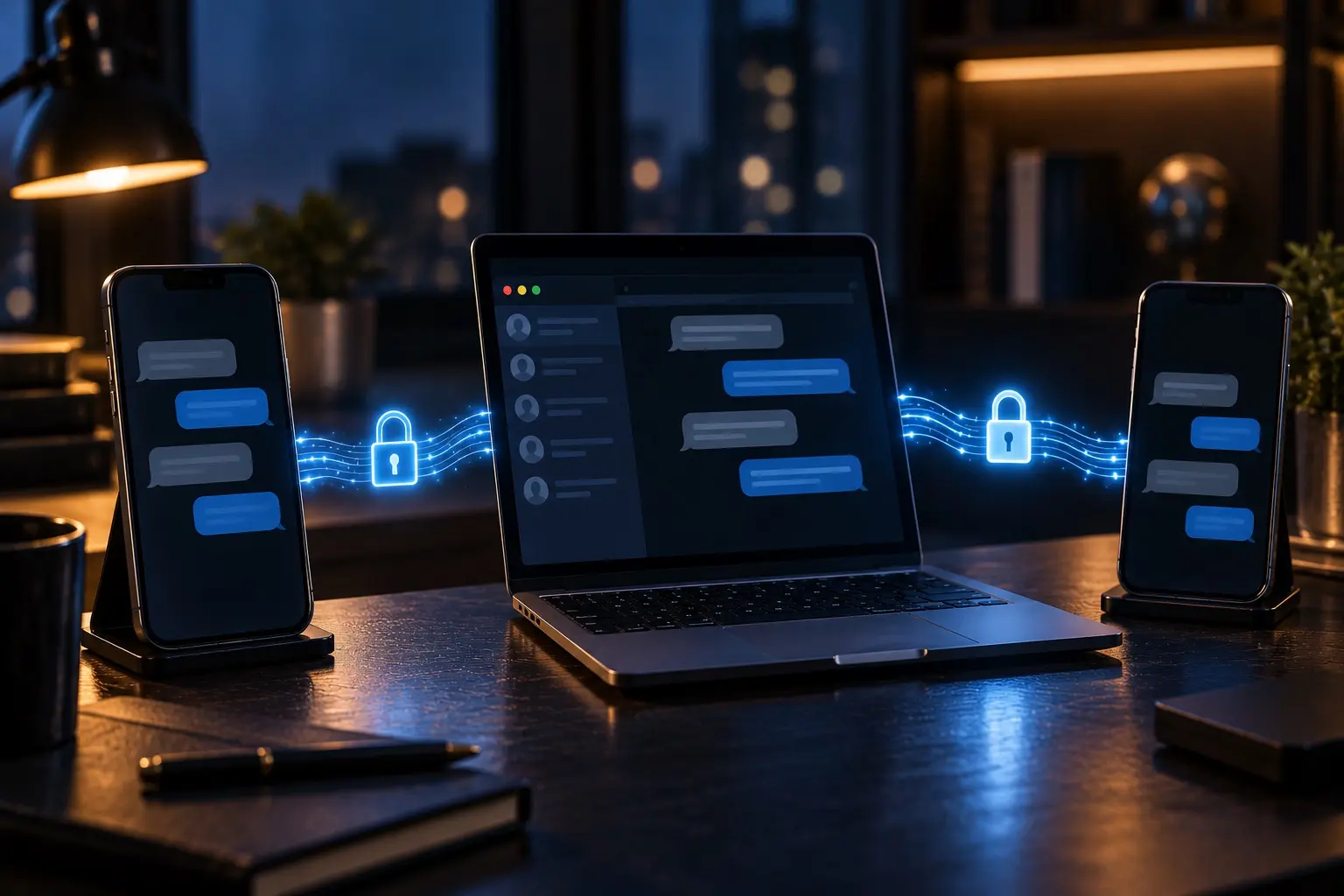
Police Can Read WhatsApp and Signal Without Breaking Encryption
The encryption works. Police simply joined the conversation.
For years, one of the biggest arguments surrounding encrypted messaging has sounded like this:
Police want access.
WhatsApp and Signal say they can’t provide it.
Governments complain that criminals are “going dark.”
Security experts warn that creating an encryption backdoor would weaken security for everyone.
But German investigators have been using a remarkably simple alternative.
Don’t break the encryption. Become one of the authorized devices.
Newly published internal documents from Germany’s Customs Criminal Police Office reveal an investigative technique called “messenger monitoring.”
It can allow authorities to monitor communications through services including WhatsApp, Telegram and Signal without cracking the encryption protecting messages in transit.
The technique exploits something millions of ordinary users rely on every day:
Linked devices.
Think About WhatsApp Web
You probably already understand the technology.
Open WhatsApp on your computer.
Link the computer to your account.
Now messages appear on your phone and your computer.
Nobody broke WhatsApp’s encryption.
Your computer simply became another authorized endpoint.
The German technique applies that same basic concept to surveillance.
Get a police-controlled computer authorized as a linked device.
Messages intended for the account can then arrive on that machine in readable form.
The encryption still works perfectly.
The police computer is now on the inside.
This Is Not an Encryption Backdoor
That’s the most important distinction in this story.
End-to-end encryption protects a message while it travels between authorized endpoints.
Imagine Alice sends Bob a Signal message.
On Alice’s device, the message exists in readable form.
It gets encrypted.
It travels across the internet.
Signal’s infrastructure handles encrypted information.
It reaches Bob.
Bob’s device decrypts it.
Encryption protects the journey.
But Bob eventually needs to read the message.
So somewhere, by definition, the message becomes readable again.
End-to-end encryption protects the space between endpoints. It cannot protect you from an endpoint that has legitimately been added to the conversation.
Germany Calls It “Messenger Monitoring”
According to the internal German document published by Netzpolitik, the Customs Criminal Police Office began testing the capability toward the end of 2023.
The pilot apparently worked well enough that officials said it produced significant investigative successes involving serious and organized crime.
In August 2025, the technique moved from a trial into permanent operational availability for customs investigators.
The document describes the technique as a way to record data exchanged through instant messengers without having to infiltrate the IT system with surveillance software.
That last part matters.
Germany already has another controversial method for dealing with encrypted communications.
Government hacking.
The Traditional Solution Is a Government Trojan
If investigators can’t intercept a Signal message while it’s encrypted, they can theoretically attack the phone itself.
Install surveillance software.
Capture information before encryption.
Or capture it after decryption.
Germany calls this source telecommunications surveillance—often discussed in connection with the infamous Staatstrojaner, or state trojan.
The concept is straightforward.
You don’t defeat Signal.
You compromise the device running Signal.
German legal and technical analysis has described precisely this endpoint approach: encrypted communications become accessible at the source because the content necessarily exists in readable form before encryption or after decryption.
Messenger monitoring potentially provides another route.
Instead of secretly installing malware:
Make the investigator’s computer an endpoint.
And There’s Evidence Police Have Actually Done It
Netzpolitik describes a particularly revealing case involving parents who went to police as witnesses concerning their daughter.
Police wanted to examine WhatsApp communications with the daughter.
According to the reporting, the parents voluntarily provided their phones.
But investigators allegedly went considerably further than simply examining the existing messages.
Police used the phones to authorize WhatsApp Web on a police computer.
From that point, the police machine could reportedly continue receiving future WhatsApp communications.
Netzpolitik reports that the resulting access also exposed broader archived communications and could technically permit messages to be sent through the account—capabilities that raised serious questions about whether investigators had exceeded their legal authority.
That case demonstrates why this isn’t merely a theoretical vulnerability.
The functionality exists because users want it.
The QR Code Is Essentially an Authorization Ceremony
Think about what happens when you link WhatsApp to a computer.
The computer presents something.
Your authenticated phone approves it.
The service establishes trust.
The computer becomes associated with the account.
From a security perspective, that approval is enormously important.
You’re effectively saying:
“This computer is allowed inside my encrypted communications.”
The same principle applies throughout cybersecurity.
When you approve a new device, you’re not weakening encryption.
You’re expanding the trusted perimeter.
This Is the Same Lesson as the Apple Handoff Story
We just discussed Apple’s new iPhone Handoff capability.
One telephone number.
Multiple authorized pieces of hardware.
The technology itself isn’t necessarily insecure.
The important question becomes:
Who is allowed to add another endpoint?
That same question applies here.
Signal can have excellent cryptography.
WhatsApp can have excellent cryptography.
But if another device becomes legitimately enrolled into the account, the encryption can continue functioning exactly as designed.
The trust boundary simply changed.
Encryption Can’t Protect You From Someone Inside the Endpoint
This is one of the most misunderstood concepts in cybersecurity.
People hear:
“Signal is end-to-end encrypted.”
And interpret that as:
“Nobody can ever read my Signal messages.”
That’s not what encryption promises.
It protects communications against particular kinds of interception.
If someone unlocks your phone, they can potentially read your messages.
If malware compromises your phone, it may be able to capture information.
If screenshots are taken, encryption doesn’t erase them.
If your recipient forwards your message, encryption doesn’t stop them.
If a linked computer is authorized, that computer may receive communications.
Encryption protects the tunnel. It does not magically secure everything at either end of the tunnel.
The United States Has the Same Fundamental Reality
This is where I would slightly modify the viral framing.
It would be tempting to write:
“Germany does this, and U.S. agencies do exactly the same thing to Americans.”
We shouldn’t claim the exact same linked-device technique without evidence.
But U.S. investigators absolutely confront the same cryptographic reality.
For example, Signal’s own disclosures concerning U.S. government requests repeatedly emphasize that Signal cannot turn over messages it doesn’t possess.
In March 2026, Signal published details of a federal grand-jury subpoena from the District of Columbia and again explained that it doesn’t possess users’ messages, calls, contacts, groups and much of the other information investigators might seek.
That’s the beauty of good end-to-end encryption.
There isn’t a giant database of everyone’s readable Signal messages waiting for a subpoena.
So investigators look elsewhere.
The Endpoint Becomes the Target
This is why commercial spyware matters so much.
We’ve previously discussed tools capable of compromising smartphones and accessing information associated with encrypted applications.
Again:
That doesn’t mean Signal’s encryption was cracked.
It means the attacker got close enough to the human to see the message where the human sees it.
Imagine sending a confidential letter through an armored truck.
Nobody can open the truck.
Nobody can intercept the package.
Nobody can break the lock.
Fantastic security.
Then someone installs a camera above your desk.
The armored truck still worked perfectly.
The attacker simply waited until you opened the envelope.
That’s endpoint compromise.
This Is Why “Military-Grade Encryption” Can Be a Misleading Sales Pitch
Businesses love saying:
“Your information is protected with military-grade encryption.”
Great.
What happens after it is decrypted?
Who can access the laptop?
What applications can read the information?
What browser extensions are installed?
Is the endpoint protected with EDR?
Can administrators remotely access it?
Are sessions protected?
Can another device be enrolled?
Can employees approve MFA prompts?
Can malware take screenshots?
Can an AI assistant access the files?
Encryption is enormously important.
But encryption is one layer.
Cybersecurity failures usually happen around the encryption, not through it.
Linked Devices Are a Security Boundary
Open WhatsApp.
Look at your linked devices.
Do the same with other important services.
How many computers are authorized?
Do you recognize every one?
When did you last use them?
Did you ever link a hotel computer?
An old laptop?
A previous work machine?
A device you sold?
A machine that somebody else can access?
This isn’t paranoia.
An authorized session can sometimes be dramatically more valuable than a password.
Attackers increasingly understand that.
Attackers Don’t Always Want Your Password
Passwords trigger alarms.
Login from Russia?
Blocked.
Wrong password?
Blocked.
New MFA request?
Suspicious.
But what if an attacker steals an existing session?
What if they convince you to approve their device?
What if they trick you into scanning a QR code?
What if they compromise a machine that’s already trusted?
Now the attacker isn’t necessarily fighting authentication.
They’re inheriting trust that was already granted.
That’s why session-token theft has become such an important threat.
And it’s why Zero Trust needs to mean more than putting MFA on accounts.
QR Codes Deserve More Suspicion
There’s another practical lesson here.
People treat QR codes as harmless shortcuts.
Scan this menu.
Scan this parking meter.
Scan this Wi-Fi code.
Scan this to log in.
But a QR code can participate in an authentication process.
If somebody tells you:
“Scan this QR code to verify your account,”
you need to understand exactly what you’re approving.
Because sometimes you’re not verifying yourself.
You’re authorizing them.
This is conceptually similar to MFA fatigue.
The victim performs the security action.
The attacker receives the benefit.
Check Your Linked Devices
For ordinary WhatsApp users, one of the simplest defenses is reviewing linked devices periodically.
WhatsApp provides a Linked Devices section where you can see computers and other devices associated with the account.
Remove anything you don’t recognize.
Signal users should similarly review their linked-device configuration.
And don’t authorize new devices because somebody contacting you unexpectedly tells you to.
Especially not someone claiming to be:
Tech support.
Your bank.
Your employer.
Your carrier.
WhatsApp.
Signal.
Microsoft.
Google.
Or law enforcement.
If the request is legitimate, independently verify it.
Businesses Need to Monitor Sessions, Not Just Passwords
For SMBs, healthcare organizations, law firms and schools, the broader lesson is even more important.
Traditional cybersecurity focused heavily on credentials.
Username.
Password.
MFA.
But modern identity security also needs to understand:
Devices.
Sessions.
Tokens.
Application consent.
OAuth grants.
Browser cookies.
API credentials.
Linked endpoints.
A criminal who steals a valid session may never need the employee’s password.
An attacker who compromises an authorized endpoint may never need to defeat MFA.
A malicious application granted OAuth access may continue operating after the employee changes their password.
Identity doesn’t stop at login anymore.
Encryption Still Matters
Stories like this sometimes generate the wrong conclusion:
“See? Encryption is useless. Police can read it anyway.”
Absolutely not.
End-to-end encryption remains one of the strongest privacy and cybersecurity technologies ordinary people have.
WhatsApp says it cannot provide law enforcement with users’ plaintext message content because the service itself doesn’t possess the keys required to read those communications.
Signal goes even further in minimizing the information it retains.
That’s extraordinarily valuable.
Without encryption, investigators—or criminals, hostile governments, malicious insiders and compromised infrastructure—might intercept communications somewhere along the entire route.
With strong end-to-end encryption, the attack surface gets pushed toward the endpoints.
That’s a huge improvement.
But endpoints still exist.
The Lock Worked
That’s the part of this story worth remembering.
German investigators didn’t necessarily discover some mathematical trick that defeated Signal.
They didn’t announce that WhatsApp’s cryptography had collapsed.
The reported technique is clever precisely because it doesn’t require that.
The lock worked.
So instead of picking the lock, investigators reportedly found a way to become someone the system would willingly let through the door.
That is an extremely old cybersecurity lesson wrapped inside a very modern technology.
The strongest firewall doesn’t matter if someone gets an administrator account.
The strongest encryption doesn’t matter if someone controls the endpoint.
The strongest MFA doesn’t matter if the user approves the attacker.
The strongest access-control system doesn’t matter if someone gets issued a legitimate badge.
Security isn’t only about making the lock stronger.
It’s about controlling who gets a key.
70% of all cyber attacks target small businesses, I can help protect yours.
#Cybersecurity #Signal #WhatsApp #DataPrivacy #ManagedIT
police found a way to read WhatsApp and Signal WITHOUT breaking the encryption. The scary part? The encryption still works perfectly. They simply make a police computer an authorized device.