
By
November 25, 2026
•
20 min read
Project Azorian: How the CIA Secretly Raised a Soviet Submarine From the Bottom of the Pacific
The CIA Built an Entire Ship to Steal Secrets.
It sounds like something out of a James Bond movie.
A billionaire.
A missing Soviet submarine.
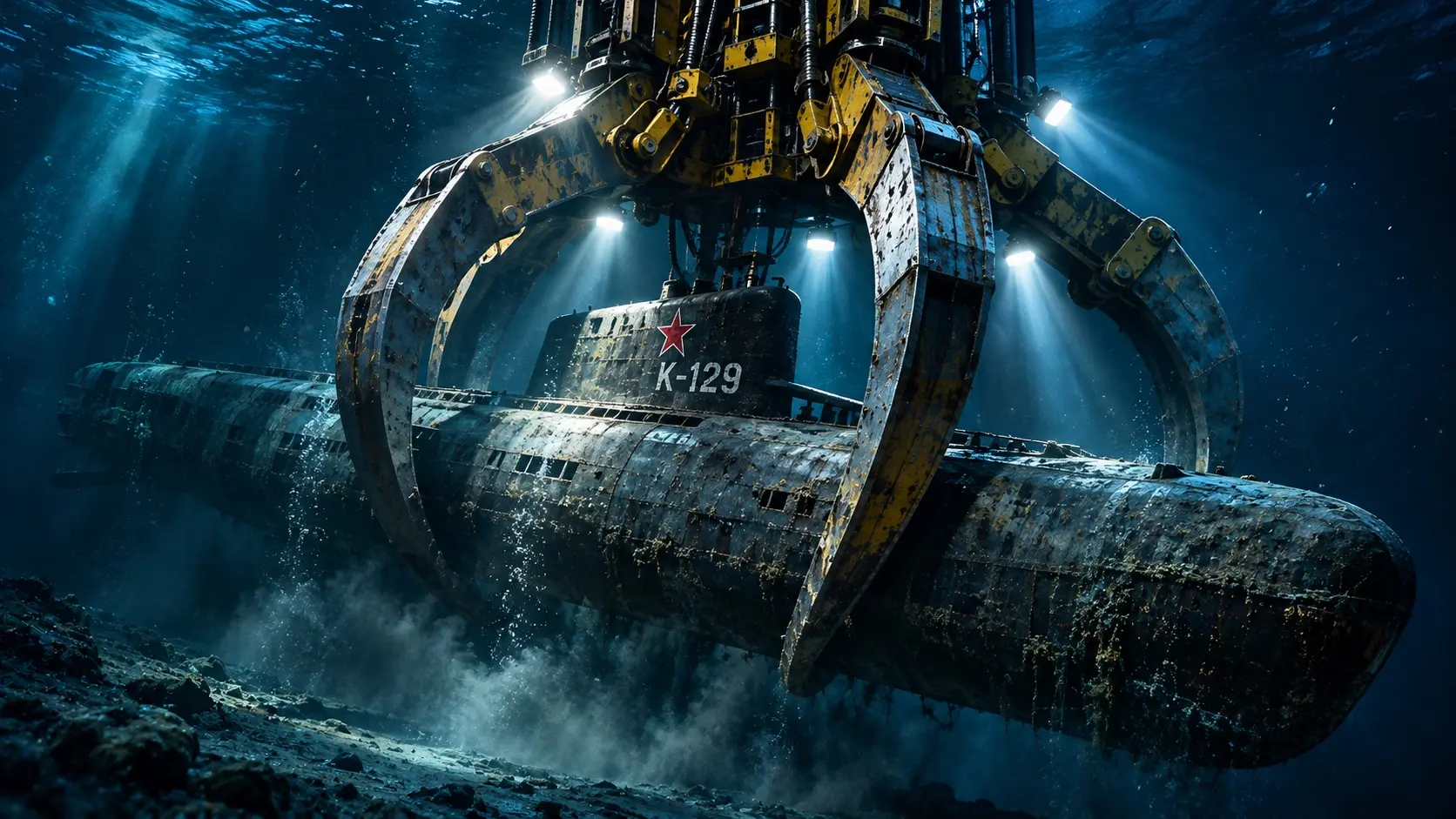
A massive mechanical claw.
A secret intelligence operation conducted three miles beneath the Pacific Ocean.
Except it actually happened.
During the Cold War, the Central Intelligence Agency undertook one of the most ambitious engineering and intelligence operations in American history.
Its objective was to recover part of a sunken Soviet submarine without the Soviet Union discovering what the Americans were doing.
The operation was called Project Azorian.
To accomplish it, the CIA wasn’t simply going to hide information.
It was going to create an entirely different explanation for an enormous industrial project taking place in plain sight.
And the technological, organizational, and information security lessons remain remarkably relevant more than 50 years later.
The Submarine That Disappeared
In 1968, Soviet submarine K-129 departed its base on Russia’s Kamchatka Peninsula for a Cold War patrol.
It never returned.
The submarine and its entire crew were lost.
The Soviet Union launched a search but was unable to locate the wreck.
The United States, however, succeeded in finding it.
Resting approximately 16,500 feet beneath the Pacific Ocean, K-129 represented an extraordinary intelligence opportunity.
Recovering material from the submarine could potentially provide information about Soviet military technology, communications, and strategic capabilities.
But finding the submarine was only the beginning.
Recovering it presented an engineering challenge unlike anything the CIA had previously attempted.
How Do You Lift a Submarine From Three Miles Underwater?
Consider the environment.
At that depth, sunlight cannot penetrate.
Temperatures are close to freezing.
Water pressure exceeds approximately 7,000 pounds per square inch.
Ordinary diving equipment cannot operate under those conditions.
And the submarine section the CIA wanted to recover weighed approximately 1,750 tons.
The agency needed equipment capable of reaching the ocean floor, securing the wreck, and raising an enormous load through miles of water.
It also needed to conduct the operation without revealing its actual purpose.
The solution was an entirely new ship.
Enter Howard Hughes
Howard Hughes was one of America’s most famous industrialists.
His interests included aviation, engineering, manufacturing, and ambitious technological projects.
His involvement in an experimental ocean-mining enterprise seemed entirely plausible.
The CIA enlisted his cooperation to provide a commercial explanation for the construction of an unusual vessel called the Hughes Glomar Explorer.
Publicly, the ship was presented as a technological breakthrough designed to collect mineral deposits from the ocean floor.
Specifically, manganese nodules containing commercially valuable metals.
The explanation accounted for the ship’s unusual appearance, extensive lifting equipment, and ability to operate in extremely deep water.
But the real objective was intelligence collection.
The mining equipment was actually part of an elaborate submarine recovery system.
The Engineering Behind the Glomar Explorer
The approximately 600-foot vessel incorporated specialized equipment designed for extreme deep-ocean operations.
One of its most remarkable features was an internal recovery chamber, commonly called a moon pool.
This opening allowed recovered material to be brought directly into the ship without being displayed on its exterior deck.
The vessel also featured precision positioning equipment, heavy lifting machinery, and a specially designed capture vehicle nicknamed Clementine.
Clementine was essentially an enormous mechanical gripping device.
The ship’s engineers had to account for ocean movement, immense loads, equipment reliability, and the extreme underwater environment.
Even a relatively small mechanical problem could jeopardize years of preparation.
The project required cooperation between intelligence officers, engineers, shipbuilders, and numerous private-sector contractors.
Much of the technology had to be developed specifically for the mission.
It was an extraordinary example of engineering driven by an intelligence requirement.
The Mission That Almost Worked
In the summer of 1974, the Glomar Explorer reached the recovery area.
Despite the presence of curious Soviet vessels, the operation proceeded without its true purpose being publicly exposed.
The capture equipment reached the wreck, and the recovery began.
But during the ascent, the submarine section broke apart.
A substantial portion fell back to the ocean floor.
The recovery crew successfully brought the remaining material into the ship.
Years of preparation had produced only a partial recovery.
The CIA has acknowledged that Project Azorian did not accomplish all its original intelligence objectives.
Nevertheless, the agency considers the operation an important intelligence achievement and a remarkable advancement in deep-ocean engineering.
The full extent of the intelligence recovered remains incompletely disclosed.
Six Soviet Sailors Were Given a Military Burial
Among the material recovered from the submarine were the remains of six Soviet sailors.
What happened next is one of the most remarkable human aspects of the story.
Although the United States and the Soviet Union were adversaries, the sailors were treated with military respect.
They received a formal burial at sea, and the ceremony was filmed.
Nearly two decades later, in 1992, following the dissolution of the Soviet Union, CIA Director Robert Gates presented footage of that ceremony to Russian President Boris Yeltsin.
An operation conceived during one of the most intense periods of Cold War rivalry ultimately produced an opportunity for a gesture of respect between former adversaries.
How an Ordinary Burglary Exposed an Extraordinary CIA Secret
Perhaps the most interesting cybersecurity lesson occurred not at the bottom of the Pacific, but in an office in Los Angeles.
Before the recovery mission began, burglars broke into offices associated with Howard Hughes and stole documents.
Among the stolen material was information connecting Hughes, the CIA, and the Glomar Explorer.
Efforts to recover those documents attracted additional attention.
Journalists began investigating.
In February 1975, the Los Angeles Times published a report connecting the vessel to the submarine recovery operation.
Further national reporting followed in March.
The CIA had been preparing another recovery attempt.
But once the mission became public, the United States could no longer reasonably expect to conduct it under the original commercial explanation.
The planned second operation was canceled.
Think about the significance of that.
The CIA had developed specialized engineering technology, coordinated an enormous industrial undertaking, and maintained secrecy during an operation thousands of miles from the United States.
Yet documents stolen during a burglary helped unravel the entire project.
An organization can invest hundreds of millions in protecting an operation and still be exposed through one overlooked information security risk.
Where “Neither Confirm Nor Deny” Comes From
Project Azorian also left an enduring legacy in government transparency and information security.
When journalists sought records concerning the operation, acknowledging whether those documents existed could itself reveal sensitive information.
The resulting refusal to acknowledge the existence or absence of requested records became known as the Glomar response.
Today, government agencies continue to use this response in certain circumstances involving classified or otherwise protected information.
The concept illustrates something fundamental about information security.
Sometimes the existence of information is itself sensitive.
Consider a business that is secretly negotiating an acquisition.
Merely confirming that documents concerning a particular acquisition exist could reveal confidential business activity, even without disclosing their contents.
The information surrounding a confidential record can sometimes be as revealing as the record itself.
In cybersecurity, this is related to the sensitivity of metadata.
What Project Azorian Teaches Us About Modern Cybersecurity
The technology may belong to the 1970s.
The security principles do not.
1. Information Has Extraordinary Value
The CIA undertook an enormous engineering project because it believed the intelligence potentially contained in a sunken submarine justified the investment.
Modern organizations routinely underestimate the value of their own information.
Customer databases.
Proprietary software.
Financial projections.
Confidential contracts.
Research and development.
Authentication credentials.
These assets may be worth considerably more to an adversary than the physical equipment on which they reside.
Cybersecurity begins with understanding what information needs to be protected and why.
2. Security Is Only as Strong as Its Weakest Dependency
Project Azorian involved government agencies, commercial organizations, contractors, engineering firms, and physical facilities.
Protecting the vessel itself was not enough.
Sensitive information elsewhere could expose the mission.
Modern businesses face the same challenge.
A company may secure its Microsoft 365 environment, deploy endpoint detection, and implement multifactor authentication.
But an outside vendor with access to confidential information could still introduce significant risk.
Third-party cybersecurity and supply-chain security are essential components of protecting an organization.
3. Not Everyone Needs Access to Everything
Sensitive intelligence operations use compartmentalization to restrict access to information.
In modern IT, a related principle is called least privilege.
Employees, contractors, applications, and automated systems should receive only the access required to perform their responsibilities.
A compromised employee account should not automatically provide access to every confidential document in the organization.
An outside vendor should not receive unrestricted administrative privileges simply because doing so makes configuration easier.
And an AI assistant should not automatically receive access to an entire corporate environment.
Restricting access reduces the potential consequences of a compromised identity.
4. Sophisticated Technology Still Requires Failure Planning
The Glomar Explorer represented years of advanced engineering.
Nevertheless, its recovery equipment experienced a serious failure.
Modern businesses often assume that purchasing sophisticated technology eliminates operational risk.
It doesn’t.
Firewalls fail.
Software updates introduce defects.
Cloud platforms experience outages.
Backups may prove incomplete.
Even carefully designed systems can behave unexpectedly under unusual conditions.
Organizations must prepare for failure rather than assuming their investments guarantee success.
5. Physical Security Is Part of Cybersecurity
The burglary associated with Project Azorian demonstrates why information security cannot be limited to digital defenses.
Printed documents, laptops, removable storage devices, unlocked offices, and unattended equipment can all expose sensitive information.
A company may invest heavily in cybersecurity while leaving confidential documents accessible to unauthorized visitors.
Effective security must account for both physical and digital environments.
Why This Matters for Healthcare, Law Firms, Schools, and Small Businesses
Most SMBs will never conduct a classified intelligence operation.
But they routinely handle information that other people would like to obtain.
Healthcare organizations maintain sensitive patient records and financial information that can be valuable to criminals.
Law firms possess confidential communications, privileged documents, litigation strategies, and client financial records.
Schools maintain student information, personnel records, and sensitive administrative data.
Small businesses often possess proprietary processes, pricing information, customer databases, and confidential vendor agreements.
All these organizations depend on employees, technology providers, and external contractors.
And all can experience serious consequences when information escapes through an overlooked dependency.
A managed IT provider should help businesses identify these risks before an incident occurs.
Five Questions Business Owners Should Ask
What information would cause the greatest damage if it were stolen?
Not all business information has the same value. Identify the most sensitive assets and prioritize their protection.
Who has access to that information?
Review employee permissions, administrator accounts, vendor integrations, and external sharing arrangements.
Could a third-party compromise expose our business?
Evaluate outside organizations that process, store, or access sensitive company information.
Are our physical security practices adequate?
Consider office access, equipment protection, confidential document storage, and secure disposal.
What happens when our security controls fail?
Maintain tested backups, documented incident response procedures, alternative communications, and recovery plans.
These questions are straightforward.
But many businesses cannot answer them confidently.
The Bigger Picture: Intelligence Gathering Has Changed
During the Cold War, obtaining access to certain military intelligence could require an operation involving specialized ships, years of engineering, and extraordinary financial resources.
Today, enormous quantities of valuable information reside in digitally connected systems.
A compromised account, poorly protected application, or exposed cloud database can provide access to information that would once have required a significant physical intelligence operation.
The methods have changed.
The value of information has not.
This is why businesses should never dismiss cybersecurity as merely an IT expense.
It is the protection of information that may be fundamental to the organization’s competitive position, financial stability, and continued operation.
The Bottom Line: Your Information Is More Valuable Than You Think
Project Azorian remains one of the most extraordinary engineering and intelligence operations of the twentieth century.
The CIA developed an enormous specialized ship to recover information hidden three miles beneath the ocean.
The operation achieved only part of its original objective, and its secrecy was ultimately undermined by an unexpected security incident.
More than 50 years later, its lessons remain applicable.
Protect information according to its value.
Restrict unnecessary access.
Understand third-party dependencies.
Prepare for technological failures.
And never assume that sophisticated security in one area compensates for overlooked weaknesses elsewhere.
The CIA understood how valuable its adversary’s information could be.
Do you understand how valuable yours is?
You may not need a giant steel claw to steal a company’s secrets anymore. Sometimes, all it takes is one compromised password.
70% of all cyber attacks target small businesses, I can help protect yours.
#Cybersecurity #ProjectAzorian #CIA #InformationSecurity #ManagedIT