
By
Gigabit Systems
•
20 min read
Your iMessage Is Encrypted. Their ChatGPT Can Still Read It.
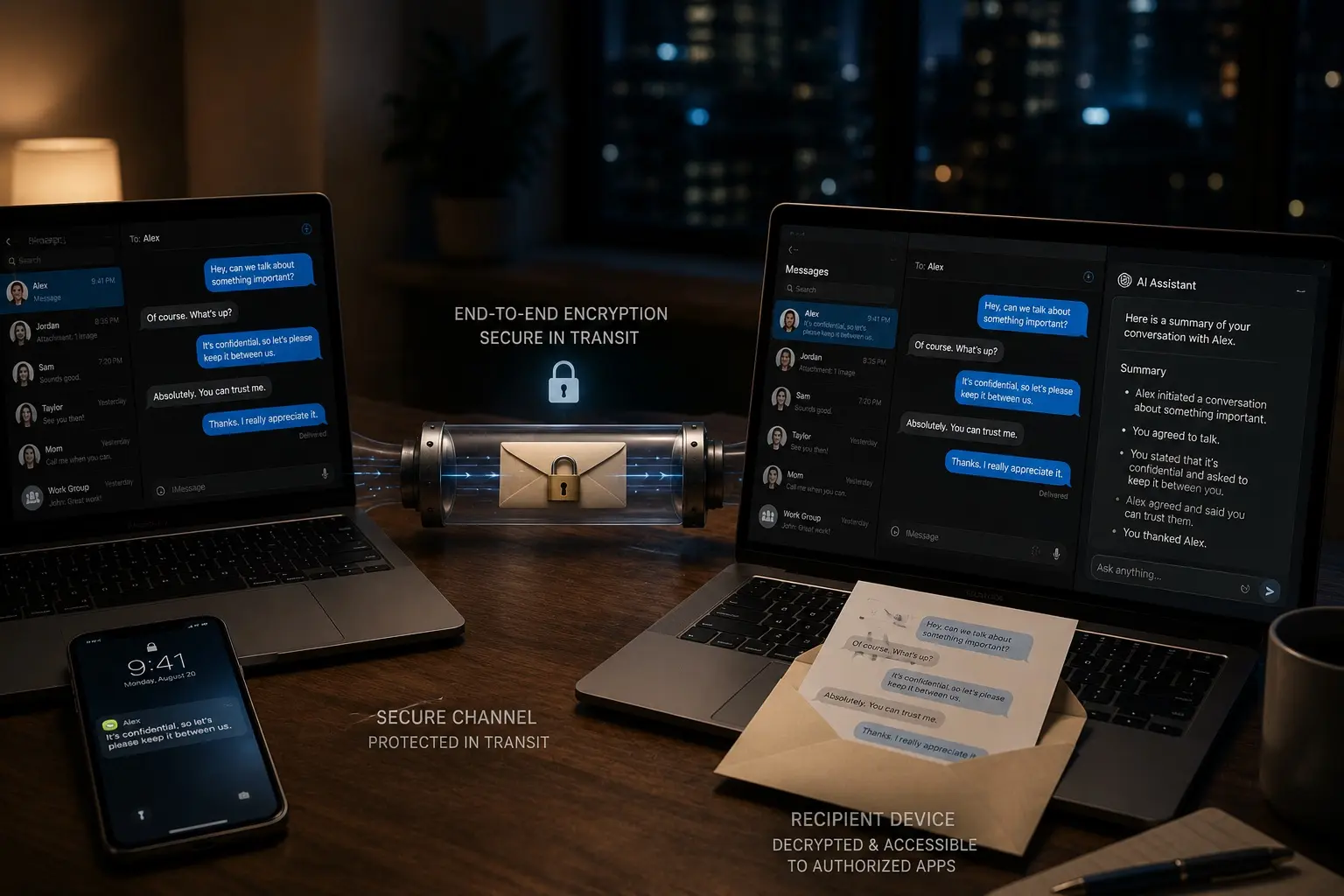
Encryption can’t protect a message after your friend unlocks it.
For years, Apple has marketed iMessage around one extraordinarily important security feature:
End-to-end encryption.
You send a message.
Apple encrypts it.
It travels across the internet.
The recipient’s authorized device decrypts it.
Someone intercepting the traffic shouldn’t simply be able to read the conversation.
That’s incredibly valuable protection.
Then OpenAI introduced something this week that demonstrates an uncomfortable limitation of encrypted messaging:
Encryption protects the journey. It doesn’t control what happens at the destination.
OpenAI’s new Apple Messages plugin can give ChatGPT access to conversations sitting inside Messages on a Mac.
And there’s something particularly interesting about that privacy decision.
You don’t necessarily get to make it.
What OpenAI Actually Released
On August 20, OpenAI announced an Apple Messages plugin for the ChatGPT desktop application on Apple-silicon Macs.
Once installed and authorized, it allows ChatGPT Work and Codex to:
Read Messages conversations.
Search them.
Summarize conversations.
Prepare responses.
And send messages through Apple’s Messages application.
That includes conversations involving:
iMessage.
SMS.
RCS.
OpenAI suggests use cases like finding birthdays mentioned in Messages, identifying follow-ups from yesterday’s conversations or checking your calendar and preparing a text telling someone when you’re available.
That’s genuinely useful.
It’s also an extraordinarily sensitive permission.
Here’s the Part Everyone Should Understand
Imagine you text me:
Here’s something confidential. Please don’t share it.
You use iMessage.
The message is end-to-end encrypted.
Apple’s encryption works exactly as intended.
Nobody breaks the encryption.
Nobody hacks Apple.
Nobody intercepts the message.
It arrives on my Mac.
And now it’s decrypted.
If I’ve deliberately given an AI application permission to access my Messages database, that application can potentially access the conversation on my endpoint when I ask it to.
Your encryption didn’t fail.
It finished its job.
That’s an incredibly important distinction.
This Is Not an iMessage “Backdoor”
Words matter in cybersecurity.
A traditional encryption backdoor would mean creating some mechanism allowing an unauthorized third party to bypass or defeat the encryption protecting communications.
That’s not what OpenAI has announced.
ChatGPT isn’t secretly cracking iMessage encryption.
The user installs the plugin.
The user grants ChatGPT permissions on their Mac.
The plugin accesses messages that the Mac is already authorized to decrypt.
That’s fundamentally different.
But from the perspective of the other person in the conversation, there’s still a legitimate privacy concern.
You may have chosen iMessage specifically because you wanted an encrypted conversation.
You have no control over what applications the recipient subsequently authorizes to access the decrypted copy.
The Permission Requirement Should Make You Pay Attention
Getting this functionality isn’t merely clicking:
“Allow ChatGPT to send texts.”
According to OpenAI’s documentation and reporting on the implementation, the Messages integration requires substantial macOS permissions, including access necessary to read Messages and interact with the Messages application.
One particularly notable requirement is Full Disk Access.
That’s a powerful macOS permission.
It exists because macOS normally prevents applications from freely reading certain protected information.
Giving any application Full Disk Access deserves serious consideration.
Not:
“OpenAI is evil.”
Not:
“Never use AI.”
Simply:
Understand the permission you’re granting before clicking Allow.
That’s good cybersecurity.
The Other Person Never Clicked “Allow”
This is the part I find most interesting.
Suppose Rachel and David have a private iMessage conversation.
Rachel doesn’t use ChatGPT.
She’s never connected anything to OpenAI.
She’s never installed this plugin.
She’s never granted OpenAI permission to access anything.
David does.
Now David asks:
“Summarize my conversation with Rachel from this week.”
ChatGPT can access the conversation stored on David’s Mac, assuming he has installed and authorized the plugin appropriately.
Rachel’s messages are part of that conversation.
Rachel never clicked:
Allow.
That’s not unique to ChatGPT.
David could always:
Screenshot Rachel’s messages.
Forward them.
Copy them into ChatGPT.
Photograph the screen.
Back them up.
Give someone his unlocked laptop.
The recipient of information has always been capable of sharing it.
What AI changes is the friction and scale.
Instead of manually copying one conversation, software can search and reason across potentially enormous amounts of communication.
That’s a meaningful change.
Privacy Often Depends on the Least Private Person in the Conversation
This principle existed long before AI.
Think about Signal disappearing messages.
You can configure a message to disappear.
The recipient can still photograph the screen with another phone.
Think about confidential email.
You can secure your Microsoft 365 environment beautifully.
The recipient can forward your email somewhere else.
Think about an encrypted PDF.
The authorized recipient eventually needs to decrypt it to read it.
Once information reaches someone legitimately:
Technical control becomes much harder.
AI integrations magnify that old problem because they make analyzing large amounts of previously private information incredibly easy.
Imagine Asking AI About Five Years of Messages
This is where the feature becomes fascinating.
Don’t think about:
“Read my last text from Mom.”
Imagine asking:
“Go through my messages with everyone I’ve worked with for the last five years and identify every conversation involving pricing negotiations.”
Or:
“Find every time anyone sent me a password.”
Or:
“Summarize everything my former business partner said about our company.”
Or:
“Find every conversation where someone discussed a medical issue.”
Or:
“Tell me everything this person has told me about their marriage.”
Search changes privacy.
AI-powered semantic search changes it even more.
Information that once required hours or days to manually locate can potentially become accessible through a natural-language question.
The information didn’t become more private just because finding it used to be difficult.
We simply benefited from friction.
AI removes friction.
This Should Matter Enormously to Businesses
Now replace personal texts with business conversations.
An executive’s Messages history may contain:
Customer discussions.
Vendor pricing.
Employee issues.
Passwords someone foolishly texted.
Financial information.
Contract negotiations.
Personal employee information.
Acquisition discussions.
Screenshots.
Internal problems.
Emergency communications.
Confidential strategy.
And possibly years of it.
If employees are allowed to connect AI agents to corporate communication repositories, businesses need to understand exactly what the agent can access.
This is no longer just:
“Should employees use ChatGPT?”
The better question is:
“What corporate systems are we willing to let AI agents see and operate?”
Your MSP Should Be Thinking About AI Permissions
Businesses spent years implementing:
MFA.
Least privilege.
Conditional Access.
Mobile device management.
Data Loss Prevention.
Endpoint security.
Email security.
Application controls.
Then AI agents arrived.
Now an employee may be able to give an AI system access to multiple applications containing enormous amounts of corporate information.
That’s why AI governance belongs inside modern cybersecurity and managed IT.
The principle should be familiar:
Give AI the minimum access necessary to perform the task.
That’s simply least privilege applied to machines.
Don’t Give an AI “Everything” Because It’s Convenient
This is a practical rule worth adopting.
When installing an AI integration, ask:
What exactly can it read?
Can it write?
Can it delete?
Can it send things?
Does it access historical information?
What operating-system permissions does it require?
Does it retain information?
Can information be used for model training?
What happens to information processed during the request?
Can access be revoked?
Can administrators disable it?
Are actions logged?
Does it require approval before taking actions?
And:
What happens if the AI misunderstands my instruction?
Those questions should come before convenience.
Not afterward.
OpenAI Actually Warns About Persistent Approval
There’s another security detail businesses shouldn’t ignore.
By default, OpenAI says ChatGPT asks users to approve a message and its recipients before sending through Messages.
That’s good.
But OpenAI’s own release notes specifically point users to warnings about persistent approval risks and a known issue involving tasks that disable approval prompts.
That tells you something important about AI agents.
Human approval isn’t annoying friction.
It’s a security control.
If your AI prepares:
Tell John I’ll arrive at 7.
You should see exactly what it intends to send—and to whom—before it impersonates you to the outside world.
Businesses should be extremely cautious about removing those approval gates.
Law Firms Should Be Particularly Careful
Imagine an attorney has years of Messages conversations involving:
Clients.
Opposing counsel.
Partners.
Witnesses.
Experts.
Employees.
Now connect an AI agent capable of searching those conversations.
The productivity possibilities are obvious.
So are the confidentiality implications.
Law Firm IT should not allow powerful AI integrations simply because an employee finds them convenient.
Approved platforms.
Defined permissions.
Data classification.
Retention policies.
Vendor review.
Auditability.
Those need to come first.
Healthcare Has an Even Bigger Problem
A healthcare employee’s Messages history might contain information that should never have been texted in the first place.
Patient names.
Photos.
Scheduling details.
Clinical information.
Insurance information.
Internal discussions.
Giving an AI application broad access can expose information nobody remembered was sitting there.
Healthcare IT needs to evaluate AI agents based on everything they can reach, not merely what employees intend to ask them about.
That’s a crucial distinction.
Schools Need Rules Before Teachers Experiment
Teachers and administrators increasingly use AI.
They also communicate about:
Students.
Parents.
Behavioral issues.
Grades.
Accommodations.
Personnel matters.
Disciplinary issues.
A useful AI integration can become a data-governance nightmare if nobody establishes boundaries.
School Technology policies should specify which systems AI may access and what information employees may expose to AI tools.
Should You Install the Messages Plugin?
For a personal Mac, that’s a risk decision.
The feature is optional.
If the convenience is valuable enough to you, understand the permissions and configure it conservatively.
I would strongly recommend:
Don’t grant persistent sending approval unnecessarily.
Review macOS permissions.
Don’t casually give AI access to sensitive repositories.
Revoke integrations you stop using.
Keep highly sensitive information out of ordinary messaging whenever possible.
For business-managed Macs, I would go further.
Don’t let individual employees make this decision independently.
OpenAI says Business administrators can disable Apple Messages through its existing Computer Use controls.
Organizations should decide whether the integration fits their security and compliance requirements before employees connect it.
What About the FBI?
Here’s where the viral framing gets ahead of the facts.
There is no evidence in OpenAI’s announcement that this feature was created for the FBI.
There is no announced FBI “backdoor” into iMessage.
And ChatGPT isn’t defeating Apple’s end-to-end encryption.
Those claims shouldn’t be repeated as facts.
There is, however, a broader issue worth understanding.
Information stored by cloud providers can potentially become subject to valid legal demands depending on what information the provider possesses, where it is stored and applicable law.
That is not unique to OpenAI.
It’s one reason organizations handling highly sensitive information need to understand the data flows of every cloud service they use.
But saying:
“The FBI can now read everyone’s iMessages through ChatGPT”
would be inaccurate.
And exaggerating the threat actually weakens the legitimate privacy warning.
End-to-End Encryption Still Matters
Don’t draw the wrong conclusion from this.
You absolutely should continue using encrypted communication.
iMessage’s encryption hasn’t suddenly become worthless because an authorized endpoint can share information.
Encryption protects you against enormous categories of threats.
Network interception.
Certain infrastructure compromises.
Unauthorized third parties.
The lesson isn’t:
Stop using iMessage.
The lesson is:
Encryption cannot protect information from the person you intentionally sent it to—or the applications they intentionally authorize.
That’s always been true.
AI just made the consequences much more interesting.
We’re Entering the Age of the AI Insider
For decades, cybersecurity worried about insiders.
Employees can access information outsiders cannot.
AI agents introduce something new.
Software acting with the permissions of that insider.
Your AI may eventually have access to:
Email.
Messages.
Calendar.
Documents.
Contacts.
Browser.
CRM.
Cloud storage.
Code.
Financial systems.
Each integration makes the assistant more useful.
Each integration also expands what it can potentially see and what can go wrong if the agent, account or endpoint is compromised.
That’s why the future of AI security isn’t simply about making smarter models.
It’s about controlling their permissions.
Your Private Conversation Has Always Had Two Attack Surfaces
Your device.
And theirs.
End-to-end encryption protects what happens between them.
But eventually the message has to become readable.
And once it does, the security of your conversation depends on what both endpoints permit.
OpenAI’s new Messages integration didn’t destroy encryption.
It demonstrated something more uncomfortable:
The lock on the tunnel can be perfect while somebody leaves the door wide open at the other end.
That’s the cybersecurity lesson worth remembering.
Before connecting AI to your messages, email, files or business systems, stop asking only:
“What can this AI do for me?”
Start asking:
“What am I giving it permission to see?”
70% of all cyber attacks target small businesses, I can help protect yours.
#Cybersecurity #DataPrivacy #ArtificialIntelligence #DataProtection #ManagedIT
Your iMessage can be perfectly encrypted—and still end up inside someone else’s AI conversation.